
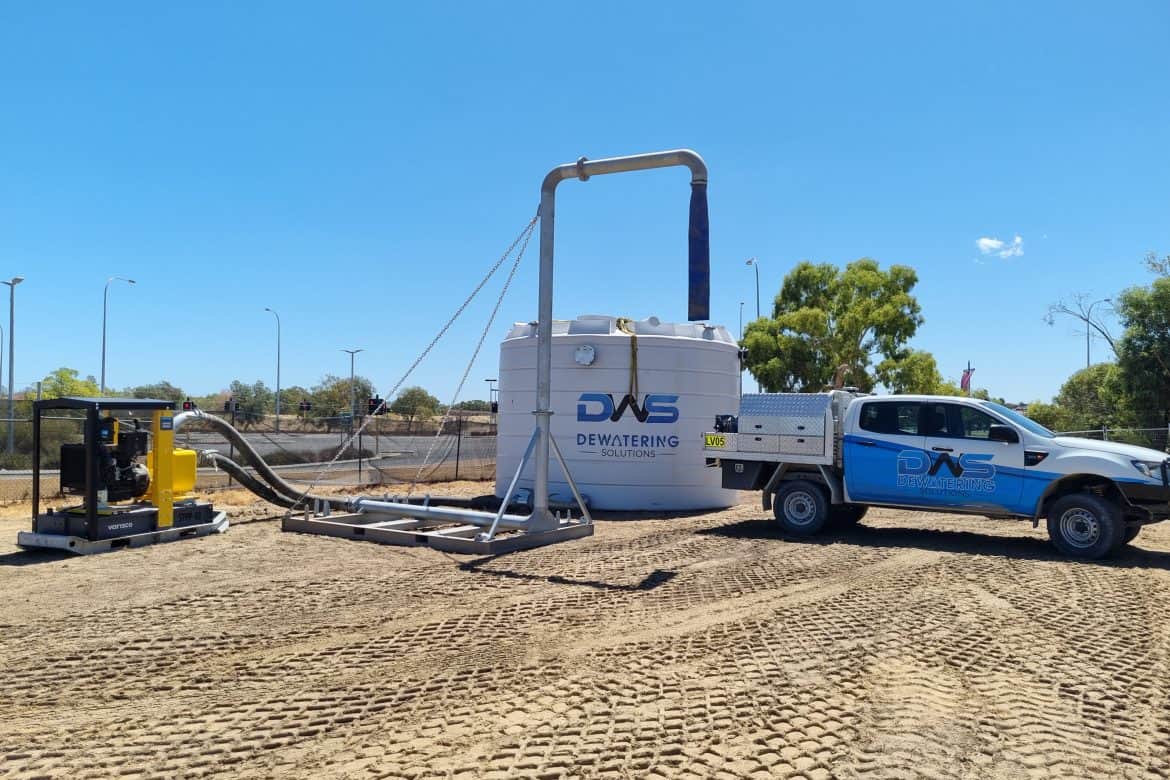
Groundwater rarely causes just one problem on a project. It slows excavation, affects access, reduces formation stability, complicates concrete works and can quickly turn a controlled programme into a reactive one. A deep well dewatering system is often the right response when excavations extend below the water table and the site demands dependable drawdown over a larger area or greater depth.
For project managers, engineers and principal contractors, the real question is not whether dewatering is needed. It is whether the selected method can hold water levels where they need to be, for as long as the job requires, without creating avoidable risk elsewhere on site. That is where deep well systems earn their place.
What a deep well dewatering system does
A deep well dewatering system lowers groundwater by pumping from drilled wells positioned around or within the excavation zone. Each well is fitted with a submersible pump and designed to intercept groundwater at depth, drawing the water table down so earthworks, foundation construction or below-ground installation can proceed in dry and stable conditions.
This method is typically used where the required drawdown is beyond the practical range of a wellpoint system, where soils are permeable enough to allow groundwater flow to the wells, or where excavation geometry calls for broader hydraulic control. On many civil, mining and infrastructure sites, that combination makes deep wells the more reliable option.
The principle is straightforward. The delivery is not. Performance depends on the well design, pump selection, aquifer conditions, discharge management and day-to-day operational control. If any of those elements are misjudged, the system can underperform even when the installed equipment appears adequate on paper.
When deep well dewatering is the right fit
Deep wells are generally considered when excavations are deeper, inflows are significant, and the water table needs to be lowered by several metres across a defined work area. They are well suited to bulk excavations, shaft works, basement construction, pipeline structures, treatment plants, bridge works and mine-related civil infrastructure.
They also become valuable when site access or staging makes surface water management alone unrealistic. Sumps and open pumping can handle local nuisance water, but they do not control groundwater pressure in the same way. If the excavation base is at risk of instability, boiling or ongoing seepage, relying on surface pumping alone can be a costly mistake.
That said, a deep well dewatering system is not automatically the best answer for every wet site. In lower permeability soils, closely spaced wellpoints, eductor systems or cut-off measures may be more effective. The correct approach depends on the ground model, target drawdown and the consequences of getting it wrong.
How the system works in practice
The process starts with understanding the subsurface conditions. Bore data, piezometric information, permeability estimates and excavation levels all influence the design. From there, wells are positioned to achieve the required radius of influence and depth of drawdown. Well depth, screen interval, filter pack and pump duty are selected to suit the expected groundwater regime.
Once installed, the wells pump continuously or in a controlled sequence to lower and maintain groundwater levels below formation level. Discharge water is then managed in line with site constraints and environmental obligations. That may involve settlement, treatment, staged discharge or reuse, depending on water quality and the project setup.
Monitoring is essential. Groundwater levels need to be tracked against the design assumptions, and pump performance must be checked routinely. A system that starts strongly can lose efficiency if screens blind, pumps cycle poorly, discharge lines fail or groundwater conditions shift as excavation progresses.
The factors that drive performance
The biggest variable in any deep well system is the ground itself. Permeable sands and gravels often respond well because water can move freely towards the wells. Mixed profiles are more complicated. Interbedded silts, clay lenses and variable permeability can produce uneven drawdown, perched water or delayed recovery that is not obvious at design stage.
Excavation shape matters as well. A narrow trench, a deep shaft and a broad excavation each place different demands on well spacing and pumping strategy. The drawdown target must account for working clearance below founding level, not just the excavation depth. If that margin is too tight, minor groundwater rebound can affect productivity and safety.
Power reliability and redundancy also deserve attention. A dewatering system is part of the project’s critical path. If the pumps stop, the site condition can change quickly. Backup planning, alarm response and routine maintenance are not extras. They are part of disciplined execution.
In Western Australia and Queensland, local ground conditions can vary sharply even within the same corridor. Coastal sands, alluvial deposits, weathered rock interfaces and mining-related ground disturbance all influence response. That is why practical field knowledge matters as much as theoretical design.
Common risks and where projects come unstuck
A poorly planned deep well dewatering system usually fails in predictable ways. The most common issue is underestimating inflow or overestimating the permeability consistency across the site. That can leave dry areas near some wells but active seepage or pressure issues in others.
Another risk is treating discharge as an afterthought. Pumping groundwater out is only half the task. The water has to go somewhere, and disposal needs to align with environmental requirements, available infrastructure and site operations. If discharge capacity is limited, the dewatering system can become constrained even when the wells themselves are performing.
Settlement and off-site impacts also need to be considered. Lowering groundwater can affect adjacent assets, services or structures in sensitive settings. Not every site presents that risk, but where it does, monitoring and staged operation are critical.
Then there is the simple operational reality that construction sites change. Access routes move, excavations deepen, temporary works shift and subcontractors compete for space. A good dewatering setup has to be technically sound and workable within the site logistics.
Why design and delivery must stay connected
One of the most common gaps on complex projects is the separation between dewatering design and field execution. A concept can look fine in a report, but once drilling starts, actual conditions may call for adjustment. Screen lengths may need to change. Pump sizing may need refinement. Monitoring points may need to be added where the programme risk is highest.
That is why experienced contractors place value on adaptive management, not just initial installation. The system should be reviewed as live data comes in, particularly during early drawdown and the first stages of excavation. This is where practical performance is won or lost.
For project teams, that translates into fewer surprises. It helps keep excavation fronts open, reduces unplanned wet-weather-style delays during dry periods, and supports cleaner handover between earthworks, structural and services crews.
What to look for in a dewatering partner
If a project depends on groundwater control, contractor selection should go beyond rates and equipment lists. The better question is whether the provider can assess the site properly, install to the required standard, respond quickly when conditions change and manage environmental and safety obligations without turning them into project delays.
Strong dewatering delivery is usually visible in the basics. Clear methodology. Realistic staging. Sensible contingency planning. Monitoring that informs action. Pumps and wells maintained before they fail, not after. On higher-risk sites, that level of discipline protects more than the excavation. It protects budget confidence and programme certainty.
Dewatering Solutions works in that space because reliable water control is not a side task on complex projects. It is part of how risk is managed from the ground up.
Deep well dewatering system outcomes that matter on site
A deep well dewatering system is not there to impress anyone with technical terminology. Its value is practical. It creates working conditions that let the rest of the project move. Stable excavation faces, drier foundations, safer access, better productivity and fewer reactive fixes all stem from getting groundwater under control early and keeping it controlled.
The right system is not always the biggest one or the most heavily pumped. It is the one matched to the site, operated with discipline and adjusted when field conditions demand it. That is what keeps dewatering from becoming a recurring site problem and turns it into a controlled part of project delivery.
When groundwater is treated as a design and execution issue from day one, the project has a better chance of staying on programme for the reasons that matter – predictable conditions, safer work areas and fewer expensive surprises below ground.