
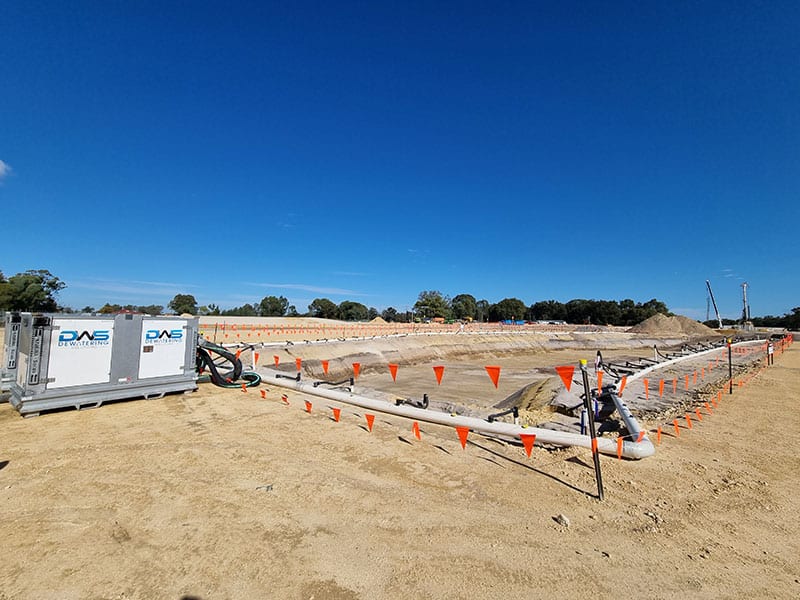
Groundwater rarely arrives at a convenient point in the programme. It shows up when excavations are open, access is tight, plant is committed, and the cost of delay starts rising by the hour. That is why installing well points for dewatering needs to be treated as a planned construction activity, not a last-minute response once the hole is already taking water.
For project managers, engineers and site teams, the value of a well point system is straightforward. It lowers groundwater around a shallow excavation so work can proceed in stable, safer and more predictable conditions. The detail that matters is how the system is designed and installed, because poor spacing, the wrong pump selection or a bad read on ground conditions can turn a simple dewatering scope into an ongoing site problem.
Why installing well points for dewatering works
A well point system is designed for relatively shallow groundwater control. It uses a series of small-diameter well points installed around or along an excavation, connected to a common header pipe and vacuum-assisted pump. The system draws down groundwater before it can seep into the work area and compromise formation levels, batter stability or productivity.
This approach is often effective where excavations are too deep or too wet for sump pumping alone, but do not justify a full deep well setup. It is commonly used for trenching, service installations, basement works, pits, tank excavations and civil infrastructure works where maintaining dry working conditions is critical to programme and safety.
The key point is that well points do not just remove visible water from the excavation. They reduce pore water pressure in the surrounding soil. That can make a major difference to excavation performance, especially in sands, silty sands and other permeable materials where inflows can be persistent.
Ground conditions decide the method
No two dewatering jobs behave exactly the same, even when the excavation footprint looks similar on paper. Soil profile, permeability, aquifer thickness, recharge, nearby structures and discharge constraints all affect system performance. In parts of Western Australia and Queensland, local ground conditions can shift quickly across a site, which is why field experience matters as much as the design basis.
Well points are generally suited to shallow drawdown in permeable ground. In low-permeability clays, they may offer limited benefit because groundwater does not move freely enough to the point. In coarse sands or gravels, they can perform well, but inflow rates may require careful pump sizing and closer control of discharge management.
That is where early investigation pays for itself. Existing geotechnical data, groundwater observations, trial pits and bore information help determine whether well points are the right tool or whether a combination of methods will produce a better outcome. Sometimes the best answer is not a larger well point system, but a staged excavation supported by sump pumping or a switch to deep wells where the required drawdown is greater.
The process of installing well points for dewatering
Installation starts well before any equipment reaches site. The first step is defining the required drawdown level relative to the excavation base and understanding how long that drawdown must be maintained. From there, the system can be laid out with realistic spacing, pump capacity and discharge planning.
The well points themselves are typically installed using jetting or drilling methods, depending on the ground. Jetting can be efficient in suitable sandy soils, allowing the point and riser to be advanced to depth with water pressure. In denser formations or where control is tighter, pre-drilling may be the better option. The aim is to place the screened intake at the correct level within the target water-bearing zone and then achieve good filter contact around the point.
Once installed, each well point is connected to a header main that runs back to the pump unit. Air leaks are a common source of poor performance, so connection quality matters. A vacuum-assisted system depends on maintaining negative pressure across the network. Even a small leak at a joint, valve or cap can reduce efficiency and compromise drawdown across the line.
Commissioning is not simply a matter of starting the pump and walking away. Water levels need to be checked against expected drawdown, suction performance confirmed, and the system balanced so that the full line is operating effectively. In some cases, a section of the system may need adjustment because one part of the excavation is receiving stronger recharge than another.
What good installation looks like on site
A well-installed system is usually not dramatic. It is orderly, controlled and easy to monitor. The excavation remains workable, inflows are managed before they become visible problems, and the pump setup does not interfere with access, lifting zones or other active trades.
From an operational perspective, good installation also means planning for the full site environment. That includes suction line protection, discharge routing, sediment control, noise management and safe refuelling access where diesel pumps are used. If the system sits in a high-traffic corridor, pipework and header lines need protection from plant interaction. If environmental conditions are sensitive, water quality and discharge handling need to be addressed from the start rather than after the first complaint or non-conformance.
This is where specialist contractors separate themselves. The equipment is only part of the job. The real value sits in system setup, field adjustments and disciplined operation over the life of the works.
Common problems and where projects lose time
Most well point issues are avoidable, but they usually come from assumptions made too early. One common problem is underestimating recharge. A system may appear adequate based on standing water levels, then struggle once excavation opens up more permeable layers or intercepts localised water-bearing seams.
Another issue is poor spacing or insufficient depth. If points are too far apart, localised wet zones remain active and the excavation never really stabilises. If the screen section is set too high, the system may lower perched water but fail to control the deeper inflow affecting the base.
Air ingress is another frequent cause of underperformance. Vacuum systems rely on tight connections, sound seals and regular inspection. Leaks can be subtle, but the result is obvious enough – reduced drawdown, uneven performance and a pump that appears to be running hard without delivering the expected result.
There is also the practical issue of site change. Excavation extents move, programme sequencing shifts, and temporary works evolve. A dewatering setup that was right for the original footprint may need to be extended, relocated or staged differently as the project develops. Rigid planning can become a liability if the contractor is not ready to adapt.
Safety, compliance and discharge control
Dewatering is often discussed as a productivity measure, but the safety and compliance side is just as significant. Uncontrolled groundwater can soften excavation bases, increase slip risk, destabilise shoring loads and create plant access hazards. Keeping the work area dry is not only about speed – it is about protecting people and reducing failure points across the site.
Discharge management also needs proper attention. Pumping water off a site without considering sediment, water quality, receiving conditions or approval requirements can create a separate set of problems. Depending on the site, treatment or controlled settlement may be required before discharge. Monitoring may also be necessary where environmental sensitivity or licence conditions apply.
For principal contractors and procurement teams, this is one of the practical reasons to engage a specialist rather than treat dewatering as a minor mechanical hire package. The cost of getting it wrong is rarely limited to pump downtime. It can affect environmental compliance, rework, inspection hold points and the broader relationship between construction activities and surrounding assets.
When well points are the right choice
Well points are a strong option when the required drawdown is relatively shallow, the ground is permeable enough to respond, and the excavation layout suits a distributed suction system. They are especially effective when early installation can lower groundwater ahead of bulk excavation rather than reacting after water ingress is already disrupting work.
They are not always the answer. If the drawdown target is too deep, if the soil is too tight, or if recharge volumes are too high for a vacuum-led system to control efficiently, another method may be more suitable. The right decision is not about forcing a preferred system onto every site. It is about selecting the method that reduces risk, supports the programme and performs reliably under actual field conditions.
At Dewatering Solutions, that is how dewatering scopes are approached – with a clear focus on site conditions, safety, environmental responsibility and practical construction outcomes. The system has to work in the ground, not just on the drawing.
The best time to think seriously about well points is before groundwater starts dictating the job. When the installation is planned properly, the excavation tends to stay on schedule, the site stays safer, and the project team can focus on building rather than chasing water.