
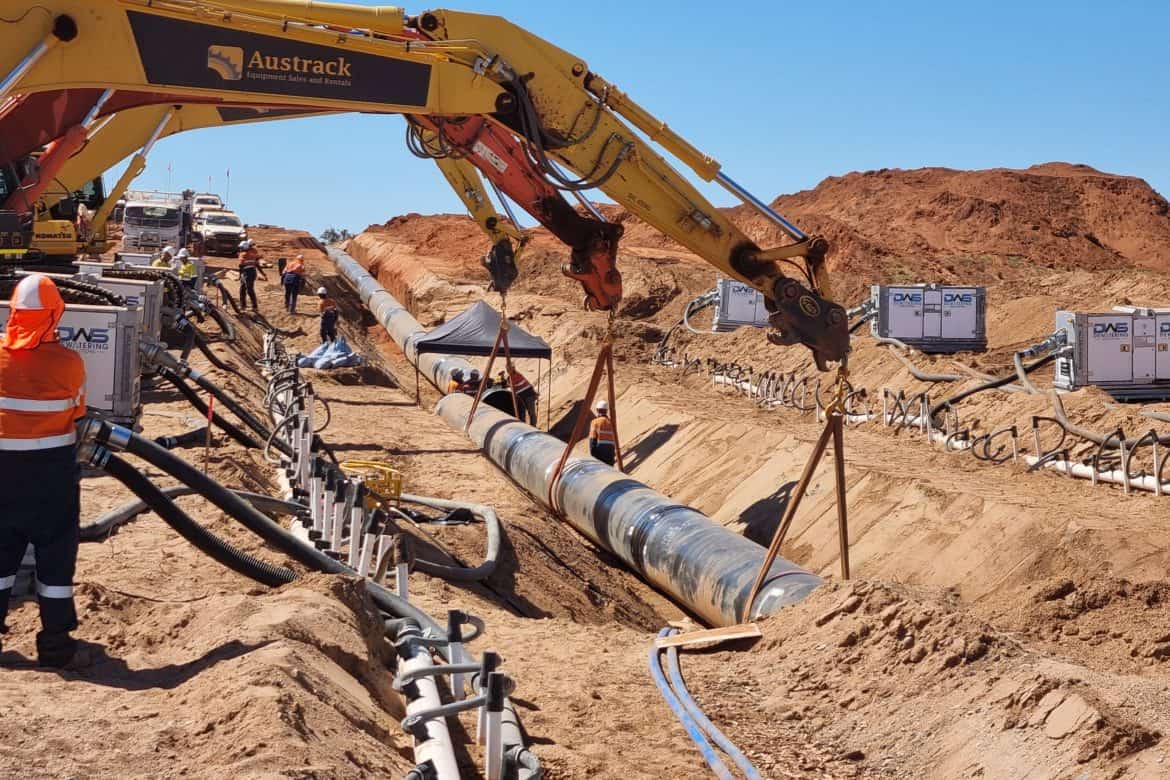
Groundwater rarely becomes a problem at a convenient stage of a project. It shows up when excavation starts moving, when the programme is tight, and when unstable ground begins affecting safety, access and productivity. That is why a clear understanding of how wellpoint dewatering works matters for project managers, engineers and contractors responsible for keeping a site operational.
Wellpoint dewatering is a controlled groundwater lowering method used to reduce the water table around an excavation. The system uses a series of closely spaced shallow wells, known as wellpoints, connected to a header pipe and pump. As the pump applies vacuum and removes water, groundwater is drawn toward each wellpoint, allowing the surrounding soil to drain and the excavation to remain drier and more stable.
How does wellpoint dewatering work in practice?
A wellpoint system is designed around one basic objective – create enough drawdown across the required area to keep groundwater below the formation level. The layout normally includes multiple wellpoints installed around the perimeter of the excavation, or sometimes in straight runs along trenches, service corridors or work zones.
Each wellpoint consists of a small-diameter riser pipe with a screened intake at the bottom. That screened section sits within the water-bearing soil layer. The individual wellpoints are then connected to a common header pipe, which leads to a vacuum-assisted pump unit. Once the system is primed and operating, the pump removes air and water from the line. This creates suction at each wellpoint and encourages groundwater to flow through the surrounding soil and into the system.
The result is not that water simply disappears from the excavation. The system lowers the groundwater table in the soil mass around it. That distinction matters. When groundwater is lowered before and during excavation, the base is less likely to soften, trench walls are less likely to degrade, and equipment access usually improves. In suitable ground, this can make the difference between productive earthworks and constant rehandling of wet material.
Wellpoint systems are generally most effective in permeable soils such as fine sands, coarse sands and some sandy silts. If the ground has enough hydraulic conductivity to allow water to move toward the wellpoints, the system can perform very well. If the site is dominated by low-permeability clays, the drawdown response is often limited, and a different dewatering method may be more appropriate.
The main components of a wellpoint system
The strength of wellpoint dewatering is in its simplicity, but performance still depends on each part doing its job properly. The wellpoints themselves are small intake units installed at regular spacing, often by jetting or drilling depending on the ground conditions. Their depth is set to intercept the target water-bearing layer while staying within the operating limits of suction lift.
The header pipe collects flow from all wellpoints and carries it back to the pump. It needs to be laid out carefully to avoid air leaks, poor connections and losses in vacuum efficiency. Even a well-designed system can underperform if the header line is damaged, poorly graded or not sealed correctly.
The pump unit is usually a vacuum-assisted centrifugal setup designed for continuous site duty. It has to maintain prime, handle variable inflows and operate reliably across the project duration. Discharge management is just as important. The extracted water may need settlement, filtration, treatment or controlled release, depending on site conditions and environmental obligations.
Monitoring completes the system. Drawdown levels, flow rates, pump performance and surrounding ground response all need to be tracked. On higher-risk sites, this is not optional. It is part of controlling ground risk, protecting adjacent assets and avoiding surprises once excavation reaches depth.
Where wellpoint dewatering works best
Wellpoint dewatering is commonly selected for shallow to moderate excavations where groundwater sits above the required working level. Typical applications include basement excavations, pump stations, pipelines, utilities, culverts, roadworks and temporary earth-retaining works.
It is especially useful where excavation geometry is long or irregular, because the system can be arranged to suit the shape of the works. For trenching and linear infrastructure, wellpoints can be installed in staged sections to support progress without overcapitalising the dewatering setup.
That said, depth matters. A standard wellpoint system relies on suction, so there are practical limits to how far groundwater can be lowered from a single stage. If the excavation is too deep, the solution may involve multi-stage wellpoints, deep wells, eductors or a combined system. The right answer depends on the target drawdown, soil profile, recharge rate and construction sequence.
In parts of Western Australia and Queensland, ground conditions can vary sharply over short distances. Clean sands may sit beside cemented layers, fill, weathered material or low-permeability seams. That is why desktop assumptions are rarely enough. Dewatering performance comes from matching the method to the actual subsurface conditions, not the drawing title.
Installation, operation and what affects performance
A wellpoint system starts with investigation. Groundwater level, soil gradation, permeability, stratification and expected inflows need to be understood early. If those inputs are wrong, spacing and pump selection will also be wrong.
Installation method then becomes critical. In suitable sandy ground, wellpoints are often jetted in efficiently. In harder or more variable conditions, predrilling may be needed to achieve depth and maintain proper filter placement. Poor installation can smear the screen, collapse the bore, or leave gaps that reduce flow into the point.
Once operating, the system needs time to establish drawdown. Some sites respond quickly. Others need longer lead-in periods due to recharge from surrounding strata or surface sources. Rainfall, tidal influence, nearby water bodies, leaking services and variable soil layers can all affect results.
Air leaks are a common cause of lost efficiency. Because wellpoint systems depend on vacuum, a small leak can reduce performance across the entire run. Maintenance, inspection and disciplined operation matter just as much as initial design. Reliable dewatering is not achieved by simply setting a pump on site and hoping for a dry excavation.
Trade-offs and limitations to understand
Wellpoint dewatering is effective, but it is not universal. The method suits shallow groundwater lowering in permeable soils. It is less effective in tight clays where groundwater movement is too slow, and it can be constrained by suction lift if significant depth is required.
There are also broader project considerations. Lowering groundwater can influence adjacent ground conditions and, in some cases, contribute to settlement if not properly managed. On constrained urban or brownfield sites, that risk needs careful assessment. The discharge water quality can also trigger treatment requirements, particularly where sediments, hydrocarbons or dissolved contaminants are present.
Cost is another factor, and it should be viewed properly. A wellpoint system may look straightforward on paper, but underdesigned dewatering often becomes more expensive than a properly engineered setup. Delays, bogged plant, remediation of unstable excavations and repeated rework usually cost more than getting groundwater control right from the start.
Why design and field experience matter
The difference between a system that works and one that struggles is usually found in the early decisions. Pump sizing, wellpoint spacing, intake depth, discharge handling and monitoring requirements all need to align with the construction methodology. Dewatering should support the programme, not operate as a disconnected temporary service.
This is where site-based experience counts. Theoretical design is essential, but groundwater behaves according to field conditions, not assumptions. Contractors with practical experience across civil, mining and infrastructure sites understand what happens when sandy lenses appear unexpectedly, when recharge is higher than expected, or when environmental controls change the discharge pathway.
For that reason, wellpoint dewatering is best approached as a managed construction risk, not a commodity hire item. A properly planned system protects excavation stability, improves access, reduces wet weather exposure and helps maintain schedule certainty. That is exactly why specialist contractors such as Dewatering Solutions treat dewatering as an operational discipline tied directly to safety, compliance and project performance.
When groundwater is interfering with excavation, the right question is not simply whether a wellpoint system can be installed. It is whether the ground conditions, target depth and site constraints support a wellpoint solution that will perform consistently under project conditions. Answer that early, and the rest of the job usually gets easier.