
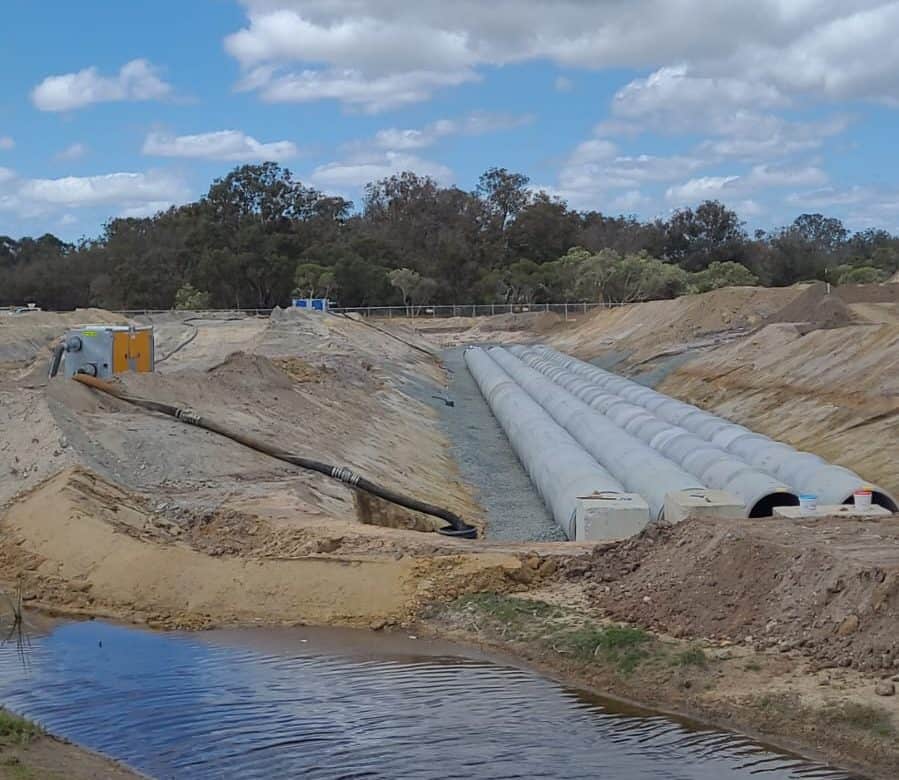
Groundwater rarely announces itself politely. On a project site, it shows up as soft ground under plant, water in the base of an excavation, unstable trench walls, reduced productivity and a programme that starts slipping one day at a time. That is why asking what is groundwater management is not an academic exercise. For construction, mining and civil teams, it is a practical question tied directly to safety, stability, compliance and cost.
Groundwater management is the planned control, movement, treatment and monitoring of subsurface water so a site can operate safely and efficiently. In practical terms, it means understanding where groundwater is, how it behaves in local ground conditions, what risks it creates for the works, and what system is needed to manage those risks without creating new ones elsewhere on site or off site.
This is broader than simply pumping water out of a hole. A sound groundwater management approach considers hydrogeology, excavation depth, soil profile, inflow rates, discharge requirements, environmental obligations and the sequencing of works. The goal is not just a dry work area. The goal is controlled site conditions that support the programme and protect the asset being built.
What is groundwater management in practice?
In practice, groundwater management is a combination of planning, field execution and ongoing control. It starts before excavation begins, with site investigation and a realistic assessment of likely groundwater conditions. On many sites, that means accounting for variable sands, gravels, silts, clays and weathered rock profiles that can change significantly over short distances.
Once groundwater conditions are understood, the next step is selecting the right control method. That could be well point dewatering for shallow excavations in permeable soils, deep well systems for deeper drawdown, sump pumping for localised inflows, or a staged combination of methods. In some cases, treatment is also required before water can be discharged, reused or managed under environmental conditions.
The management piece matters because groundwater control is never static. Conditions can shift as excavation progresses, rainfall changes recharge, adjacent works alter flow paths, or unexpected strata are exposed. A system that looked adequate on paper can become underpowered or inefficient if monitoring and adjustment are not built into the plan.
Why groundwater management matters on live projects
When groundwater is not managed properly, the impacts spread well beyond wet ground. Excavation faces can become unstable. Trench bases can heave or soften. Foundation preparation can be compromised. Plant access becomes more difficult, productivity drops and rework increases. None of that stays contained to one workfront.
There is also a direct safety dimension. Uncontrolled groundwater can contribute to slips, bogging, trench instability and poor working conditions around excavation zones. For project managers and principal contractors, that means increased exposure at exactly the point where control should be strongest.
Then there is compliance. Water extracted from site is not simply a nuisance to be moved elsewhere. Depending on the site, the discharge pathway, water quality and local approvals, groundwater may need treatment, testing, containment or documented monitoring. The cost of getting this wrong is not limited to operational inefficiency. It can become an environmental and contractual issue very quickly.
The main objectives of groundwater management
A well-designed groundwater management strategy usually serves several objectives at once. It lowers groundwater pressure around excavations, reduces inflow into work areas and helps maintain stable ground conditions for construction activities. Just as importantly, it supports predictable sequencing so other trades can work without repeated interruption.
It also protects quality. Concrete works, foundation systems, underground services installation and earthworks all rely on controlled moisture conditions. If groundwater is allowed to interfere with those stages, defects and delays often follow.
From a commercial perspective, good groundwater management reduces uncertainty. It helps contractors avoid emergency pump hire, repeated clean-up, standby time and programme drift. The cheapest approach at the start is not always the lowest-cost outcome by the end.
Common groundwater management methods
The method depends on the site and the level of control required. Well point systems are commonly used where relatively shallow drawdown is needed across a broader footprint, particularly in permeable soils. They can be effective and efficient, but only when spacing, depth and pump capacity are matched properly to site conditions.
Deep well dewatering is generally used where excavations are deeper or where greater drawdown is required. These systems can provide stronger control over larger depths, although they require careful design, installation and operation. They are not a casual add-on once excavation has already started going wrong.
Sump and open pumping can be suitable for localised water collection or lower inflow scenarios, especially where water can be directed safely to collection points. But this approach has limits. In the wrong ground conditions, it can lead to erosion, local instability or ineffective water control if it is asked to do a job better suited to a structured dewatering system.
Treatment systems may also form part of groundwater management where sediment, pH, hydrocarbons or other contaminants are present. In these situations, moving water is only part of the task. The discharge must also meet project and regulatory requirements.
What makes groundwater management successful
Success starts with realism. Groundwater does not respond well to assumptions, especially on pressured programmes. A successful system is based on actual site data, informed interpretation and installation methods that suit the ground, the excavation and the construction sequence.
It also relies on disciplined execution. Pumps, headers, risers, discharge lines, monitoring points and backup contingencies all need to function as part of one coordinated system. If one part is undersized, poorly maintained or exposed to site damage, overall performance can fall away quickly.
Monitoring is another factor that separates a controlled operation from a reactive one. Water levels, pump performance, discharge quality and drawdown response should be tracked so the team can see whether the system is achieving the intended result. This is where experienced field crews add value. They recognise early signs of underperformance before those issues become delays.
The trade-offs and constraints to consider
Groundwater management is rarely a one-size-fits-all exercise. A more aggressive dewatering system may improve excavation conditions, but it can also increase power use, treatment demand or discharge volumes. A lighter-touch approach may reduce upfront cost, but it might not provide enough control to protect the programme.
There can also be interactions with surrounding assets and ground conditions. Excessive or poorly controlled drawdown may affect adjacent services, batters, pavements or structures depending on the site context. That is why system design has to look beyond the immediate excavation.
Timing matters as well. Early engagement generally creates better options. Once a site is already wet, unstable and behind schedule, the solution set becomes narrower and more expensive. Groundwater management works best when it is treated as enabling infrastructure, not emergency response.
What project teams should look for in a groundwater management partner
For most decision-makers, the real question is not only what is groundwater management, but who can deliver it reliably under site conditions. Technical knowledge matters, but so does practical execution. A contractor needs to understand hydrogeology, pumping systems and discharge controls, while also working safely within live construction and industrial environments.
Local experience is especially valuable in Western Australia, where ground conditions and site logistics can vary sharply between regions and project types. A partner with field experience in similar conditions is more likely to identify likely risks early, size systems correctly and avoid avoidable disruptions.
Teams should also look for disciplined reporting, strong safety systems and a clear understanding of environmental obligations. If a dewatering contractor cannot explain how water will be controlled, monitored and discharged in operational terms, the risk usually does not disappear – it shifts back to the principal contractor.
This is where specialist operators such as Dewatering Solutions add value. The difference is not just access to pumps and wells. It is the ability to translate site conditions into a working system that supports programme certainty, protects excavation performance and keeps compliance expectations in view.
Why the answer matters before works begin
Groundwater management is one of those site functions that gets noticed most when it has been underestimated. When it is planned and executed properly, the site keeps moving. Excavations stay workable, crews stay productive and water becomes a controlled project variable rather than a daily disruption.
For decision-makers, that is the practical answer to what is groundwater management. It is the system, discipline and site knowledge required to control subsurface water so construction and civil works can proceed safely, efficiently and with fewer surprises. On complex sites, that control is not a background service. It is part of what keeps the whole project on track.
The best time to think seriously about groundwater is before the first sign of water in the cut, because by then the job is usually already paying for the delay.