
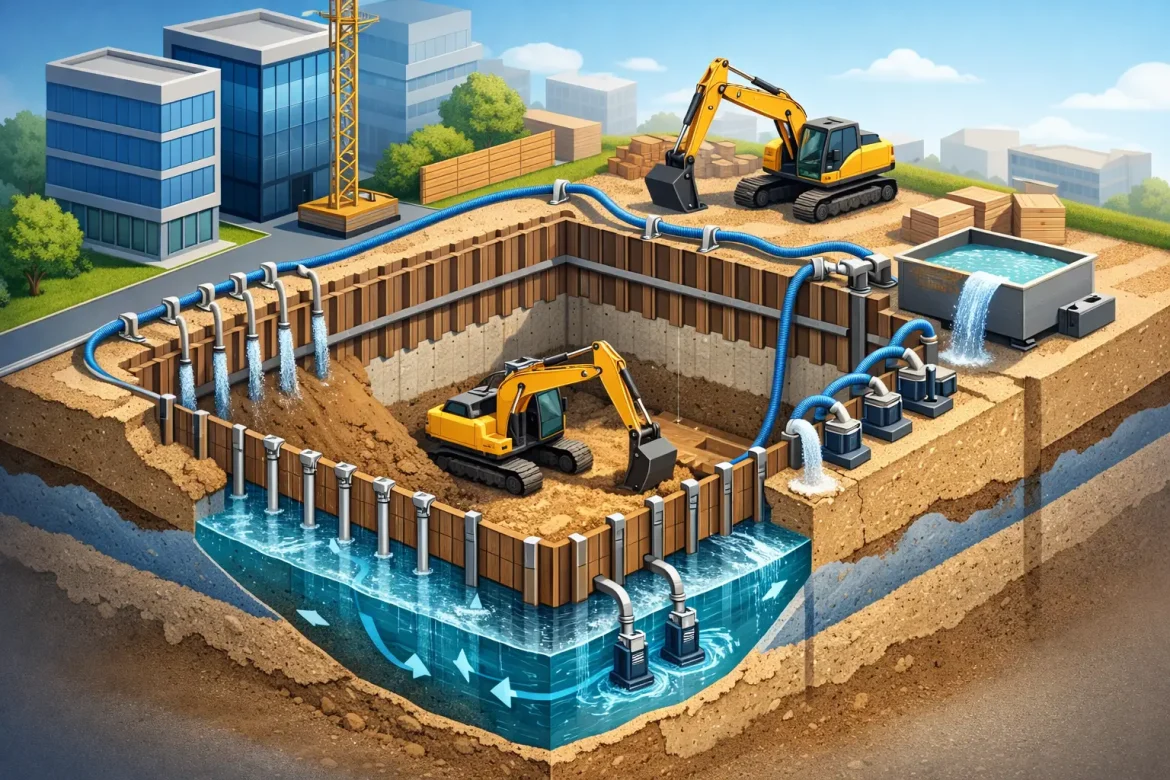
An excavation can look dry at crib time and become a safety and programme issue after one overnight inflow. Groundwater control for excavations is not simply about removing water from the bottom of a trench or pit. It is about managing pore pressure, maintaining stable excavation faces, protecting founding conditions and ensuring water is handled in line with project and environmental requirements.
For civil, construction and mining projects, the cost of getting this wrong is rarely limited to extra pumping hours. Saturated soils can reduce bearing capacity, cause base heave or slumping, delay concrete works, damage access routes and expose crews to unsafe conditions. A well-designed system gives the project team a controlled, workable excavation rather than a daily recovery exercise.
Start with the ground, not the pump
The right approach is determined by site conditions. Groundwater depth, soil profile, permeability, excavation geometry, expected inflows and the required drawdown all affect system selection. A shallow, sandy excavation may respond well to wellpoints, while a deeper excavation in more permeable strata may require deep wells. In low-permeability clays, pumping alone may have limited influence, and staged excavation, cut-off measures or other engineering controls may be required.
Ground investigation data is the starting point, but it should not be treated as the final answer. Bore logs provide a useful indication of strata and groundwater conditions, yet ground can vary sharply across a site. Previous land use, tidal influence, rainfall, perched water and nearby services can all change actual performance.
Before installing equipment, the dewatering scope should establish the target water level, likely pumping rates, discharge route, treatment needs and monitoring requirements. It should also consider whether drawdown could affect adjacent assets, existing structures or nearby groundwater users. This planning stage is where major schedule and cost risks can be identified before excavation begins.
Selecting groundwater control for excavations
There is no universal dewatering method. The practical choice depends on how water moves through the ground and what the excavation needs to achieve.
Wellpoint dewatering
Wellpoint systems are commonly used for shallow to moderate excavations in sands, silts and other soils where groundwater can be drawn effectively to a header main. A series of closely spaced wellpoints is installed around the excavation and connected to a vacuum-assisted pump.
This method provides broad, even drawdown and suits trenches, basements, service corridors and other linear or open excavations. Installation quality matters. Incorrect wellpoint depth, poor connections or inadequate filter development can reduce vacuum performance and leave wet areas within the work zone.
Deep well dewatering
Deep wells are suited to larger drawdowns, deeper excavations and more permeable ground conditions. Submersible pumps installed in screened wells lower groundwater outside the excavation before and during digging.
Deep wells can provide significant capacity with fewer installation points than a wellpoint system. They do, however, require careful well design, drilling accuracy and monitoring. A system that delivers the required drawdown in one section of an excavation may still leave localised inflows where geology changes.
Sump and open pumping
Sump pumping is often an efficient option for managing surface water, seepage and low-volume inflows once an excavation is established. Water is directed through graded drains or collection points to a sump, then pumped out.
It is not always suitable as the primary method of groundwater control. In loose granular soils, uncontrolled seepage towards a sump can carry fines, lead to erosion or undermine the excavation base. The method is best used where inflows are manageable and the excavation remains stable, or as part of a combined system.
Cut-off and treatment measures
Where drawdown needs to be limited, or where discharge quality requires additional control, pumping may need support from cut-off walls, recharge arrangements, settlement tanks, filtration or purpose-designed water treatment. These measures add complexity, but they can be essential where environmental conditions, contamination concerns or sensitive neighbouring assets are present.
Design for construction, not just drawdown
A dewatering design should work with the construction sequence. The target is not to lower groundwater as far as possible. It is to achieve the water level and ground conditions needed for safe, productive work without creating unnecessary settlement, energy use or water management costs.
For example, a system may need to be commissioned ahead of bulk excavation to establish drawdown before the formation level is reached. It may then need to remain operational through reinforcement, concrete placement and backfilling. Turning pumps off too early can allow water levels to rebound, soften prepared foundations and disrupt follow-on trades.
The layout also needs to account for plant access, haul roads, crane pads, temporary works and service interfaces. Headers, hoses, electrical leads and discharge lines should be protected from traffic and clearly managed. A technically sound system can still become a site problem if its installation obstructs construction operations or creates trip, electrical or traffic hazards.
Discharge is part of the dewatering scope
Every litre pumped from an excavation needs a compliant destination. Depending on water quality and project approvals, discharge may be directed to sewer, a licenced disposal point, approved surface-water infrastructure or retained for reuse. Sediment, turbidity, hydrocarbons, pH, salinity and potential contamination all need consideration.
In Western Australia and Queensland, discharge requirements can vary with the site, receiving environment and relevant authority conditions. Testing water early is preferable to discovering a treatment requirement after pumps are running. It allows the project team to plan tanks, settlement, filtration, monitoring and documentation without holding up excavation works.
Water treatment should be sized for actual site conditions rather than assumed clean groundwater. Construction runoff can introduce sediment, while disturbed industrial land may present additional water quality risks. The discharge arrangement must be inspected and maintained as closely as the pumps themselves.
Monitor performance and respond early
Dewatering is an active site operation, not a set-and-forget installation. Groundwater levels, pump run times, flow rates, discharge quality and excavation conditions should be checked against the design intent. Monitoring points inside and outside the excavation help confirm that drawdown is being achieved without unintended off-site effects.
Site observations are equally valuable. Softening at formation level, sand movement, cloudy discharge, falling pump performance or new seepage lines may indicate a developing issue. Responding early can prevent a local problem becoming a lost shift, a failed inspection or a larger stabilisation exercise.
A disciplined operating regime should cover daily inspections, standby capacity, fuel or power security, alarms where appropriate and clear escalation procedures. During wet weather or critical pours, response time matters. The best system on paper cannot protect the programme if a failed pump sits unnoticed overnight.
Control the risk around people and structures
Groundwater management supports excavation safety, but it does not replace the wider excavation controls required on site. Batter stability, shoring, access, exclusion zones and inspection requirements must still be managed according to the excavation conditions and project safety plan.
Drawdown also requires care near existing buildings, pavements, buried services and rail or road infrastructure. Lowering groundwater can change effective stresses in the soil and, in some conditions, contribute to settlement. The risk depends on the soil profile, extent of drawdown, duration and sensitivity of nearby assets. Monitoring and staged operation may be appropriate where consequences are high.
The most dependable outcomes come from treating dewatering as a construction-critical service. Dewatering Solutions plans and operates systems around the ground conditions, construction sequence and discharge obligations, with field teams focused on keeping excavations safe, dry and ready for the next activity.
A dry excavation is not the finish line. The useful measure is whether the ground remains stable, the water is managed responsibly and the work can continue without avoidable interruption.