A small seep at the toe of an excavation can become a major ground-control issue far faster than most programmes allow for. Knowing how to identify soil piping gives site teams an opportunity to intervene before fines are carried away, voids develop behind a batter or retaining system, and the ground loses its ability to support plant, services or people.
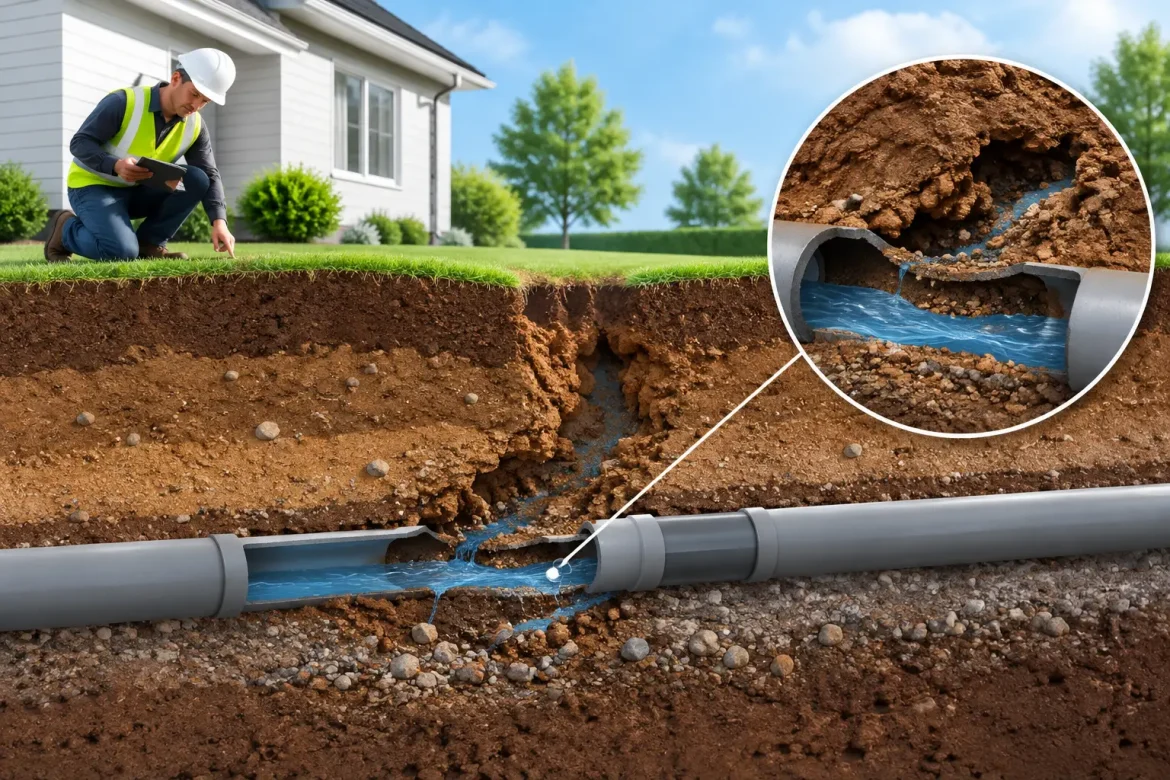
Soil piping is an internal erosion process. Water moves through permeable ground, fractures, service trenches or poorly controlled fill and carries fine soil particles with it. The loss may be hidden at first. By the time a depression, sinkhole or sudden muddy discharge is visible, the subsurface pathway can already be well developed.
For construction, mining and civil projects, this is not simply a drainage problem. It is a stability, safety, environmental and programme risk that requires a disciplined response.
What soil piping looks like on an active site
Piping occurs where seepage forces are strong enough to dislodge and transport fine particles through the soil skeleton. It is more likely in variable ground containing loose sands, silts, dispersive materials, uncontrolled fill, fractured weathered rock or interfaces between different soil layers. Water does not need a large visible flow path to cause damage. A persistent hydraulic gradient across an excavation, embankment, trench backfill or retaining structure may be enough.
The initial evidence is often subtle. Water may emerge from a point that was previously dry, or a normal seep may become increasingly cloudy. Small amounts of sand can collect around a drain outlet, at the base of a batter, behind shotcrete, or near a pipe penetration. These are not defects to monitor casually. They may indicate that the ground is being removed from inside.
Surface erosion is different. Surface runoff cuts channels from the top down and is generally easier to observe and manage. Soil piping develops below the surface and can progress without an obvious rut, gully or large flow. A sinkhole is a possible late-stage symptom, not the process itself.
How to identify soil piping: early warning signs
No single sign proves piping. The risk assessment should consider changes in flow, water quality, ground movement and the site’s recent activities. The following indicators warrant immediate inspection by a competent person.
- Cloudy, silty or sandy discharge: Water that was previously clear becomes turbid, or deposits fine material at a seepage point, drain, sump or discharge outlet.
- Increasing flow from a localised point: A seep grows stronger after rainfall, pumping changes, excavation advance or nearby water-main activity, particularly when the source cannot be explained.
- Sand boils or heave: Fine sand and water rise through the base of an excavation or around a structure. This can indicate upward seepage pressure and loss of effective stress in the ground.
- Depressions, cracks or local settlement: Fresh cracking in a platform, pavement, batter crest or backfilled trench may reflect void development below. A soft patch can be equally significant.
- Unexpected loss of water or pumping performance changes: A sump level drops unusually quickly, make-up water requirements rise, or a dewatering system starts drawing fines. These changes can indicate a new or expanding flow path.
- Damage at interfaces: Pay close attention to penetrations, joints, culverts, service crossings, sheet pile interlocks, temporary works connections and transitions between fill and natural ground. Water preferentially follows these discontinuities.
The pattern matters as much as the symptom. For example, turbidity immediately after a heavy downpour may be surface runoff. Turbidity that continues during controlled pumping, grows with drawdown, and is accompanied by settlement is a much stronger internal erosion warning.
Check the water, ground and operating conditions
A reliable investigation starts by making the area safe. Restrict access around settlement, boils, soft ground and excavation edges. Do not send personnel into an excavation, trench or confined area to inspect a suspected piping zone without an appropriate assessment and controls. Ground conditions can deteriorate without warning.
Record the location, time, weather, water level, pumping rate and appearance of the discharge. Photographs taken from safe locations are useful because they establish whether a seep, crack or depression is changing. If monitoring points, piezometers or standpipes are installed, compare current readings with the expected drawdown profile. A sudden local pressure change can be more informative than a single water-level reading.
Inspect the wider water system rather than treating the outlet as an isolated issue. Trace likely recharge sources, including rainfall runoff, perched groundwater, leaking services, upstream ponds, temporary diversion drains and adjacent excavations. Review recent changes to well point operation, deep-well pumping, sump locations, discharge routing and excavation depth. Piping is often triggered by a change in hydraulic conditions rather than by one dramatic event.
Water quality should be checked in a practical way. Visual turbidity is a useful first warning, but samples can help establish whether the discharge contains mobilised fines. Where appropriate, monitor turbidity and flow over time rather than relying on a one-off sample. Consistent evidence supports decisions on filtration, pumping rates and remedial works.
Why dewatering can expose a piping risk
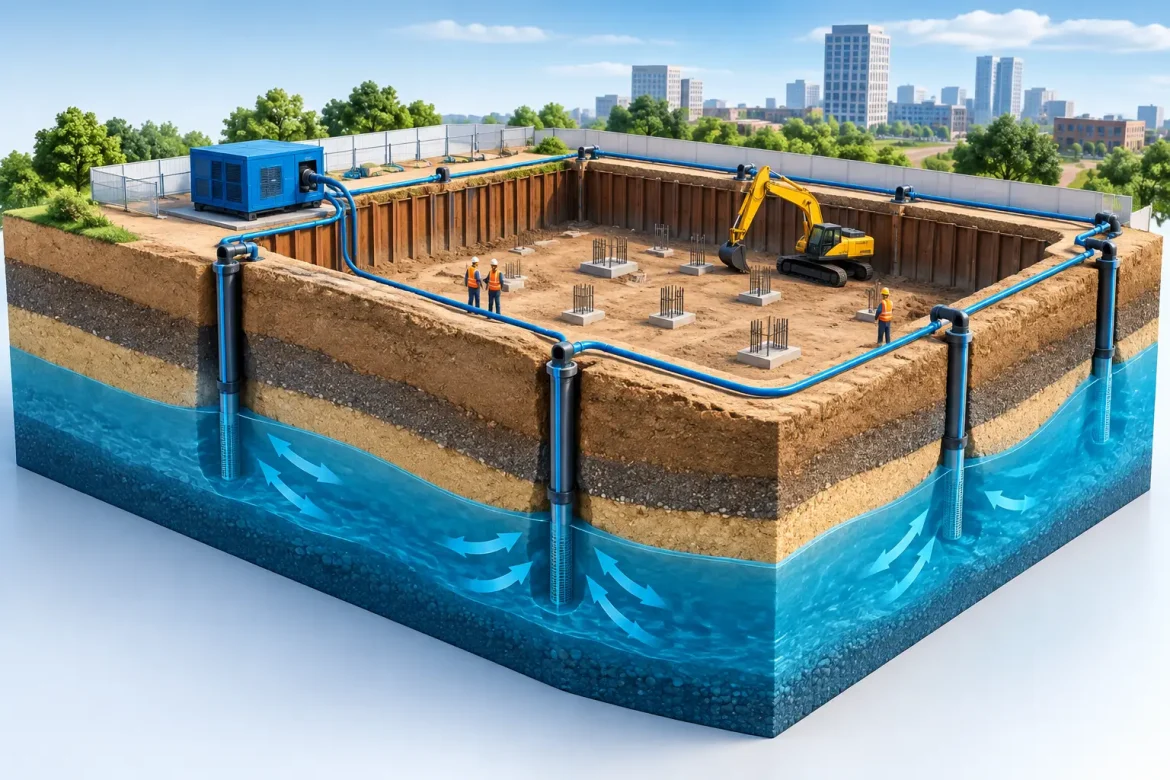
Dewatering is essential for many excavations, but poorly matched systems can contribute to internal erosion. High localised gradients near a sump, well screen or discharge point may draw fine material into the system. Aggressive pumping can also create a preferential path through loose or variable ground.
That does not mean pumping should simply be reduced or stopped. Allowing groundwater levels to recover may create uplift pressure, batter instability or flooding. The correct response depends on the ground model, the excavation geometry, the water source and the temporary works design.
Where fines are entering the system, the control strategy may involve staged drawdown, additional or repositioned wells, appropriate filter packs, screened intakes, filter media, relief measures, or a change from open pumping to a better-controlled well point or deep-well arrangement. Sump pumping can be effective in competent ground with managed inflows, but it is not always suitable where the excavation base is susceptible to boiling or erosion.
A dewatering specialist should assess the system against actual site conditions, not just the original design assumptions. Groundwater behaviour in Western Australia and Queensland can vary sharply over short distances, particularly in mixed fill, coastal sands, alluvial deposits and weathered profiles.
Respond before a small defect becomes a ground failure
Once piping is suspected, the priority is to prevent further soil loss while maintaining safe water control. Escalate the issue through the project’s geotechnical, temporary works and dewatering management process. The response should be coordinated, as an isolated change to pumping or drainage can shift the problem elsewhere.
Immediate controls may include establishing exclusion zones, reducing surcharge near affected edges, diverting surface water away from the area, inspecting nearby services for leaks, and managing discharge through suitable sediment controls. If a pump is visibly extracting fines, do not assume a larger pump is the answer. Continuing high-energy extraction can enlarge the internal pathway.
Remedial options need design input. Depending on the mechanism, the solution may include engineered filters, regrading and compacted replacement, local grouting, cut-off measures, drainage relief, stabilisation of the excavation base, or changes to the dewatering layout. Simply filling a surface hole can conceal an active void and create false confidence.
Environmental controls also matter. Turbid water from internal erosion can carry sediment off site, affect receiving environments and breach project conditions. Capture, settle or treat water as required, and keep clear records of observations, sampling and corrective actions.
Build piping checks into daily site control
The most effective approach is prevention through routine observation and clear escalation. Pre-start inspections should include excavation toes, batter crests, sump areas, discharge points, service crossings and any location where water meets variable ground. After heavy rain, pumping changes, service works or a significant excavation advance, repeat the inspection.
Site teams need simple triggers: new turbidity, fresh settlement, unexplained seepage, visible fines, altered pump performance or cracking near water-affected ground should be reported early. These observations are valuable operational data, not housekeeping issues.
For high-risk works, baseline photographs, survey monitoring, water-level records and a defined response plan provide the evidence needed to act before the condition reaches a critical stage. Dewatering Solutions applies this field-led approach because reliable groundwater control is not just about removing water. It is about managing the way water moves through the ground.
When water begins carrying soil, treat it as a warning from the formation. Early investigation, measured pumping and properly engineered controls can protect the excavation, the programme and the people working around it.