
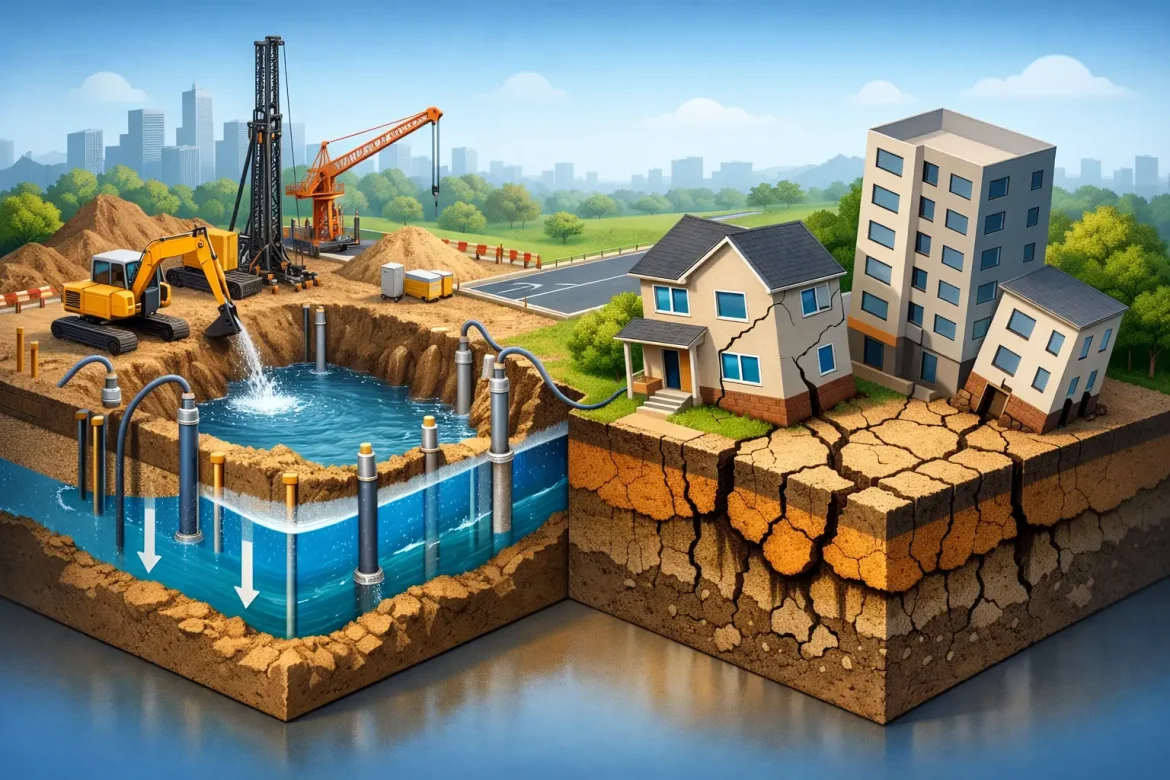
A dry excavation is not automatically a stable excavation. Can dewatering cause subsidence? Yes – where groundwater is lowered in compressible or variable ground, the resulting increase in soil stress can cause settlement at the surface or below nearby structures. The risk is manageable, but only when dewatering is designed around the ground conditions, the excavation and the assets that must remain protected.
For project managers, engineers and principal contractors, subsidence is not a theoretical geotechnical issue. Even modest ground movement can affect services, pavements, adjacent footings, rail corridors, roads and finished structures. It can also generate claims, remediation costs and programme disruption well beyond the original dewatering scope.
How dewatering can cause subsidence
Groundwater within soil pores carries part of the load from the ground above. When pumping lowers the groundwater level, water pressure in those pores reduces. The soil skeleton then carries more of the load. In suitable material, that change is small and largely reversible. In loose, compressible or layered soils, particles can rearrange and consolidate, producing settlement.
The effect is most likely where drawdown extends beyond the excavation and intercepts sensitive strata. Fine-grained silts and clays can consolidate slowly, so movement may continue after pumping rates change. Loose sands can densify under changed effective stresses, particularly where vibration, variable loading or poorly controlled flows are also present. Organic soils, uncontrolled fill and ground with solution features require particular care because their response can be difficult to predict.
The issue is therefore not simply whether a system pumps water. It is how far the water level is lowered, how quickly drawdown occurs, the hydraulic connection between layers, and what sits within the zone of influence.
Drawdown travels beyond the excavation
Every pumping system creates a drawdown cone. Its actual extent depends on soil permeability, aquifer thickness, recharge, pumping rates, well spacing and local geology. In highly permeable sands, groundwater levels can respond over a considerable distance. In layered ground, an apparently isolated excavation may connect to a more sensitive layer through sand seams, poorly sealed boreholes or other preferential pathways.
That is why a dewatering design based only on achieving a dry formation level can create avoidable risk. The required outcome is controlled groundwater management: sufficient drawdown to maintain safe, workable excavation conditions without unnecessarily depressing groundwater beneath neighbouring assets.
When the subsidence risk is highest
Risk rises when a deep excavation is close to existing buildings, buried services or infrastructure with low movement tolerance. It also rises where the dewatering duration is long, groundwater levels must be lowered substantially, or a site has inconsistent fill and natural soils across a small area.
In Western Australian conditions, coastal sands, limestone profiles, clay lenses and variable reclaimed ground can all influence how water moves and how the ground responds. Conditions must be confirmed at the project site rather than assumed from nearby work. A bore log provides useful information, but pumping tests, groundwater observations and an understanding of surrounding construction are often needed before finalising the system.
Basement excavations, shafts, deep service trenches and below-water-table piling works can require significant drawdown. The closer these works are to older structures, shallow footings, live services or sensitive pavements, the more critical the assessment becomes. A short-duration system can still cause movement if it creates rapid drawdown in susceptible ground.
Subsidence is not always caused by dewatering
Settlement around an excavation does not automatically prove that dewatering is responsible. Excavation-induced stress relief, retaining wall movement, leaking services, poor compaction, vibration, changes in surface loading and pre-existing ground defects can produce similar signs. Cracking may also reflect seasonal moisture changes in reactive soils rather than active groundwater drawdown.
This distinction matters when determining the correct response. Reducing pumping may be necessary, but it may also compromise excavation stability if the true cause is a leaking water main or wall movement. A disciplined baseline condition survey, groundwater monitoring and movement monitoring make it easier to identify changes early and assess likely causes using evidence rather than assumptions.
Designing a dewatering system to control movement
The lowest-risk approach starts before plant arrives on site. Dewatering needs to be coordinated with the geotechnical model, excavation support design, construction sequence and discharge strategy. A practical design considers the target water level, anticipated inflows, pumping capacity, standby arrangements and the acceptable groundwater level outside the excavation.
The selected method should match the ground. Wellpoint systems can provide controlled shallow drawdown in permeable soils. Deep wells may be appropriate for deeper excavations and higher-volume groundwater control. Sump pumping can suit localised or low-flow applications, but in running sand or unstable formation it may draw fines into the excavation, cause erosion and worsen ground loss if not properly managed.
Where adjacent structures are sensitive, cut-off walls, sealed shoring systems or recharge measures may be considered to limit off-site drawdown. These measures add cost and planning requirements, but can be justified where the consequence of movement is high. It depends on the ground, the required drawdown and the consequence of failure – not on applying the same solution to every excavation.
Control pumping rates and the sequence of drawdown
Rapid pumping can create a sharp change in groundwater pressure and expose weaknesses in the ground model. Staged commissioning allows the team to confirm actual well performance, compare water levels with design assumptions and adjust the system before full drawdown is reached.
Pump capacity should not be confused with a licence to over-pump. The objective is stable, predictable control. Variable-speed pumps, correctly spaced wells, functioning filters and well-maintained pipework help maintain the required water level without unnecessary groundwater depression. Standby capability remains essential so a pump failure does not allow sudden water recovery and destabilise the excavation.
Monitoring turns risk into a managed condition
Monitoring is the operational control that confirms whether a dewatering system is performing as intended. Readings should be meaningful, timely and linked to a clear action plan. Collecting data without defined response thresholds does little to protect the project.
A monitoring programme may include groundwater standpipes or vibrating-wire piezometers inside and outside the excavation, settlement points, crack gauges and regular inspections of neighbouring assets. The right instruments and locations depend on the risk assessment, but the purpose is consistent: confirm drawdown is controlled and identify movement before it becomes consequential.
Baseline readings should be established before pumping starts. During commissioning and critical excavation stages, readings may need to be taken more frequently than during steady-state operation. Trigger levels should identify when the site team must investigate, notify relevant parties, modify pumping rates, inspect assets or implement contingency measures.
Site records also matter. Pump run times, discharge volumes, rainfall, excavation depth, system changes and observed ground conditions provide valuable context when interpreting a groundwater or settlement trend. This is particularly useful on complex sites, where several activities may affect ground behaviour at once.
Protecting the excavation without shifting risk elsewhere
Dewatering is often essential for safe construction. It can reduce uplift pressure, improve formation conditions, support trench stability and allow foundations or services to be installed to programme. The answer is not to avoid pumping whenever subsidence is possible. It is to manage water with the same discipline applied to temporary works, lifting operations and environmental controls.
That includes managing discharge responsibly. Uncontrolled discharge can erode soils, surcharge drainage systems or create sediment issues away from the excavation. Treatment, settlement, filtration and approved discharge arrangements should be integrated into the project plan, particularly where groundwater quality or receiving-environment requirements apply.
A capable dewatering contractor will also work closely with the superintendent, geotechnical engineer and excavation team as site conditions develop. Groundwater control is rarely a set-and-forget activity. Changes in excavation depth, rainfall, nearby works or actual soil behaviour may require the system to be adjusted.
For high-consequence sites, early specialist input is usually the most cost-effective control. A properly investigated, monitored and responsive dewatering system protects more than the bottom of the excavation – it helps protect adjoining assets, safety performance and the certainty of the overall programme.