
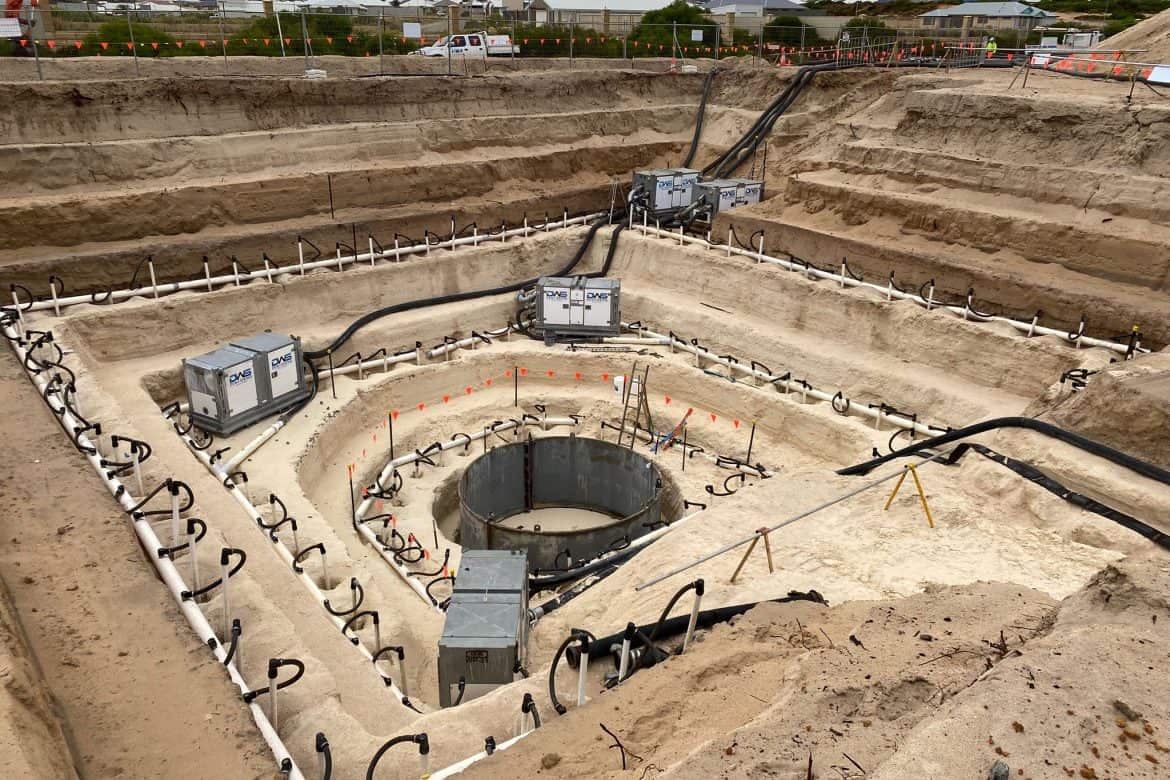
Groundwater rarely becomes a problem at a convenient stage of a project. It usually shows up once excavation starts, productivity drops, trench walls soften, and the programme begins to absorb delay. A well point dewatering system is often the most practical way to regain control on shallow to moderate excavations where groundwater needs to be lowered quickly, safely, and with predictable site performance.
For project managers, engineers, and principal contractors, the value of the method is not just that it removes water. It helps create stable working conditions, protects formation levels, reduces rework, and gives downstream trades a cleaner, safer area to operate in. Like any dewatering approach, though, it only performs well when the system matches the ground conditions and the excavation objective.
What a well point dewatering system does
A well point dewatering system lowers the groundwater table by drawing water through a series of closely spaced small-diameter wellpoints installed around or along an excavation. Those wellpoints connect to a common header pipe, which is then connected to a vacuum-assisted pump. As the system runs, groundwater is intercepted before it enters the excavation in damaging volumes.
The concept is straightforward. The execution is where project outcomes are won or lost. Spacing, depth, pump selection, discharge management, filter arrangement, and installation quality all affect whether the system achieves a stable drawdown or simply chases water without controlling it.
This method is commonly selected for trenches, sewer and pipeline works, basement excavations, tank pits, utilities, and other civil construction activities where the excavation is not excessively deep and the soil profile allows groundwater to move toward the wellpoints at a workable rate.
Where well point dewatering works best
Wellpoint systems are generally most effective in permeable to moderately permeable soils such as sands, sandy silts, and some fine gravels. In these conditions, groundwater can flow toward each wellpoint with enough consistency for the system to develop drawdown across the excavation footprint.
That does not mean every sandy site is a straightforward job. Layering matters. A clean sand profile behaves very differently from a stratified sequence with clay lenses or variable fill. On many sites, groundwater control issues come less from the water table itself and more from inconsistent subsurface conditions that interrupt flow, create perched water, or cause isolated wet zones that are easy to miss during planning.
In Western Australian and Queensland conditions, that local variability can be the deciding factor between a system that performs cleanly and one that needs redesign once work is underway. A desktop assumption is rarely enough. Site-specific investigation and field experience remain central to choosing the right approach.
When it may not be the right method
A well point dewatering system is not the answer to every groundwater problem. If the excavation is too deep, a deep well system may offer better control and efficiency. If the ground is dominated by very low permeability clays, vacuum assistance can help in some cases, but the achievable inflow reduction may still be limited. If the issue is localised seepage into a small pit, sump pumping may be more economical.
There are also sites where environmental constraints change the decision. If discharge quality is likely to require treatment, if there is a risk of drawing fines, or if surrounding assets are sensitive to groundwater movement, the design needs to account for more than just pump capacity. Dewatering is not only about getting water out. It is about doing so without creating settlement, erosion, turbidity issues, or compliance exposure.
Key design factors that affect performance
The first factor is the target drawdown. It sounds obvious, but the required water level should be tied to the actual excavation and working platform needs, not a vague aim to keep the site dry. Over-design can add unnecessary cost. Under-design usually shows up as downtime, bogging, and instability.
The second factor is soil permeability and stratigraphy. Wellpoints rely on groundwater moving toward the intake. If the formation transmits water unevenly, the system layout has to reflect that. Blindly applying standard spacing can lead to dry sections in one area and uncontrolled seepage in another.
The third factor is installation quality. Proper jetting or drilling, correct filter selection, sound connections, and a well-sealed header arrangement all matter. A wellpoint system is only as reliable as its weakest point. Air leaks, poor set depth, or blocked screens can reduce vacuum efficiency and compromise the entire line.
Pump selection also deserves close attention. The pump must maintain the vacuum and handle expected inflows without losing performance under site conditions. Redundancy is often worth considering on critical works, especially where loss of drawdown would affect excavation stability, programme, or safety.
Then there is discharge management. Water has to go somewhere, and that part of the job is often underestimated. Flow rates, settlement control, treatment needs, discharge approvals, and erosion protection should be planned from the start rather than solved after pumping begins.
Installation and operation on active sites
On a live project, the best dewatering systems are the ones that integrate with the broader construction sequence. Wellpoint installation needs to be coordinated around access, piling, services, trafficable areas, and other subcontractor interfaces. A technically sound system can still create programme issues if it is installed without regard to how the site actually operates.
Commissioning is another critical stage. Once the system is installed, drawdown should be monitored against the design intent, and the excavation should not be treated as fully controlled until the groundwater response has been confirmed. Starting bulk excavation too early is a common cause of avoidable setbacks.
Ongoing operation also requires attention. Pumps, headers, discharge points, and standby arrangements need regular inspection. Groundwater conditions can shift with rainfall, tidal influence, nearby works, or changing excavation geometry. Good dewatering management is active, not set-and-forget.
Common risks and how to manage them
One of the main risks is assuming that visible water is the whole problem. Often the greater issue is the loss of effective ground strength caused by elevated pore water conditions. A site may look manageable until equipment loads increase or trench support is stressed. Lowering groundwater is as much about geotechnical stability as it is about water removal.
Another risk is underestimating fines migration. If the filter arrangement is not suited to the soil, the system can pull fines and contribute to settlement or turbidity problems. That risk increases when installation quality is inconsistent or when pumping rates are pushed beyond what the formation can sustain cleanly.
There is also programme risk. Dewatering scopes are sometimes brought in late, after excavation methodology has already been fixed. When that happens, the site ends up trying to make the groundwater control method fit the programme instead of designing the programme around realistic groundwater behaviour. Early planning usually costs less than reactive troubleshooting.
Why contractor experience matters
A well point dewatering system can look simple on paper. In practice, results depend on how well the contractor reads the ground, installs the system, responds to site changes, and manages performance under pressure. Experience shows up in small decisions that have major consequences – where to tighten spacing, when to stage installation, how to manage discharge, and when the original approach needs adjustment.
That is particularly relevant on construction, mining, and civil infrastructure projects where dewatering is tied directly to critical path activities. If the system underperforms, the impact flows quickly into excavation delays, safety controls, subcontractor disruption, and rising cost. Reliable groundwater control is not a support task. On many sites, it is a production enabler.
At that point, the discussion moves beyond equipment hire and into project risk management. The right dewatering partner brings technical judgement, field discipline, and accountability for outcomes, not just pumps and pipework.
Choosing the method with the end result in mind
The right question is not whether a wellpoint system can remove water. It is whether it can achieve the drawdown required for the excavation, in the ground that actually exists, with controls that suit the environmental and operational demands of the site. Sometimes the answer is yes, and it is the most efficient option available. Sometimes a different method, or a staged combination of methods, will perform better.
That is why early assessment matters. Ground conditions, excavation depth, asset sensitivity, discharge constraints, and construction sequencing all influence the decision. A practical design backed by experienced installation and disciplined monitoring will nearly always outperform a generic setup that looked cheaper at tender stage.
On demanding sites, groundwater does not reward assumptions. It rewards planning, field knowledge, and systems that are built to perform under real conditions.