
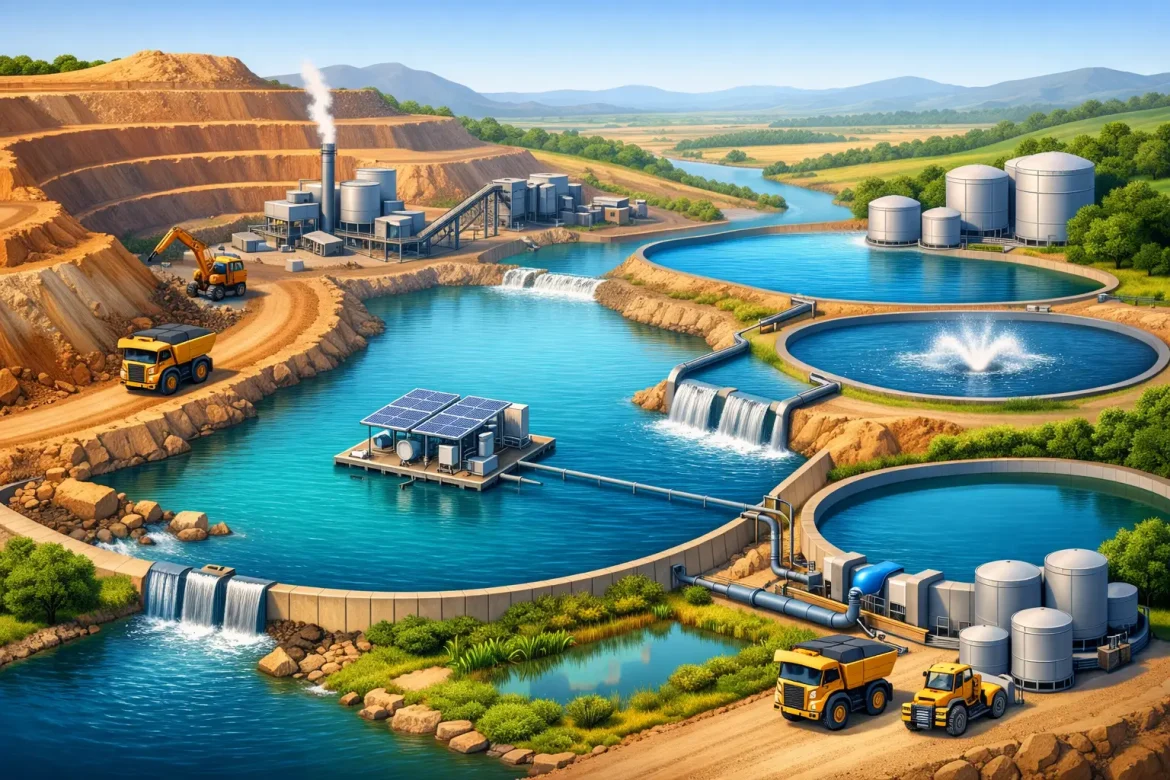
Water rarely arrives on a mine site as a single, predictable problem. It can enter an open pit through fractured ground, collect in low points after a storm, emerge around underground development, or carry sediment and dissolved contaminants that limit where it can go next. Effective mine site water management turns those variables into a controlled operating system that protects people, production schedules and environmental obligations.
For project managers and mine operators, the objective is not simply to remove water. It is to manage the right water, at the right rate, through the right control measures, without transferring risk to another part of the operation. That requires field knowledge, clear responsibilities and systems that can perform in changing ground and weather conditions.
Why water control is a production issue
Unmanaged water has a direct operational cost. Waterlogged haul roads slow cycle times and increase maintenance. Saturated batters can affect slope stability. Wet work fronts reduce access for drilling, loading, excavation and civil works. In underground environments, inflows can restrict development, create electrical hazards and place additional demand on pumping infrastructure.
The financial effect is often larger than the pump hire or treatment cost recorded against a work package. A delayed blast, inaccessible bench, unstable excavation or unplanned shutdown can quickly disrupt the critical path. There are also safety implications when crews work around soft ground, exposed hoses, open sumps or rapidly changing water levels.
Environmental performance is equally connected to operational performance. Discharging turbid, saline, acidic or contaminated water without suitable controls can create compliance exposure and damage relationships with regulators, landholders and surrounding communities. Good water management protects the site licence to operate as well as the daily work plan.
Start mine site water management with a water balance
A practical water balance is the foundation of a workable strategy. It identifies where water enters the site, where it is stored or used, how it changes in quality, and where it can be safely discharged, treated or reused. It should be a live operational tool, not a document prepared once for approvals and left in a project folder.
Inputs may include groundwater inflow, rainfall runoff, pit catchment water, process water, construction water and water imported for dust suppression. Outputs can include evaporation, reuse, controlled discharge, treatment residuals, seepage and removal by tanker where no discharge option is available.
The balance needs to reflect seasonal variation. A dewatering system sized for typical dry-season groundwater may be overwhelmed by a short, intense rainfall event. Conversely, a system designed only around wet-weather storage can become unnecessarily expensive to run during normal operations. The right capacity depends on the site’s hydrology, ground conditions, available storage, risk tolerance and production plan.
Understand water quality before selecting the solution
Quantity alone does not define the management approach. Water quality determines whether water can be reused for dust suppression, released under an approval, directed to a sediment basin, or requires specialist treatment.
Sampling should consider likely parameters for the site and receiving environment. These may include turbidity, pH, electrical conductivity, total suspended solids, hydrocarbons, metals and sulphates. Where mine water is influenced by sulphidic material or legacy workings, the risk of acidic or metal-affected drainage needs early assessment.
Quality can change over time and between locations. Clear groundwater from a deep well may be suitable for reuse, while runoff from a disturbed area may need sediment removal before it enters any storage or discharge pathway. Separating water streams at source is often more cost-effective than mixing all site water and treating it to the highest required standard.
Match controls to the ground and mine plan
There is no single dewatering method that suits every mine. The system must match the geology, permeability, excavation geometry, anticipated inflow and duration of works. A strong design also considers how the mine will develop, rather than solving only the next few weeks of production.
Deep wells can lower groundwater levels across a wider area where aquifers and ground conditions support their use. Well point systems can be effective in shallow, permeable soils where temporary drawdown is required for infrastructure works, trenches or excavations. Sumps and open pumping remain useful for localised runoff and seepage management, but they are generally reactive controls rather than a substitute for planned groundwater depressurisation.
Surface water controls matter just as much. Clean water diversion drains, bunding, graded work areas and appropriately sized sediment basins reduce the volume that reaches disturbed ground. Keeping clean water clean reduces pumping, treatment and storage demand. It also preserves capacity for water that genuinely requires management.
The trade-off is clear: more extensive drainage and dewatering infrastructure can increase up-front cost, but undersized or poorly located controls can create recurring downtime and emergency mobilisation costs. On high-risk work fronts, the lower-cost option is not always the option with the lowest whole-of-project cost.
Design for operating reality, not ideal conditions
A water management plan must be practical for crews working long shifts in demanding conditions. Pumps need access for maintenance. Pipelines need protection from traffic, abrasion and damage at crossings. Power supply, backup generation, telemetry and alarms need to be considered before a critical pump fails during a storm or overnight inflow event.
Duty and standby capacity is particularly important where a loss of pumping would affect pit access, underground safety or environmental containment. Redundancy does not mean duplicating every component without thought. It means identifying failure points and ensuring the consequences are proportionate to the available backup.
Storage is another common constraint. Ponds and tanks need enough freeboard to manage forecast rainfall, pump failure contingencies and operational variation. They also need safe access, stable embankments, erosion protection and a clear understanding of what water types they are authorised to hold.
At Dewatering Solutions, field execution is approached as part of the engineering outcome. A technically sound concept only delivers value when equipment is installed safely, maintained properly and adjusted as actual inflows and site conditions change.
Treat, reuse or discharge with clear controls
The preferred destination for mine water depends on its quality, volumes, available infrastructure and approval conditions. Reuse can reduce imported water demand and lower disposal costs, particularly for dust suppression or process applications. However, reuse must be assessed against equipment requirements, salt accumulation, worker exposure and the risk of spreading contaminants across the site.
Treatment may involve sediment settlement, filtration, pH correction, hydrocarbon separation or more advanced processes for dissolved contaminants. The treatment train should be selected based on verified water quality and expected flow rates. Overspecifying treatment wastes capital and operating cost. Underspecifying it creates non-compliant discharge risk and can leave the site without a workable outlet.
Discharge management requires disciplined monitoring. Approval limits, discharge locations, sampling frequency and reporting responsibilities should be clear to the operational team. Weather forecasts and downstream conditions can also affect when discharge is appropriate, even where a discharge point is approved.
Monitor performance and respond early
Water systems should be measured against operational outcomes, not merely whether pumps are running. Useful indicators include groundwater levels, inflow rates, sump levels, discharge quality, storage capacity, pump availability and the number of water-related interruptions to production.
Telemetry can provide early warning of rising levels, loss of flow or pump faults, but it does not replace site inspection. Operators still need to check hoses, connections, erosion points, bunds, sediment accumulation and access conditions. A small leak or blocked intake can become a significant issue if left until the next scheduled review.
Contingency planning should be specific. Identify who responds, what equipment can be mobilised, where temporary storage is available, and what actions are required if water quality moves outside acceptance criteria. The best time to decide how to manage a major rainfall event is before the forecast arrives.
Build water management into the next stage of works
Mine plans change, pits deepen and civil works move across the lease. Water controls should change with them. Reviewing the water balance and dewatering layout at each significant stage helps prevent temporary systems becoming permanent weak points.
The strongest mine site water management programs are visible in the daily operation: dry and accessible work areas, stable ground, reliable pumping, controlled discharge and fewer last-minute decisions. Treat water as a planned production input and risk control, and the site is better placed to keep work moving when conditions become difficult.