
A dewatering system can look effective on paper and still fail to protect an excavation if it does not match the ground conditions. The decision between wellpoint vs deep well dewatering affects excavation stability, plant access, discharge management, programme certainty and the cost of keeping water under control for the life of the works.
For project managers and engineers, the question is not which method is generally better. It is which system can achieve the required groundwater drawdown, maintain it reliably and do so without creating avoidable environmental or geotechnical risk.
Wellpoint vs deep well dewatering: the core difference
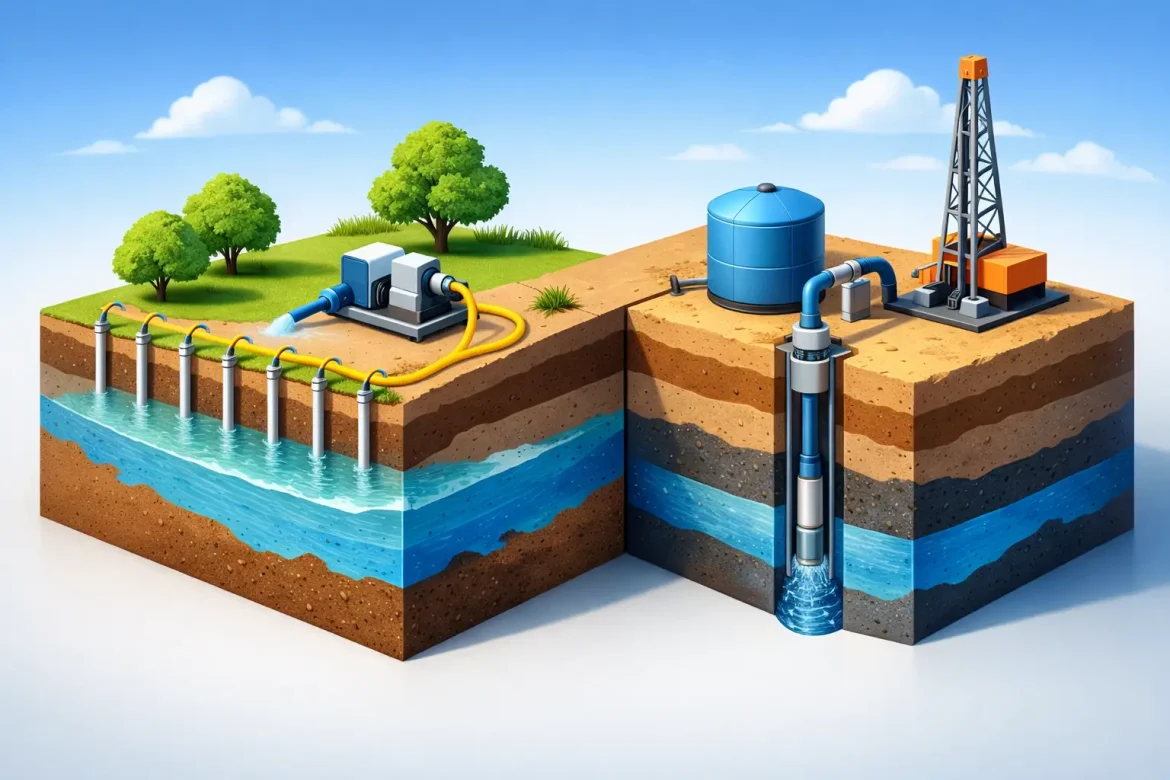
Wellpoint dewatering uses a series of small-diameter, screened points installed around an excavation or across a work area. The points are connected to a header main and a vacuum-assisted pump. By drawing air and water through the system, wellpoints lower the local water table and relieve pore water pressure in the surrounding soil.
Deep well dewatering uses larger-diameter drilled wells fitted with screens, gravel packs and submersible pumps. Each well draws groundwater from a greater depth and typically influences a wider area than an individual wellpoint. Deep wells are commonly selected where the required drawdown is beyond the practical capacity of a single-stage wellpoint system, or where higher groundwater volumes must be managed.
Both systems can be highly effective. The difference lies in how they interact with the aquifer, the excavation geometry and the construction sequence.
When wellpoints are the practical choice
Wellpoints are often well suited to shallow excavations in permeable sands and gravels, particularly where a broad, relatively uniform drawdown is required. They are commonly used for trenches, service installations, basements, pits and civil works where water levels need to be lowered by a modest depth.
A wellpoint system typically provides effective drawdown of about 4 to 6 metres per stage, subject to soil permeability, installation quality, pump performance and atmospheric limits. Where deeper excavation is required, staged wellpoints may be used. This involves lowering the system as excavation progresses, although it adds planning, installation and operational complexity.
The key strength of wellpoints is coverage. A closely spaced line of points can intercept shallow groundwater before it reaches the excavation, helping maintain firmer working conditions across a large footprint. Installation can also be efficient where access is available and the ground allows points to be jetted or driven to depth.
That said, wellpoints are not a default answer for every shallow excavation. Very low-permeability clays may not yield enough water for the system to be effective, while variable silts and fine sands can require careful filter selection and vacuum control. Poorly installed points, leaking headers or inadequate pump capacity can quickly reduce performance across the system.
Where deep wells perform better
Deep wells are generally more appropriate where excavations extend well below groundwater level, where the target aquifer is deeper, or where the required drawdown exceeds the practical limit of wellpoints. They can also suit large excavations with enough room for drilling access and a well layout outside the permanent works.
Because deep wells use submersible pumps and longer screened intervals, they can remove substantial volumes of groundwater from deeper permeable strata. This makes them useful for major basements, shaft works, mine infrastructure, deep service structures and projects where several metres of sustained drawdown is required over an extended period.
A properly designed deep well system may require fewer abstraction points than a wellpoint installation. However, fewer wells does not necessarily mean a simpler project. Every well must be drilled, developed, tested and monitored. Screen depth, gravel pack specification, pump duty, electrical supply and discharge controls all need to suit the actual ground profile, not just assumed conditions from a preliminary bore log.
Deep wells can also create a larger drawdown cone. This may be essential for excavation control, but it needs to be assessed against nearby structures, services, water bores and environmental receptors. Excessive drawdown can contribute to settlement in susceptible soils or draw poorer-quality water towards the site. These are design issues that should be addressed before mobilisation, not after a nearby asset begins to move or water quality changes.
Ground conditions decide the outcome
The most useful starting point is a site-specific hydrogeological assessment. Groundwater depth alone is not enough. The system must account for soil layering, permeability, aquifer thickness, recharge sources, tidal influence where relevant, expected inflows and the depth to any low-permeability layer that may restrict drawdown.
In Western Australia and Queensland, conditions can change considerably across a single project footprint. Sandy alluvium may sit beside clay lenses, weathered rock or highly variable fill. A system designed around the most favourable borehole can underperform when excavation reaches a less permeable zone or a higher-yielding sand channel.
Test pumping is often the most reliable way to reduce uncertainty on complex sites. It provides practical information on yield, drawdown response, recovery, water quality and the likely operating duty of the final system. This information supports better pump sizing and helps avoid the common problem of mobilising a system that is technically capable but operationally underpowered.
Excavation depth and programme matter
The required water level should be defined in relation to the formation level, not simply the current groundwater level. As a general rule, the system must maintain groundwater sufficiently below the base of excavation to control seepage and reduce the risk of instability. The actual allowance depends on soil conditions, excavation support, construction activities and the engineer’s requirements.
For a shallow pipe trench in clean sand, wellpoints may provide fast, broad control with relatively straightforward adjustment as the works advance. For a deep lift station excavation, deep wells may be more reliable because they can lower pressure from beneath the base rather than relying on multiple wellpoint stages close to the excavation edge.
Programme also changes the equation. Wellpoints can be deployed quickly for many short-duration scopes, while deep wells require drilling, development and commissioning before the main excavation reaches critical depth. On a constrained programme, early investigation and design are often worth more than a low initial equipment price.
Compare the full cost, not the mobilisation cost
Wellpoint systems can have lower upfront drilling costs, but they may require many points, extensive headers, multiple pumps and regular attention as excavation progresses. Deep wells usually involve higher establishment costs due to drilling and well construction, yet they may provide more efficient long-term control on deeper or higher-flow sites.
The real cost comparison should include installation, power or fuel, standby capacity, labour, monitoring, water treatment, discharge infrastructure, maintenance and the consequences of downtime. A system that saves money at mobilisation but causes wet formations, delayed pours or repeated excavation clean-outs is rarely the lower-cost option.
Reliability should be designed into either method. Duty and standby pumps, backup power where required, remote alarms, flow monitoring and routine inspections help identify issues before groundwater affects the works. For critical excavations, the dewatering system should be treated as construction-critical plant, with the same discipline applied to any other item protecting safety and programme.
Discharge quality and environmental controls
Dewatering does not end at the pump outlet. Water may contain sediment, iron, hydrocarbons, elevated salinity or naturally occurring contaminants. The approved discharge point, treatment requirements and monitoring obligations should be understood before pumping begins.
Wellpoint discharge can carry fine material if filters are poorly matched or the system has not been adequately developed. Deep wells may produce clearer water after development, but water quality can vary significantly between aquifers and across screened intervals. Settlement tanks, filtration, pH adjustment, oil-water separation or other treatment measures may be needed depending on the water and the discharge pathway.
Managing discharge properly protects compliance, nearby waterways and the project’s reputation. It also avoids last-minute changes to pumping rates when disposal capacity becomes the limiting factor rather than the dewatering equipment itself.
Selecting the right system for the site
A wellpoint system is generally strongest where the excavation is shallow to moderate, the ground is reasonably permeable and broad control near the surface is needed. A deep well system is generally stronger where drawdown must reach greater depths, groundwater volumes are substantial or the aquifer needs to be relieved beneath a deep excavation.
There are exceptions. A staged wellpoint arrangement may suit a deep excavation with favourable ground and adequate working room. Conversely, deep wells may be selected for a relatively shallow excavation if the aquifer is highly transmissive, access favours drilling or a wide spacing between abstraction points reduces disruption to the works.
The most dependable approach is to set the groundwater target early, investigate the soil and aquifer conditions, confirm likely inflows through testing where warranted, and design the system around the construction sequence. Dewatering Solutions applies this site-based approach so that pumping capacity, well layout and water management controls support the work in front of them.
The right choice is the system that keeps the excavation dry, stable and productive without shifting risk somewhere else on the project. When groundwater is treated as an engineering and delivery issue rather than a temporary pumping task, teams are better placed to protect their people, programme and budget.