
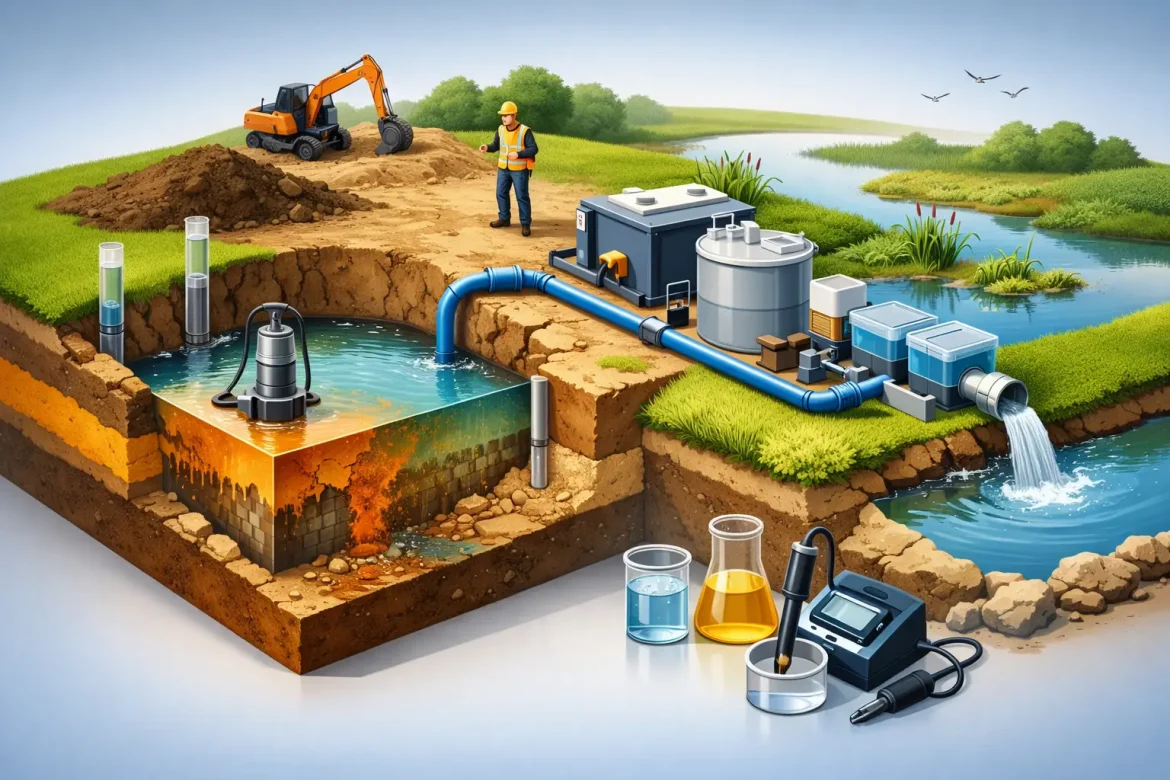
An excavation can be dry, stable and still create a serious environmental problem. Acid sulphate soil dewatering changes groundwater levels and exposes sulphidic materials to oxygen, potentially producing acidic water and mobilising dissolved metals. For project teams, the issue is not simply how much water must be removed. It is how to control that water, the soil it interacts with, and every discharge pathway without putting the programme, approval conditions or surrounding environment at risk.
In coastal and low-lying areas of Western Australia and Queensland, acid sulphate soils can occur in estuarine sediments, wetlands, floodplains and reclaimed land. They are not always obvious from the surface. A dewatering system that is technically effective in ordinary sands can become a compliance and treatment challenge where potential acid sulphate soils are present.
Why acid sulphate soil dewatering needs a different approach
Potential acid sulphate soils contain iron sulphides, commonly pyrite, that have remained stable in waterlogged, oxygen-poor conditions. When excavation, drainage or groundwater drawdown allows oxygen to reach those materials, oxidation can generate sulphuric acid. That acidity may dissolve or mobilise iron, aluminium and other metals.
The consequences can develop in several places at once. Groundwater entering wells or sumps may become acidic. Excavated spoil can generate acidic runoff after rain. Discharged water can affect drains, creeks, wetlands or marine environments. Acidic conditions can also damage pumps, pipework and downstream treatment equipment, adding avoidable maintenance and replacement costs.
The degree of risk depends on the soil profile, groundwater chemistry, drawdown depth, duration of works, excavation footprint and wet-season conditions. It also depends on whether the site contains actual acid sulphate soil, where acidity has already formed, rather than only potential acid sulphate soil. Treating every site as identical is inefficient. Treating an identified risk as a standard pumping scope is worse.
Start with investigation, not equipment selection
A controlled outcome begins before wellpoints, deep wells or sump pumps arrive on site. Existing geotechnical reports, contamination investigations, groundwater data and approval documentation should be reviewed together. They may indicate sulphidic sediments, acidic groundwater, elevated metals, tidal influence or sensitive receiving environments.
Where the risk is plausible, the investigation needs to establish what material is present and where. Field observations can assist, but they are not enough on their own. Soil sampling, laboratory assessment and groundwater testing provide the evidence required to determine likely acid generation, existing acidity and treatment needs.
The practical questions are direct. How far will groundwater need to be lowered? Will the drawdown expose sulphidic layers? Can water be retained, reinjected or treated before release? Where will excavated material be placed, and will that stockpile remain wet or be exposed to air? A dewatering design should answer these questions before it commits the project to a discharge arrangement.
For complex sites, this process should sit within an acid sulphate soil management plan and be coordinated with the project environmental team, geotechnical adviser and relevant approval requirements. That coordination prevents a common failure point: designing the pumping system separately from the soil and water management controls.
Design the system around containment and treatment
The preferred water-management hierarchy is generally to avoid disturbance where practicable, minimise the drawdown footprint, contain affected water and treat it when required before discharge. The best option is site-specific. A short, shallow excavation may be managed differently from a long-term basement dig, pipeline trench or mine infrastructure upgrade.
Wellpoint or deep-well systems can offer better control than broad open pumping where they limit water ingress and reduce unnecessary disturbance. However, a larger system is not automatically safer. Excessive drawdown can expose more sulphidic material, pull water from a wider area and increase the volume requiring treatment. The design target should be the drawdown needed for safe, productive construction – no more.
Treatment commonly involves collection in a controlled settlement and treatment train, followed by pH adjustment, aeration, settling and, where necessary, filtration or further polishing. The exact arrangement depends on flow rate and water quality. Neutralisation can address low pH, but it does not remove every risk. Once pH is adjusted, dissolved metals may precipitate as solids, creating sludge that requires appropriate containment, testing and disposal.
Discharge points need equal attention. Water that appears clear may still be unsuitable for release. A compliant discharge arrangement considers pH, turbidity, electrical conductivity, dissolved metals, flow limits and the sensitivity of the receiving environment. It also accounts for the fact that water quality can change after rainfall, tide movement, changes in pumping rate or contact with newly exposed soils.
Control spoil as carefully as pumped water
Dewatering and excavation are linked. If spoil containing potential acid sulphate soil is removed from below the water table and stockpiled without controls, it can oxidise and generate acidic leachate even if the pumping discharge is well managed.
Stockpile locations should be selected to avoid runoff entering drains or waterways. Where material must be temporarily stored, containment, covering, staged placement and runoff collection may be required. Some material may need to remain saturated, be treated, or be removed to an approved facility. The right method depends on the volume, laboratory results, site constraints and the duration of stockpiling.
This is also where construction sequencing matters. Keeping an excavation open longer than necessary increases exposure time. Coordinating excavation, support works, service installation and backfill reduces the period in which soil and groundwater are vulnerable to change. Good sequencing is both an environmental control and a programme control.
Monitoring keeps decisions grounded in site conditions
An acid sulphate soil dewatering plan should not rely on a single pre-start sample. Conditions shift during construction, particularly where works intersect variable soil layers or seasonal groundwater patterns. Routine monitoring confirms whether controls are working and provides early warning before a minor variation becomes a reportable incident.
Monitoring frequency and parameters should reflect the project risk and approval conditions. At a minimum, this often includes flow volumes, pH and turbidity at defined points in the treatment process and before discharge. Projects with a higher risk profile may also require electrical conductivity, acidity and alkalinity, dissolved metals, groundwater levels and rainfall records.
Instrumentation needs to be maintained and calibrated, and site crews need clear trigger levels. A pH result outside the accepted range should lead to a defined response: hold discharge, investigate the source, adjust treatment, retest and record the outcome. Without that discipline, operators can be left making high-consequence decisions under pressure.
Daily records are not paperwork for its own sake. They demonstrate compliance, help diagnose treatment performance and give the project team evidence to adjust pumping rates or construction sequencing. They are particularly valuable when weather events, changing ground conditions or client reporting requirements place the system under scrutiny.
Common failures that create unnecessary exposure
The most costly problems usually start with assumptions. One is assuming groundwater is suitable for discharge because it looks clean. Another is treating pH correction as the entire treatment solution, without considering metals, sludge or the receiving environment. A third is allowing treated water and untreated runoff to mix in an uncontrolled area.
Projects also run into trouble when temporary works are undersized for wet weather, when bypass pumping is not planned, or when crews are unclear about who can authorise a discharge. Treatment capacity, storage capacity and contingency arrangements must reflect credible peak flows, not just average pumping rates.
A specialist dewatering contractor brings practical value by connecting the hydraulic design with field operation. This includes selecting suitable extraction methods, managing pump and treatment reliability, maintaining containment and responding quickly when monitoring identifies a change. At Dewatering Solutions, the focus is on water control systems that support safe excavation while keeping environmental obligations and programme pressure in view.
Plan for the full dewatering lifecycle
The work does not finish when excavation reaches formation level. As construction progresses, drawdown may need to be reduced, relocated or stopped in stages. Recovery of groundwater levels can affect adjacent works, backfilled trenches and temporary structures. Discharge quality may also change as the system transitions.
A planned demobilisation considers how wells, sumps, treatment units and stockpiles will be managed, how monitoring will be closed out, and what evidence is required for the client and regulators. It is a controlled handover, not simply removal of pumps.
Early investigation and disciplined field controls give project teams choices. They can reduce the drawdown area, adjust the construction sequence, allow realistic treatment capacity and prevent contaminated water from becoming a late-stage emergency. On sites with acid sulphate soil risk, that preparation protects far more than a discharge point – it protects the workfront, the budget and the project’s ability to keep moving.