
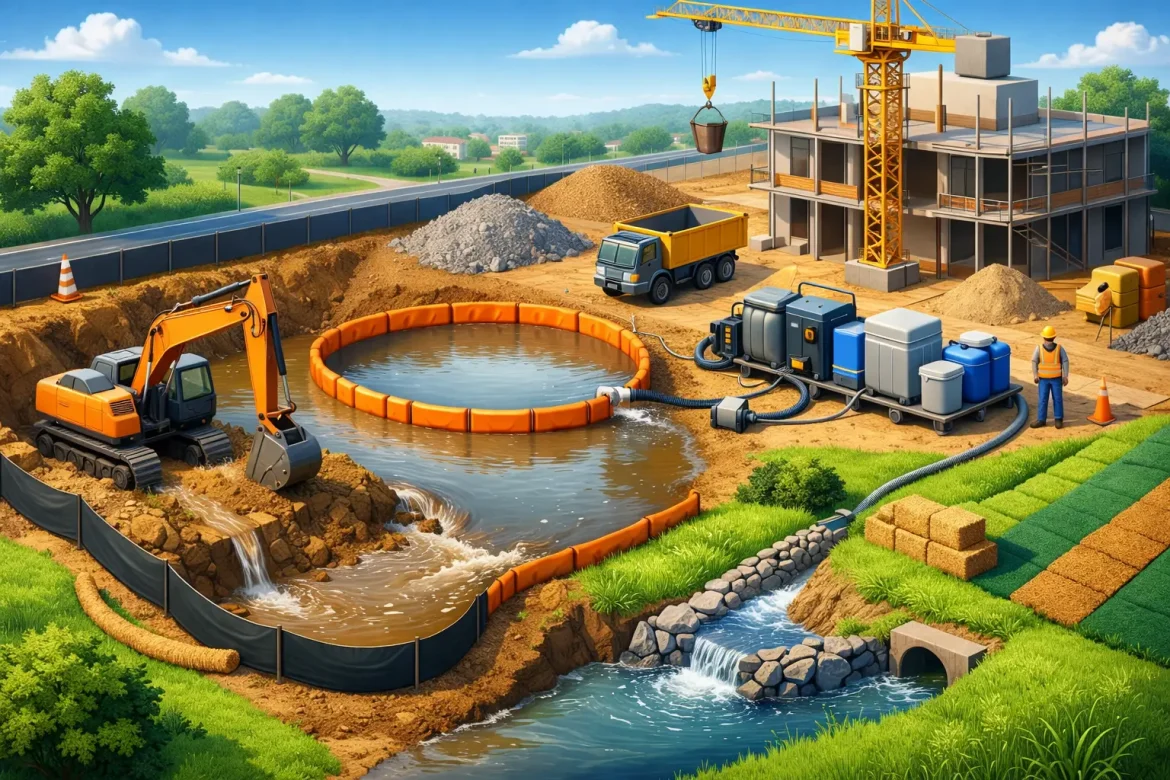
An excavation can be ready to pour, crews can be mobilised and plant can be on hire, yet the programme can still stop because water has nowhere compliant to go. Construction water regulations are not a paperwork exercise completed after dewatering begins. They shape the way groundwater, stormwater and wastewater are assessed, contained, treated, monitored and discharged from the first site plan.
For project managers and principal contractors, the practical objective is clear: keep water out of the work area without creating an environmental breach, a safety exposure or an avoidable delay. That requires a water-control strategy matched to the ground conditions, the receiving environment and the approvals that apply to the project.
Why water compliance becomes a programme issue
Water on a construction site rarely stays in one category. Groundwater entering an excavation may mix with sediment-laden stormwater. Water from bore development or drilling can carry fines. A temporary sump may receive runoff from disturbed areas, while water used for washdown can introduce hydrocarbons, concrete residue or other contaminants.
Once streams are mixed, treatment and disposal options may become more limited. A system that was suitable for relatively clean groundwater may no longer meet discharge conditions if sediment, pH variation or visible contamination is introduced upstream. This is why separation at source is often one of the most effective controls a site can establish.
The commercial impact is equally direct. Unplanned water treatment, tanker removal, additional monitoring and idle plant all add cost. More seriously, uncontrolled inflows can soften formation levels, destabilise trench walls, undermine access tracks and place workers in hazardous conditions. A compliant dewatering system protects more than the environment. It protects the construction sequence.
Construction water regulations start before mobilisation
Regulatory requirements differ by location, project type, discharge destination and water quality. In Western Australia and Queensland, a project may need to consider environmental approvals, local government requirements, water licences or permits, land access conditions, utility authority requirements and conditions set by the principal contractor or client.
There is no reliable one-size-fits-all discharge rule. Sending water to a stormwater drain, watercourse, sewer, groundwater system or off-site disposal facility each carries different requirements. Even discharge to land can require careful assessment where erosion, salinity, acid sulfate soils, vegetation or nearby sensitive receptors are factors.
The key question is not simply, “Can we pump it out?” It is, “What is the water, where will it go, and what evidence is required to demonstrate that the chosen method is acceptable?” Answering that question early gives the project team time to select the right system rather than improvising under pressure.
Define the source and likely water quality
A pre-construction investigation should identify expected groundwater levels, aquifer conditions, soil types, potential contamination and the influence of tides, rainfall or nearby water bodies where relevant. Historical land use matters. A former industrial site, landfill, service station or fill area may require a more cautious approach than a greenfield civil excavation.
Initial sampling can establish a baseline, but it should not be treated as a permanent guarantee. Water quality can change as drawdown progresses or after rainfall. Fine sediments may increase during well development. In coastal settings, salinity can be a critical consideration. In some ground conditions, pH, metals, hydrocarbons or acid sulfate soil-related impacts may also need attention.
A sound plan identifies what will be tested, how often, where samples will be taken and who has authority to respond when results fall outside the agreed operating range.
Match discharge pathways to approvals
Discharge should only occur through an approved pathway. Depending on the project, this may involve controlled release to land, a lawful connection to sewer with authority approval, discharge to an approved receiving environment, reuse on site, or containment and removal by a licensed provider.
Reuse can reduce disposal volumes, but it is not automatically compliant or practical. Water proposed for dust suppression, compaction or washdown still needs to be suitable for that use and managed so it does not create runoff, soil impacts or worker exposure. Off-site removal may be the right option for difficult water, though it can increase haulage costs and requires secure storage capacity on site.
The best pathway depends on water quality, available space, programme duration and approval conditions. The lowest-cost option on paper is not necessarily the lowest-risk option once treatment, monitoring and potential rework are considered.
Build controls around the actual site conditions
A dewatering design should address both the inflow itself and the route water takes after extraction. Wellpoint systems, deep wells, sumps and open pumping each have a place, but they do not solve the same problem. The correct approach depends on permeability, excavation depth, drawdown requirements, footprint and the need to limit ground movement near structures or services.
For example, a deep excavation in permeable sands may require a staged wellpoint or deep-well arrangement to lower groundwater reliably. A localised trench may be managed with sumps and pumping if inflows are modest and the excavation remains stable. In either case, pumping directly to discharge without sediment control, monitoring or contingency capacity is an avoidable risk.
Treatment systems may include settlement tanks, sediment basins, bag filtration, cartridge filtration, pH adjustment, oil-water separation or more specialised treatment where site chemistry demands it. Equipment selection should be based on verified conditions and required discharge quality, not simply the pump flow rate.
The system also needs to accommodate the weather. Stormwater management and dewatering are often designed separately, then forced to share the same containment during heavy rain. That is when basins overtop, sediment escapes and clean water becomes contaminated. Separate clean-water diversion from dirty-water containment wherever practicable, and provide enough storage and pumping redundancy for realistic rainfall events.
Make monitoring useful, not ceremonial
Monitoring only has value when it changes site decisions. A field team needs practical trigger levels for turbidity, pH, flow, water level and visual condition, together with clear actions when a trigger is exceeded. This might mean pausing discharge, redirecting to containment, changing filters, increasing settlement time or arranging further laboratory analysis.
Records should show more than a set of test results. They should document where water was pumped from, treatment operating conditions, discharge volumes, inspection findings, maintenance performed and any corrective action. Accurate records protect the project when questions arise from the client, regulator or superintendent, and they help diagnose problems before they become major events.
Remote level or flow monitoring can improve response times on high-risk or long-duration sites, but it does not replace inspections. Hoses move, pumps block, fuel runs low and treatment performance can change quickly. Competent site checks remain essential.
Four controls that prevent common failures
The following controls are simple in principle, but they prevent a significant share of water-management failures:
- Keep clean stormwater separate from excavation water, washdown areas and sediment-generating activities.
- Install treatment and containment before major pumping begins, rather than reacting after water reaches the excavation.
- Set written response actions for poor water-quality results, equipment failure and forecast heavy rainfall.
- Inspect pumps, hoses, bunds, tanks and discharge points routinely, with responsibility assigned to named personnel.
These controls work best when they are included in daily planning. A change in excavation depth, rainfall forecast, piling activity or discharge location can alter the risk profile quickly.
Contractor capability matters
Water compliance is often lost at the handover between design, installation and operation. A well-designed system will not perform if it is installed without regard to site access, operated without inspection or modified by multiple parties without clear responsibility.
Specialist dewatering support brings practical value when groundwater conditions are uncertain, excavations are deep, water quality is variable or discharge requirements are tight. The benefit is not merely supplying pumps. It is applying field experience to select the right extraction method, manage treatment performance and keep the system operating safely as conditions change.
For Dewatering Solutions, that means planning around real site constraints: ground conditions, construction staging, available footprint, discharge obligations and the consequences of failure. A water-control scope should give the broader project team confidence that excavation works can proceed without shifting risk downstream.
A compliant water plan is most effective when it is treated as a live construction control. Review it before the first pump starts, test it against the next stage of works, and give the site team authority to stop a discharge that does not meet the agreed standard. That discipline keeps water from becoming the issue that decides the programme.