
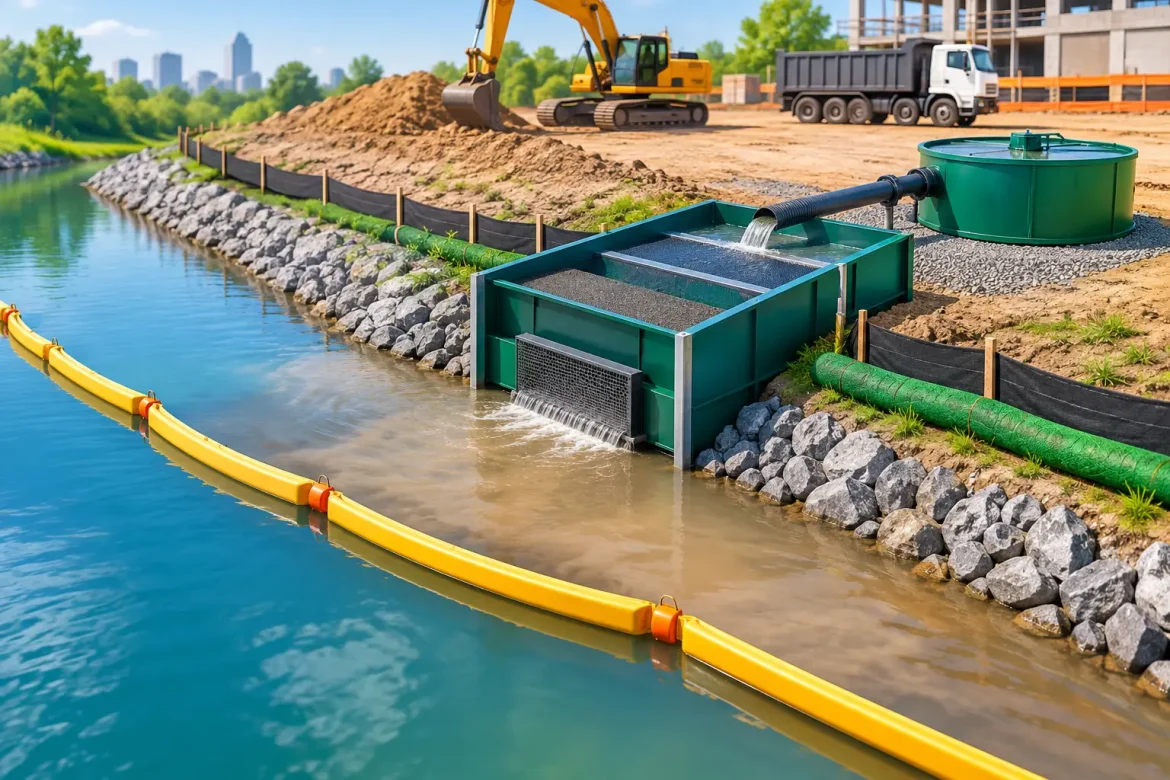
A discharge point can look acceptable at the start of a shift and fail visually within minutes of excavation, rainfall or a pump rate change. The best turbidity controls for construction sites are not a single product at the end of a pipe. They are a planned treatment train that prevents sediment mobilisation, allows solids to settle, and verifies that released water meets the project’s approval conditions.
For project managers, the consequence of getting this wrong is more than cloudy water. High turbidity can trigger environmental non-compliance, stop pumping when an excavation needs to remain dry, damage downstream drainage assets, and create an avoidable programme delay. On constrained civil, mining and infrastructure sites, water control needs to be designed with the same discipline as the excavation itself.
What makes turbidity difficult to control?
Turbidity measures the cloudiness of water caused by suspended particles. On construction sites, those particles may include clay, silt, fine sand, drill spoil, cementitious material and organic matter. The finest particles are often the hardest to manage because they can remain suspended for hours or days rather than settling naturally.
This is why a stilling tank that performs well on sandy groundwater may be ineffective once a clay-bearing excavation is opened or stormwater enters the system. Pumping can also create the problem it is intended to solve. Excessive inlet turbulence, a poorly positioned suction line or high-velocity discharge can re-suspend settled solids and send them straight through the treatment process.
The right control depends on the source water, expected flow, excavation sequence, available footprint, discharge location and applicable water-quality criteria. A system must also cope with real site conditions, including wet-weather events, changing groundwater levels and plant movements.
Best turbidity controls for construction sites
The most reliable approach is to use controls in sequence. Each stage reduces the load on the next, making performance more predictable and reducing treatment costs.
Start with source control
The cheapest suspended solids are the ones that never enter the water stream. Keep clean stormwater separate from excavation water wherever practical, divert run-on around disturbed areas, and maintain perimeter drains before rain arrives. Stabilising batters, limiting exposed soil and managing stockpiles also reduce the sediment burden entering sumps and collection points.
Within the excavation, locate sumps away from active digging where possible. Use rock check structures, geotextile protection or sacrificial settling areas to slow incoming water before it reaches the pump. A sump is not a treatment system by itself, but a well-designed sump can remove coarse material and protect pumps from unnecessary wear.
Source control has limits. On a deep excavation in reactive clay, or a site with continuous groundwater inflow, water will still require treatment. The purpose is to reduce variability before it reaches the treatment plant.
Use settlement where particle size allows it
Sediment basins, settlement tanks and weir tanks work by reducing water velocity and creating retention time. Heavier particles settle first, leaving clearer water near the outlet. Baffles can improve performance by preventing short-circuiting, where water enters and exits without spending enough time in the tank.
Settlement is straightforward and cost-effective for sand, grit and heavier silts. It is less dependable for very fine silts and clays. A basin sized only for average flow can also be overwhelmed by a rainfall event or a sudden increase in pumping demand. In those situations, adding capacity is often more valuable than simply increasing pump speed.
Routine maintenance matters. Sediment needs to be removed before it reduces effective capacity, and outlet structures need inspection after significant inflow events. A basin that has filled with sludge is no longer providing the retention time assumed in the design.
Apply flocculation for fine clays and silts
Where particles are too fine to settle efficiently, a flocculant can bind them into larger particles, known as flocs. These larger particles can then settle or be captured through downstream filtration. This is often the key step for turbid water from clay-rich ground, drilling operations or disturbed soil following rain.
Flocculation is highly effective when selected and dosed correctly, but it is not a set-and-forget process. The product type, dosage, mixing energy and pH all influence the result. Under-dosing may achieve little improvement; over-dosing can leave residual chemical in the discharge or produce weak flocs that break apart during pumping.
Jar testing or controlled field trials should inform the treatment approach before full-scale operation. Operators should also allow enough gentle mixing to form flocs, followed by a calm zone for them to settle. High-shear pumps and sharp bends downstream of dosing can damage the flocs before they are removed.
Add filtration as the final barrier
Bag filters, cartridge filters, media filters and geotextile dewatering units can provide a valuable polishing stage after settlement or flocculation. They are particularly useful when discharge criteria are tight or the receiving environment is sensitive.
Filtration performs best when the upstream water is already reasonably clear. Sending heavily sediment-laden water directly to fine filters creates rapid blinding, increased change-out frequency and avoidable operating cost. Think of filtration as a finishing control, not a replacement for sediment management.
Filter selection should match the expected solids load and required flow rate. A unit that achieves excellent clarity at a low flow may be unsuitable if it constrains the dewatering system and places the excavation at risk. Duty and standby capacity should be considered where continuous pumping is critical.
Control the discharge point
Even treated water can cause problems if it is discharged carelessly. High-velocity water can scour soil, disturb a drain or mobilise sediment from an unprotected outlet. Use appropriate energy dissipation and protect the discharge area so water leaves the treatment process without creating a new sediment source.
The approved discharge route must be clear to the crew. Temporary hose relocations, damaged bunding and unplanned connections are common causes of avoidable incidents. Marking the route, securing hoses and inspecting discharge points at the start of each shift are simple actions with real value.
Monitoring turns equipment into a control system
Turbidity controls are only as reliable as the checks around them. Visual inspection remains useful, particularly for identifying sudden changes in water quality, but it should not be the sole measure where formal limits apply. Calibrated turbidity meters provide measurable data and help operators see whether conditions are trending in the wrong direction before a limit is exceeded.
Monitoring locations should reflect the treatment process: incoming water, post-settlement or post-treatment water, and final discharge. Recording pump rates, rainfall, dosing changes, maintenance and turbidity readings creates a practical operating record. If performance changes, those records help identify whether the cause is an altered water source, overloaded treatment capacity, ineffective dosing or a blocked filter.
Site teams also need clear response actions. If turbidity rises, operators should know when to slow or stop discharge, divert water to additional storage, adjust treatment, inspect the system and escalate the issue. A written plan is useful only when the people running the plant can apply it under pressure.
How to choose the right system for the job
There is no universal best setup. A shallow trench in clean sandy material may only require a managed sump, settlement tank and protected outlet. A deep basement excavation in fine clay may need staged settlement, chemical treatment, filtration, continuous monitoring and contingency storage. The difference is not excessive caution. It is matching the controls to the risk.
Before selecting equipment, establish the expected inflow range, likely suspended solids, groundwater chemistry, discharge destination, site footprint and construction programme. Include worst-case conditions rather than designing around a calm-weather average. The system should be able to operate while crews excavate, rainfall occurs and pumps cycle.
In Western Australia and Queensland, local ground conditions and wet-season or storm-event exposure can materially change the treatment requirement. Early investigation and practical water testing reduce the chance of hiring equipment that is undersized, poorly matched or difficult to operate within the available work area.
Dewatering Solutions approaches turbidity management as part of the full groundwater-control scope. That means considering how pumping, excavation sequencing, treatment capacity, discharge requirements and operator access work together, rather than treating water quality as an issue to solve at the end of the line.
A well-run turbidity system protects the receiving environment, but it also protects the programme. Plan for the water you are likely to encounter, retain capacity for the water you hope not to encounter, and give the site team a treatment process they can operate confidently every shift.