
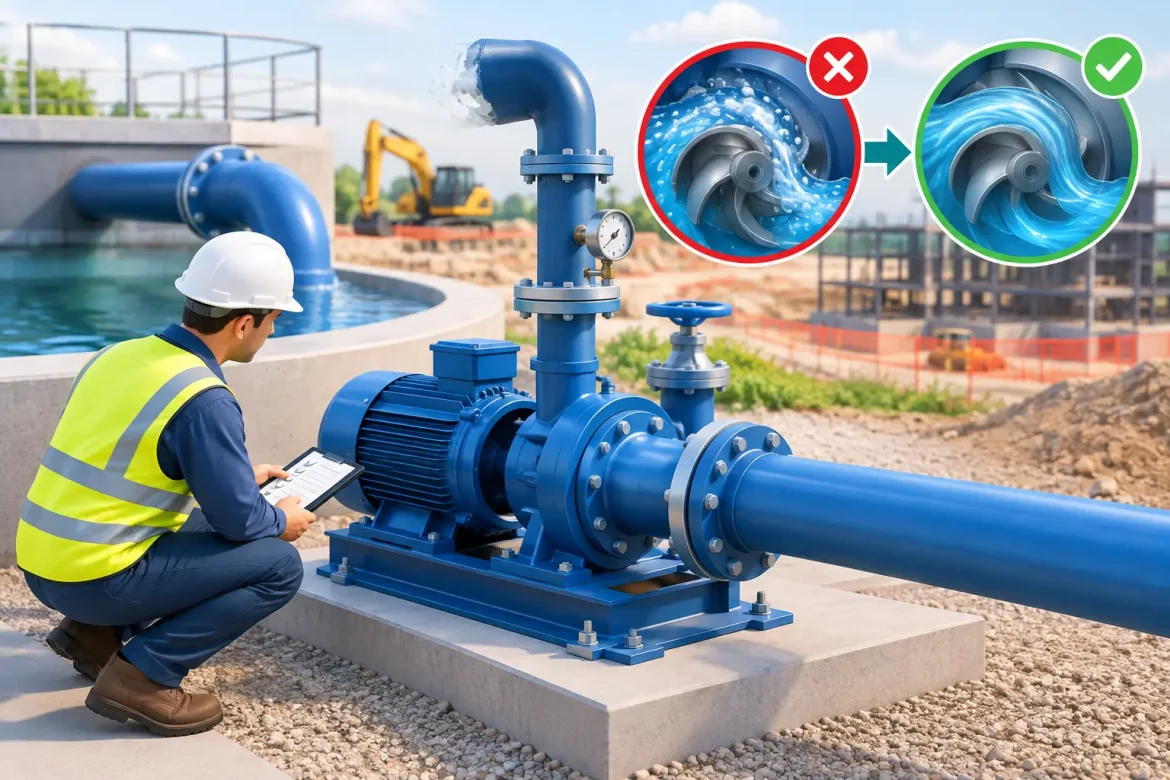
A dewatering pump that sounds like it is pumping gravel is not merely running rough. It may be losing capacity at the point an excavation, sump or well system needs it most. To prevent pump cavitation, site teams need to manage suction conditions as deliberately as they manage discharge flow, fuel supply and pump run hours.
Cavitation can quickly turn a reliable pumping arrangement into a programme risk. It erodes impellers, damages seals and bearings, reduces flow, increases vibration and can cause repeated breakdowns. On a construction, mining or civil site, the result may be rising water levels, unstable excavation conditions, lost shifts and costly reactive maintenance.
What causes pump cavitation?
Cavitation occurs when pressure at the pump suction falls below the liquid’s vapour pressure. Small vapour bubbles form in the water, then collapse violently when they move into a higher-pressure area inside the pump. Those implosions create the characteristic crackling or rattling sound and progressively remove material from the impeller and casing.
The immediate issue is insufficient net positive suction head available, commonly called NPSHa. Every pump has a net positive suction head required, or NPSHr, set by the manufacturer. For reliable operation, the NPSHa at the actual site condition must remain above the NPSHr with a sensible operating margin. This is not a paper exercise. Suction losses change with water level, pipe condition, temperature, flow rate and the way a temporary system is installed.
In dewatering work, cavitation commonly develops when a pump is positioned too high above the water source, suction hoses are undersized or too long, strainers become blocked, or a sump level falls below the operating range. Air leaks on the suction side can create similar symptoms and should be investigated at the same time. A pump may also cavitate where flow is pushed well beyond its intended duty point.
Prevent pump cavitation through better system design
The most effective control is to build suction margin into the system before equipment reaches site. A pump selection based only on duty flow and discharge head can overlook the operating conditions that determine whether the pump will remain stable through a full shift, rainfall event or groundwater drawdown.
Keep the pump close to the water source
For surface-mounted pumps, suction lift is a major constraint. Atmospheric pressure does the work of lifting water into the pump, and the practical limit is lower than the theoretical limit once friction losses and site conditions are considered. Position the pump as close and as low as safely possible relative to the water level.
This can require a different approach as the job progresses. A sump may be adequate at the start of an excavation but become too shallow as inflows reduce or work advances. In these circumstances, lowering the pump, changing the sump arrangement or moving to a submersible configuration may provide a more dependable outcome than repeatedly adjusting a suction hose.
Reduce suction-side losses
Suction pipework should be short, direct and appropriately sized for the required flow. Sharp bends, unnecessary valves, reducers, crushed layflat hose and long runs all consume available suction head. A larger suction line may appear to add cost, but it can reduce friction losses, improve priming performance and limit avoidable wear on the pump.
Avoid high points in suction lines where air can collect. Keep joints airtight, use sound gaskets and inspect camlocks, hose tails and mechanical seals before commissioning. Unlike a discharge-side leak, a suction-side leak may not release water. Instead, it admits air and disrupts the pump’s ability to maintain a stable vacuum.
Strainers must protect the pump without becoming a restriction. Fine screens may be necessary where sand, debris or fibrous material is present, but they need an inspection and cleaning plan. On dirty groundwater or open-sump applications, a blocked strainer can change pump performance within hours.
Allow for changing water conditions
Water temperature affects vapour pressure, so warmer water provides less suction margin. This is particularly relevant where water has been stored in exposed tanks, pumped from process areas or recirculated during hot conditions. Altitude also matters because lower atmospheric pressure reduces the available head, although it is generally a smaller factor on many coastal projects.
Ground conditions deserve equal attention. Fine sands can migrate into a sump, obstruct strainers and increase drawdown around well points. In fractured ground, intermittent inflows may cause rapid level changes. Dewatering systems in Western Australia and Queensland need to be designed around actual hydrogeological behaviour, not an assumed steady water level.
Operate within the pump’s stable range
A correctly selected pump can still cavitate if it is operated outside its preferred range. Running too far to the right of the pump curve, where flow is excessive, increases suction losses and can raise NPSHr. This often occurs after discharge pipework is shortened, a valve is opened fully, or a parallel pump arrangement changes the duty experienced by each unit.
Track suction and discharge pressures, flow where practical, water level and operating hours. These measurements give site teams an early indication of changing conditions rather than relying on sound alone. A falling suction pressure, fluctuating discharge pressure or unexplained loss of flow should trigger inspection before the pump sustains damage.
Throttling on the discharge side can be appropriate when it moves the pump back towards a suitable duty point. Do not throttle the suction side to control flow. Restricting suction increases losses and makes cavitation more likely. If duty conditions have materially changed, the right answer may be a smaller pump, a variable-speed arrangement or revised pipework rather than forcing the existing unit to do unsuitable work.
For multiple-pump installations, sequence equipment to match inflow. Operating one large pump at very low flow can create different hydraulic problems, while operating too many pumps can draw a sump down faster than it can recover. Controls should include sensible low-level cut-outs, but those set points must be tested under working conditions and reviewed as the excavation develops.
Recognise the signs before a failure occurs
Cavitation is sometimes mistaken for a bearing fault, debris passing through the pump or general engine vibration. The distinction matters because continued operation will damage a pump even if the unit appears to be holding water levels for the moment.
Common indicators include a rattling or crackling noise from the pump casing, unstable pressure gauges, declining flow, increased vibration, reduced motor or engine performance, and repeated mechanical seal failures. Inspection may reveal pitting on impeller vanes or casing surfaces, often described as a honeycomb appearance.
When these signs appear, reduce the risk first. Check the water level, suction hose condition, strainer, priming system and all suction connections. Confirm whether recent changes to pipework, pump speed, discharge elevation or pumping configuration have moved the pump away from its intended duty. Continuing to run while waiting for a convenient maintenance window usually turns a correctable operating issue into a replacement-parts issue.
Make inspection part of the dewatering plan
Cavitation prevention is not limited to pump selection. It depends on disciplined installation, commissioning and daily site checks. Before start-up, confirm the pump is primed, suction components are sound, valves are in the correct position and the intake has sufficient submergence to avoid vortexing and air entrainment.
During operation, inspect water levels and strainers at intervals that reflect the site risk. A clean, controlled well-point system may need less frequent attention than an open sump receiving silts, runoff and construction debris. After heavy rain, excavation changes or a shift in groundwater inflow, reassess the arrangement rather than assuming yesterday’s settings are still suitable.
Maintenance records should capture the pump’s operating condition, not just service dates. Notes on vibration, noise, flow performance, hose replacement, blocked strainers and impeller wear help identify recurring system issues. That evidence supports better pump sizing and layout decisions on the next stage of work.
Reliable dewatering starts with understanding the whole water-control system, from ground response and intake conditions to discharge requirements. A pump that has adequate suction margin, clean flow paths and active site monitoring is far more likely to protect the excavation, the programme and the people working around it.