
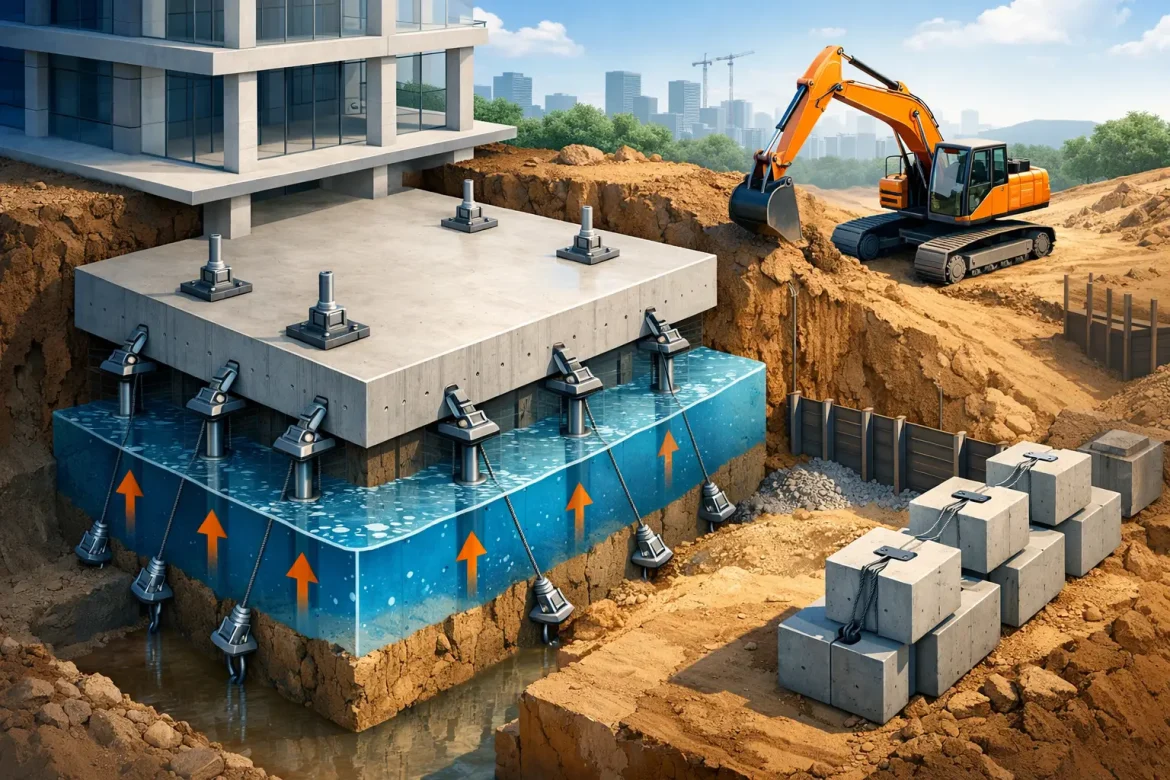
Groundwater beneath an excavation does not need to be visible to disrupt a build. Where pressure remains trapped below a slab, raft or excavation formation, it can lift the base, destabilise founding conditions and turn a planned concrete pour into a programme-critical issue. Effective foundation uplift control is therefore not simply a pumping exercise. It is a planned groundwater management measure that protects the structure, the workforce and the sequence of works.
For civil, construction and mining projects, the cost of getting this wrong is rarely limited to additional pumping. Delays to excavation, remediation of softened subgrades, redesign, environmental controls and reduced productivity can quickly compound. The practical objective is to reduce pore water pressure to a level that keeps the excavation base stable while maintaining control of water both within and beyond the work area.
What foundation uplift control is designed to prevent
Foundation uplift occurs when hydrostatic pressure beneath a foundation or excavation base exceeds the downward force holding it in place. Water pressure acts upward through permeable soils, rock fractures or confined aquifers. If it is not relieved, the result can be heave, base instability, seepage through the formation, piping of fine soils or movement that compromises the bearing surface.
The risk is often most acute in deep excavations where the proposed formation sits below the natural groundwater level. It can also arise where a less permeable layer traps water beneath the excavation, or where artesian conditions create pressure from deeper aquifers. A dry-looking excavation is not proof that uplift risk has been addressed. Water may be controlled at the surface while significant pressure remains below the base.
For permanent structures, uplift checks form part of the geotechnical and structural design. During construction, temporary conditions matter just as much. An excavation may be stable at one depth and become vulnerable when it is extended, when groundwater recharge increases after rainfall, or when a nearby system is shut down before the permanent works can resist uplift.
Start with groundwater behaviour, not pump selection
Reliable uplift control begins during planning, before plant arrives on site. The dewatering method must respond to the ground model, excavation geometry, construction sequence and discharge constraints. Selecting a pump based only on expected inflow commonly produces an underperforming system because inflow volume and groundwater pressure are related, but not identical, issues.
A competent assessment considers the depth and type of aquifer, permeability of the soils, likely recharge, seasonal groundwater variation, nearby waterways or bores, and whether fine materials could migrate under hydraulic gradients. It also considers the required drawdown at the excavation base and the time needed to achieve it before critical works commence.
Piezometers are particularly valuable for foundation uplift control. They measure groundwater levels and pressure at defined depths, allowing the project team to confirm whether the target pressure reduction has been achieved beneath the formation. Sump water level alone is not a reliable control measure, particularly where low-permeability layers or confined groundwater conditions are present.
Establish clear hold points
The dewatering plan should set measurable acceptance criteria. This may include a target piezometric level below formation level, a specified period of stable readings, trigger levels for increased pumping, and hold points before excavation advance, blinding or concrete placement.
These controls give the superintendent, engineer and site team a common basis for decisions. They also prevent the pressure to maintain programme from overriding evidence that the founding surface is not yet ready.
Selecting a method that matches the ground conditions
There is no single dewatering method for uplift control. The most suitable approach depends on the depth of drawdown, soil permeability, excavation footprint and the sensitivity of surrounding assets.
Wellpoint dewatering is often effective for shallow to moderate drawdown in sands, silts and other suitable granular soils. Installed around an excavation and connected to a header system, wellpoints can lower groundwater levels across a broad area. Staged wellpoint systems may be required as excavation depth increases.
Deep well dewatering is generally used where greater drawdown is required, groundwater is encountered at significant depth, or a large excavation requires pressure relief from below. Deep wells can provide substantial capacity and may be positioned to reduce interference with excavation activities. They require careful design, installation and monitoring to achieve consistent drawdown across the site.
Sump and open pumping can manage surface water, rainfall and local seepage, but it is not automatically a foundation uplift solution. In permeable ground, relying on sumps alone can create steep local gradients that draw fines towards the excavation. This can lead to erosion, softening or loss of ground. Sumps are most effective when used as part of a broader system that controls groundwater pressure before water reaches the base.
In lower-permeability formations or complex geology, specialist approaches may be needed. Relief wells, ejector systems, cut-off measures or a combination of methods can provide better control. The right answer depends on verified conditions, not a standard layout carried from the previous project.
Manage the construction sequence as closely as the water
A dewatering system is only effective if it remains aligned with the works. Foundation uplift risk changes as excavation depth, loading and water levels change. The system may need to be installed in stages, expanded as the footprint opens, or operated longer than expected while the permanent structure gains sufficient weight and strength.
This is especially relevant for basements, pump stations, treatment structures and below-ground civil assets. A newly cast slab may not have the capacity to resist uplift immediately. Prematurely stopping dewatering can allow pressure to recover below the structure before the design load is available.
The project team should agree on the transition from temporary dewatering to permanent uplift resistance. Depending on the design, that may involve the self-weight of the completed structure, anchors, piles, drainage measures or a permanent pressure-relief arrangement. The timing should be confirmed by the design team and supported by monitored groundwater data.
Protect surrounding ground and assets
Lowering groundwater is not without consequence. Excessive or uneven drawdown can cause settlement in susceptible soils and may affect adjoining structures, services, roads or nearby excavations. In urban and industrial settings, this is often one of the defining constraints of the dewatering design.
A controlled system balances the need to relieve pressure beneath the work area with the need to limit off-site effects. This may require staged pumping, carefully located wells, monitoring of groundwater response beyond the excavation, and adjustment of operating rates as conditions change.
Discharge management also requires early attention. Pumped groundwater may contain sediment, elevated salinity, hydrocarbons, acidity or other parameters that affect disposal options. Treatment, settlement, filtration and monitoring may be required before discharge or reuse. Managing water quality properly protects environmental compliance and avoids a dewatering solution creating a separate project risk.
Monitoring turns assumptions into control
Groundwater conditions can change quickly after rainfall, tidal influence, nearby pumping changes or penetration into a new geological layer. A foundation uplift control plan needs active monitoring rather than a set-and-forget installation.
Routine inspection should cover pump performance, flow rates, fuel or power supply, header integrity, well and sump condition, sediment build-up and discharge quality. Piezometric readings should be reviewed against agreed trigger levels, not simply recorded for the file. Where readings begin to rise, the response must be clear: investigate the cause, confirm plant capacity, check for blocked or damaged infrastructure and increase or reconfigure the system where necessary.
Remote monitoring can support rapid response on critical projects, but it does not replace experienced site supervision. Field teams need to recognise the difference between a temporary fluctuation and a developing loss of control. That judgement comes from understanding both the system and the ground it is operating in.
A practical risk-control measure, not a background service
Foundation uplift is often treated as a geotechnical design item until work reaches formation level. At that point, it becomes an operational issue with immediate consequences for safety, programme and cost. Early involvement of a specialist dewatering contractor allows groundwater controls to be integrated with excavation methodology, temporary works, environmental planning and construction staging.
For projects in Western Australia and Queensland, local ground conditions, variable rainfall and demanding delivery programmes make this practical experience particularly valuable. Dewatering Solutions approaches uplift control as a live site responsibility: establish the pressure conditions, install the right system, verify performance and maintain control until the structure can safely take over.
The best time to address uplift is before the formation starts to move. A measured groundwater plan, backed by site monitoring and disciplined execution, gives the project team the confidence to build on ground that is genuinely ready for the next stage.