
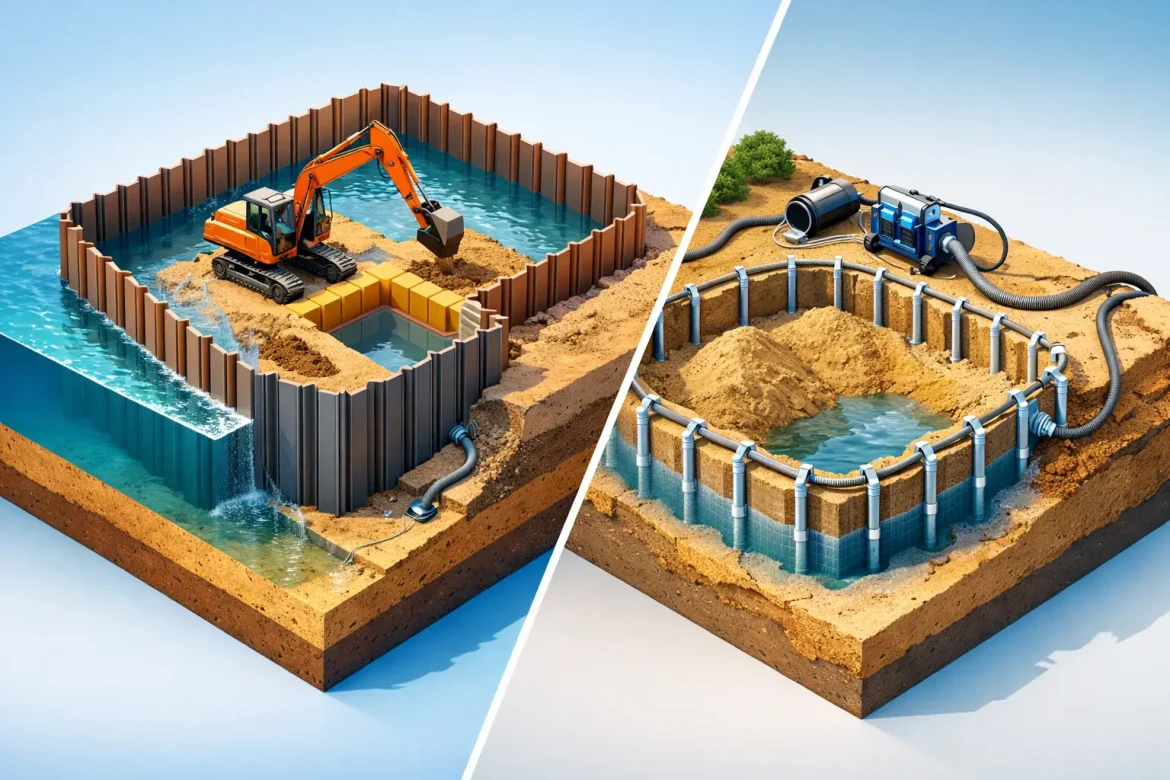
A trench can appear dry at the start of a shift and still become an unstable, high-risk work area after groundwater migrates through the formation overnight. That is why the choice between cofferdams versus wellpoint systems should not be treated as a simple equipment decision. It is a ground-control decision that affects excavation stability, access, environmental management, programme certainty and cost.
For civil, construction and mining projects, both methods can play a critical role in managing water. They solve different problems, however, and the best outcome is often a planned combination rather than a choice of one system over the other.
What each system is designed to do
A cofferdam is a temporary structure used to exclude surface water or groundwater from a defined work area. Depending on the site and scope, it may use sheet piles, driven piles, cellular structures, earth bunds, grout cut-offs or other retaining arrangements. Cofferdams are commonly selected where works must proceed below a watercourse, beside a marine frontage, within a wet excavation or where a physical barrier is needed to retain surrounding ground and water.
The key function of a cofferdam is containment. It creates a protected area in which excavation, foundation works, repairs or construction can take place. It may reduce water inflow significantly, but it does not always make an excavation dry on its own. Seepage through the base, joints, permeable layers or defects in the wall may still require internal pumping or supplementary dewatering.
A wellpoint system lowers groundwater by drawing water through a series of closely spaced small-diameter wellpoints connected to a header main and vacuum-assisted pump. It is particularly effective in sands, sandy gravels and other permeable soils where lowering the water table will improve working conditions and reduce pore-water pressure around an excavation.
Rather than physically stopping water at a boundary, wellpoints change groundwater conditions around and beneath the excavation. When correctly designed, they can provide a dry, stable formation for shallow to medium-depth excavations, service trenches, basements, pits and foundation works.
Cofferdams versus wellpoint systems: the practical difference
The central distinction is straightforward. A cofferdam controls where water can enter. A wellpoint system controls the groundwater level and pressure within the soil mass.
That difference matters when assessing excavation behaviour. If a project is exposed to tidal water, river flows, stormwater or visible external water pressure, a cofferdam may be essential for isolating the work zone. In contrast, if water is rising through a permeable formation beneath an otherwise open excavation, wellpoint dewatering may provide the more efficient solution.
A cofferdam can also offer structural benefits. Sheet-piled cofferdams, for example, may act as a retaining system where excavation support is required. This can be valuable on constrained sites with nearby assets, active roads, rail corridors or existing structures. The trade-off is that installation can involve specialist plant, noise, vibration, access constraints and a higher upfront construction effort.
Wellpoints generally mobilise more quickly and can be adjusted as excavation progresses. They are often a cost-effective option for linear infrastructure works and broad shallow excavations, particularly where the formation responds well to vacuum dewatering. Their limitation is geological. In low-permeability clays and silts, groundwater moves too slowly for conventional wellpoints to produce the required drawdown. In very coarse gravels, high inflows may exceed the practical capacity of a standard system.
Ground conditions decide the outcome
No dewatering methodology should be selected solely from a site plan or a historical bore log. Groundwater levels can vary seasonally, and Perth, regional Western Australia and Queensland sites can present highly variable formations over short distances. A sand layer may sit above clay, fractured rock may feed an excavation unexpectedly, or a perched water table may behave differently from the broader groundwater system.
Wellpoint design depends on several connected factors: soil permeability, excavation depth, target drawdown, expected inflow, wellpoint spacing, pump capacity and discharge arrangements. A system that is undersized or installed at unsuitable spacing may leave wet areas in the excavation, create soft spots at formation level and force reactive pumping that delays the programme.
Cofferdam selection also depends on the ground profile. A cut-off wall must extend far enough into a low-permeability layer, or otherwise provide sufficient seepage control, to be effective. If water can travel beneath the cofferdam, the excavation may still experience uplift pressure, piping or base heave. In these cases, internal dewatering or pressure-relief measures may still be required.
This is why a site investigation should inform the water-control plan before mobilisation. Understanding the geology is not a paperwork exercise. It determines whether the selected system can deliver stable excavation conditions without creating new risks beyond the work boundary.
When a cofferdam is the stronger option
Cofferdams are generally favoured where the project requires a defined physical barrier against surface water or substantial external inflows. Bridge pier construction, marine works, culvert replacements, pump station works and repairs within channels are common examples.
They are also useful where containment is as important as dewatering. A properly designed structure can help isolate turbid water, manage sediment and provide a controlled area for treatment before discharge. On environmentally sensitive sites, this containment role can be as valuable as the dry work area it creates.
The limitations need to be recognised early. Constructing a cofferdam may require design verification, pile-driving methodology, temporary works controls, access planning and monitoring of adjacent ground movement. Where vibration-sensitive structures are nearby, alternative installation techniques or a different water-control approach may be needed. A cofferdam is a major temporary works element, not simply a barrier placed around a hole.
When wellpoint dewatering is the better fit
Wellpoint systems are often the practical choice for excavations in permeable ground where the principal issue is groundwater rather than open-water intrusion. They are widely used for pipe trenches, valve pits, lift stations, foundations and shallow basement excavations.
Their value lies in improving conditions before the excavation reaches final depth. By lowering the water table around the work area, wellpoints can reduce seepage, improve access for plant and personnel, and help maintain bearing conditions at the base of the excavation. This is preferable to relying on sump pumps after water has already entered the excavation, particularly where pumping from the bottom could disturb fine material or contribute to instability.
Wellpoints require disciplined installation and operation. Header lines must be maintained, pumps need reliable power and standby capacity, and drawdown should be monitored rather than assumed. If the system stops during a critical stage of excavation, groundwater can recover quickly. A dewatering contractor should plan for duty and standby pumping, alarm response, fuel or power continuity, and after-hours checks suited to the project risk.
The combined approach is often the safest answer
On complex sites, cofferdams and wellpoints are not competing methods. They are complementary controls.
A cofferdam can limit direct external inflow and retain the excavation perimeter, while wellpoints lower groundwater pressure behind or inside the structure. This combination is particularly relevant where a deep excavation sits near a watercourse, where permeable soils allow underseepage, or where the formation must remain stable throughout staged construction.
Using both systems may increase initial planning and mobilisation requirements, but it can reduce the risk of recurring flooding, sediment release, uncontrolled drawdown or programme interruptions. The decision should be based on total project risk and whole-of-scope cost, not only the hire rate of the pump or the cost of temporary piling.
Safety, discharge and project controls
Neither system removes the need for active excavation management. Dewatering can alter ground conditions outside the excavation, potentially causing settlement near services, pavements or neighbouring structures. Excessive drawdown can also affect nearby bores, wetlands or contaminated groundwater pathways.
Discharge water must be assessed before it is released, reused or sent to an approved disposal point. Turbidity, pH, hydrocarbons, metals, salinity and acid sulfate soil risks may all influence the required treatment train. Sedimentation tanks, filtration, pH correction, oil-water separation and monitoring may be necessary to meet project and environmental requirements.
The operational plan should also define inspection frequency, pump redundancy, rainfall response, emergency contacts, discharge monitoring and responsibilities between the principal contractor, temporary works designer and dewatering team. Good dewatering is measured by more than a dry excavation. It is measured by stable ground, safe access, controlled water quality and uninterrupted progress.
Make the decision before water controls the programme
The right approach begins with a clear understanding of the excavation, ground profile and surrounding environment. A cofferdam may be the right answer when physical exclusion and retention are required. A wellpoint system may be the more efficient answer when groundwater drawdown in permeable soils is the primary objective. Where both risks exist, a combined system may provide the most dependable control.
For project teams, the useful question is not which system is better in general. It is which arrangement will keep this excavation stable, compliant and productive through every stage of the works. Engaging a specialist early gives the programme a far better chance of staying dry for the right reasons.