
A stable excavation can become unsafe quickly when groundwater rises, weather changes or plant loads build up at the edge. Knowing how to protect excavation walls means treating ground support, water control, access and daily inspection as one coordinated site system – not separate tasks handed between trades.
For civil, construction and mining projects, excavation wall failures rarely occur without warning. Softening at the toe, cracking near the crest, seepage through the face and loose spoil at the edge are all signs that need a response before crews enter or continue work. The right control depends on the depth of excavation, soil profile, groundwater conditions, nearby structures and the work being performed.
Start with the ground, not the excavation
Excavation protection should be considered during planning, before a machine breaks ground. A geotechnical assessment, service investigation and review of available groundwater data help establish what the ground is likely to do once it is opened up. On many Western Australian and Queensland sites, conditions can change substantially over a short distance. Sand, clay, weathered rock, fill and perched groundwater may all be present within the same work area.
The excavation design should account for the proposed depth, wall geometry, surcharge loads, adjacent assets, access points and the expected duration that the excavation will remain open. A shallow trench in competent material may be managed with battering and exclusion controls. A deeper excavation beside a road, building, crane pad or live service corridor may require engineered shoring and active groundwater management.
It is not enough to rely on how similar ground behaved elsewhere on site. Previous cuts are useful evidence, but they do not replace an assessment of the specific excavation and current conditions.
How to protect excavation walls from groundwater
Water is one of the most common causes of excavation instability. It increases pore pressure, reduces soil strength, erodes fine material and can create hydraulic uplift at the base of an excavation. Even a modest inflow can soften a wall or toe enough to trigger slumping, particularly in sandy or variable ground.
The objective is not simply to remove visible water from the bottom of the hole. Effective dewatering lowers or relieves groundwater pressure around the excavation so the soil can maintain its strength. The method must suit the formation and the required drawdown.
Match the dewatering method to site conditions
Well point systems are often effective for shallow to moderate excavations in permeable sands and gravels. They can lower groundwater across a broad area when installed, spaced and operated correctly. Deep wells may be more suitable where greater drawdown is required, where excavations are deeper, or where the groundwater source extends below the reach of well points.
Sump and open pumping can be appropriate where inflows are limited and the excavation material remains stable. However, pumping directly from a sump in loose or fine-grained soil can draw material towards the pump, undermine the base and worsen instability. Filter media, properly formed sumps and controlled pumping arrangements are essential where this risk exists.
Dewatering must also be monitored after installation. A system that worked during bulk excavation may not be adequate after rain, after a deeper cut, or when nearby works alter groundwater flow. Standpipes, piezometers, pump run-time data and regular visual checks provide practical evidence of whether the system is maintaining the required conditions.
Discharge management is part of wall protection as well. Water released too close to the excavation can recharge the ground, cause erosion or create boggy access conditions. Treatment, settlement and compliant discharge arrangements should be planned before pumping begins.
Select the right wall support approach
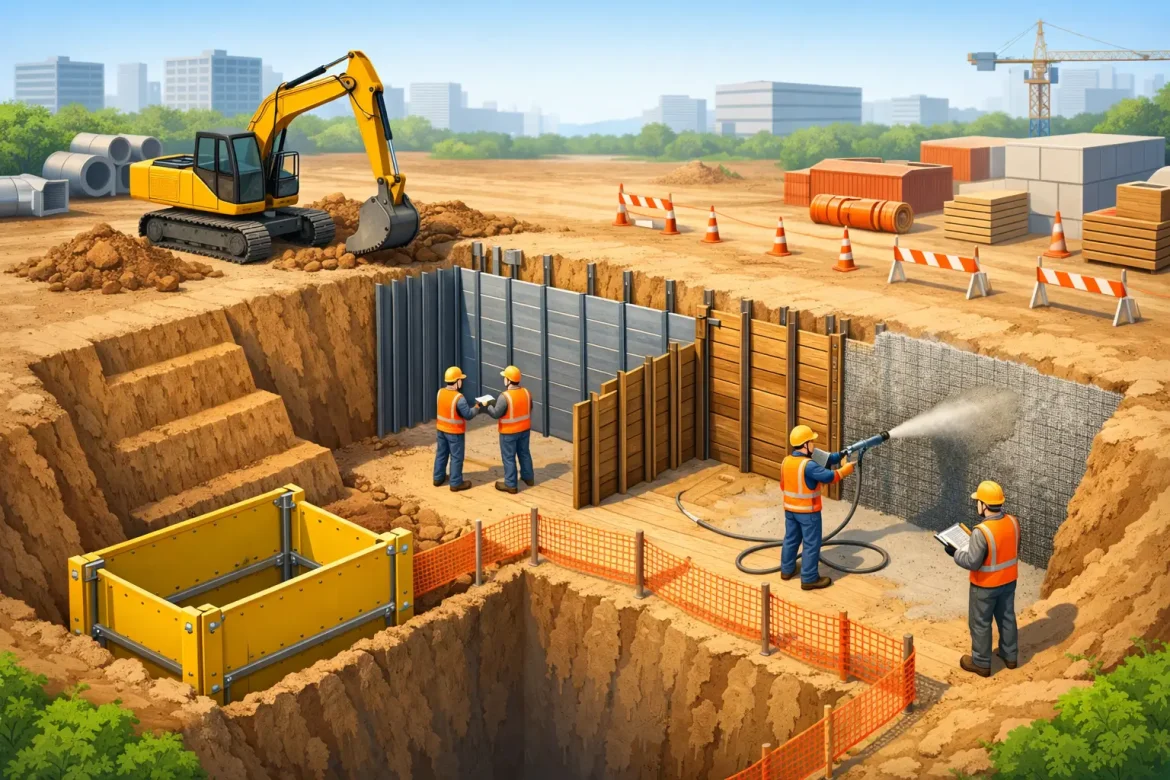
There are three broad ways to protect excavation walls: battering or benching the sides back, supporting the sides with a shield or shoring system, or using an engineered retaining solution. The right option is driven by ground conditions and available space, not convenience alone.
Battering reduces the angle of the excavation wall so material is less likely to fail. It can be efficient where there is sufficient room and soil conditions support the proposed slope. Its limitation is footprint. A battered excavation can consume valuable space, affect haul routes and encroach on adjacent work zones.
Benching creates horizontal steps in the excavation face, reducing the height of each unsupported section. It can provide an additional measure of control in suitable material, but benches must be kept clear of water, loose spoil and unnecessary traffic. Benching is not a substitute for engineering where the ground is weak or loads are close to the crest.
Shields, trench boxes and shoring systems can protect workers where open slopes are impractical. A shield does not necessarily prevent a wall collapse. Rather, it provides a protected working zone when correctly selected and used. Shoring is designed to actively support the excavation walls, and may include hydraulic, timber, steel or proprietary systems.
For excavations near existing structures, services or public infrastructure, more substantial engineered solutions may be required. Sheet piles, soldier piles, lagging, secant piles or other retaining systems may control movement where an open cut is not acceptable. These systems require competent design, installation control and verification against the actual site conditions.
Control loads at the excavation edge
A stable wall can fail when weight is added too close to the crest. Spoil piles, excavators, trucks, materials, concrete pumps and temporary site facilities all create surcharge loads that increase stress through the ground. Vibration from plant and traffic can add further risk, particularly in loose material or saturated soils.
Setback distances for spoil and plant should be established in the excavation plan and maintained in the field. The required distance depends on soil type, excavation depth, plant weight and the support system in use. A general rule of keeping material clear of the edge is not a design solution when heavy plant or deep excavations are involved.
Site teams should also look beyond the obvious load. Nearby roads, stockpiles, cranes, buildings and buried services can influence wall performance. If conditions change, such as a revised haul route or a new crane position, reassess the excavation before allowing the change to proceed.
Make inspection a working control
Excavation inspections are most useful when they lead to clear action. A competent person should inspect the excavation before workers enter, at the start of each shift, after rain or a significant weather event, following a change in groundwater conditions, and after any event that could affect stability.
The inspection should consider the full excavation, including the crest, face, toe, access routes, support systems and water-control equipment. Warning signs can include fresh cracks behind the edge, bulging or sloughing walls, new seepage paths, muddy water, exposed services, settlement near the excavation or movement in shoring members.
If there is any doubt about wall stability, stop entry and isolate the area until the condition has been assessed. Continuing work while waiting to see whether a crack grows is not a reasonable control. The cost of a short delay is minor compared with a wall collapse, injury, damaged infrastructure or a prolonged recovery program.
Protect people as well as the walls
Wall stability is only one part of safe excavation work. Safe access and egress must be available, and personnel need to know where they can enter, work and exit without crossing unsupported areas. Ladders, ramps and walkways should be positioned so workers are not forced to travel beneath unstable faces or around operating plant.
Exclusion zones, barricades and clear communication are equally important. Operators need defined limits for plant movement. Supervisors need to know when dewatering alarms, pump failures or rising water levels require an immediate response. Workers should be empowered to report changed ground conditions without pressure to keep production moving.
The excavation plan should be reviewed whenever the scope changes. A trench that was safe for pipe installation may require different controls once workers begin jointing, testing, backfilling or working near a connection pit. Conditions evolve as the job evolves.
Plan for change before it arrives
The most reliable excavation controls are those that allow for wet weather, variable soils and operational changes before they become site problems. Establish trigger levels for groundwater, rainfall and visible wall movement. Confirm who can stop work, who can adjust pumping, and when engineering advice is required.
For complex or water-affected excavations, early involvement of experienced dewatering and ground-control specialists can reduce rework and protect the programme. The aim is straightforward: maintain stable ground, keep people out of harm’s way and give the project team confidence that the excavation will remain workable through the next stage of construction.