
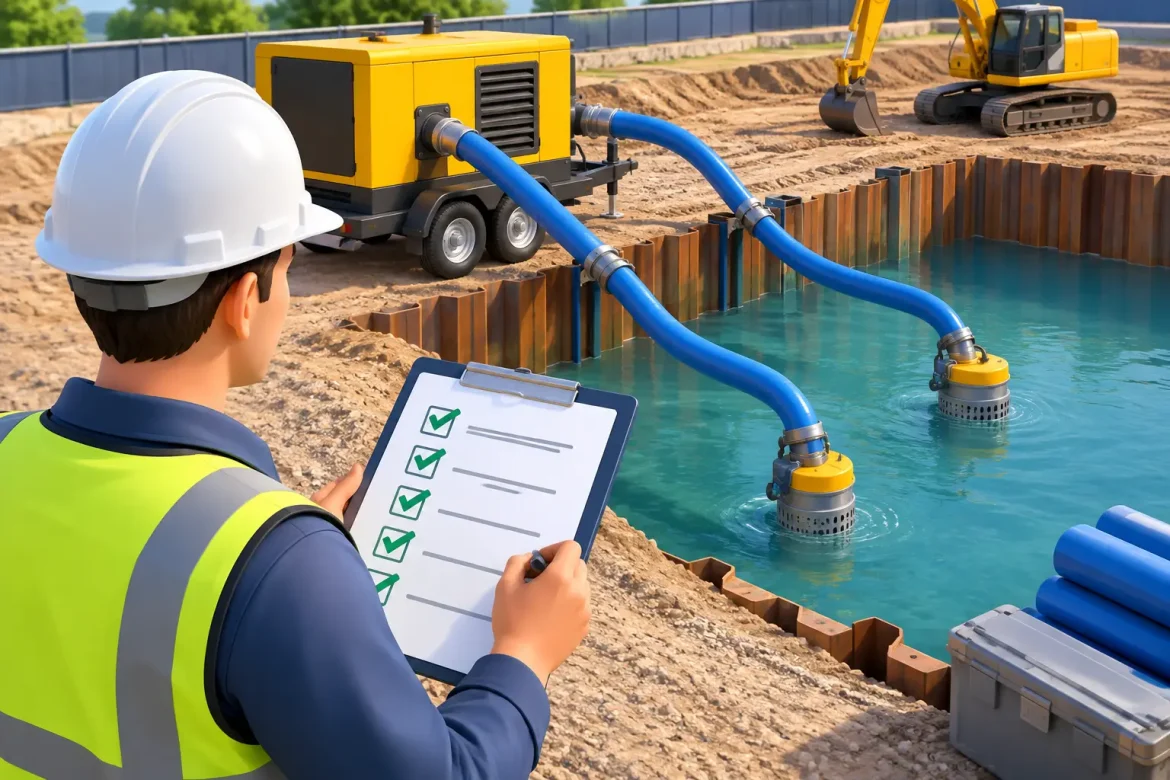
A dewatering scope can look straightforward on a programme, then become the source of excavation delays, unstable batters, contaminated discharge or escalating hire costs. A contractor dewatering capability checklist gives project teams a practical way to assess whether a proposed contractor can control groundwater reliably from mobilisation through to shutdown – not simply supply pumps once water becomes a problem.
For civil, construction and mining works, the right contractor protects more than a dry excavation. They help maintain safe access, support ground stability, manage discharge obligations and keep critical-path activities moving. Capability should therefore be tested against the actual site conditions and project risks, rather than judged by pump size or quoted rate alone.
Start with the ground and water model
A capable contractor will want to understand the hydrogeology before committing to a system. That means reviewing available bore logs, geotechnical reports, groundwater levels, soil profiles, permeability, nearby watercourses and the proposed excavation sequence. On complex sites, they should identify information gaps and recommend investigation, monitoring or trial pumping where it will reduce uncertainty.
Ask how the contractor distinguishes between perched water, shallow seepage, confined aquifers and recharge from rainfall or adjacent services. Each condition can require a different response. Wellpoint systems may suit shallow, permeable sands where drawdown is required across a broad excavation. Deep wells may be more appropriate for deeper groundwater control, while sump pumping can be effective for local surface inflows but is not a substitute for proper groundwater management in unstable ground.
The lowest-cost installation is not always the lowest-cost outcome. An undersized or poorly matched system can lead to repeated changes, lost production and ground movement. Conversely, an engineered system may involve higher upfront mobilisation but provide more dependable drawdown and fewer disruptions to follow-on trades.
Contractor dewatering capability checklist
Use the following checks during procurement, pre-start reviews and scope clarification meetings. The answers should be specific to the proposed works, not a generic statement of capability.
1. Relevant site experience
Confirm the contractor has delivered comparable dewatering scopes in similar geology, excavation depth and operating conditions. Experience in Western Australian sands, clays, fractured rock or saline groundwater can materially affect system design and operating methods. The same applies in Queensland, where seasonal rainfall, variable soils and environmental conditions may shape the solution.
Request practical examples of how the contractor dealt with changing inflows, poor bore yields, silty water, pump failures or access constraints. Strong contractors can explain what changed, how they responded and how they protected the programme.
2. System design and engineering discipline
The contractor should provide a clear basis for the proposed design. This includes expected inflow, target drawdown, well or wellpoint spacing, pump duty, pipework layout, standby capacity, discharge arrangements and monitoring locations. A design does not need unnecessary complexity, but it must show that the system is suited to the excavation and construction sequence.
Check whether there is sufficient redundancy for critical works. A single pump without duty-standby provision may be acceptable for minor, low-risk surface water control. It is rarely acceptable where a pump outage could flood an excavation, halt a pour or compromise stability. Clarify response times, spare-parts availability and who is accountable for after-hours alarms.
3. Equipment condition and mobilisation readiness
Ask what equipment will be allocated to the project, its condition, maintenance status and availability date. The contractor should be able to confirm pump capacities, generator requirements, fuel arrangements, hoses, headers, settlement tanks, filtration equipment and telemetry systems where required.
Mobilisation planning matters as much as equipment ownership. A workable plan addresses delivery access, installation sequence, electrical or diesel power, exclusion zones, noise, refuelling, pipe crossings and protection of hoses from plant traffic. On a tight site, a technically sound design can still fail if it obstructs haul routes or cannot be safely serviced.
4. Safety systems that work in the field
Dewatering introduces hazards that need active control: open excavations, electrical leads, pressurised lines, lifting activities, confined spaces, fuel, slips and interactions with mobile plant. Review the contractor’s task-specific risk assessment, safe work methods, isolation procedures and supervision arrangements.
Importantly, check how these documents translate to site practice. Who completes daily inspections? How are alarms escalated? What is the procedure when pumps need servicing beside an open excavation or during wet weather? A capable contractor will have clear answers, trained personnel and a record of disciplined housekeeping.
5. Water quality, treatment and discharge controls
Removing water is only half the scope. The other half is managing where it goes and in what condition. Groundwater and construction water may contain sediment, hydrocarbons, elevated salinity, acidity, metals or other contaminants. Discharging without suitable controls can create environmental exposure and costly rectification work.
The contractor should identify likely water-quality risks, nominate proposed treatment methods and define the discharge pathway. Depending on the water and approvals, this may involve settlement, filtration, oil-water separation, pH correction, flocculation, reuse on site, licensed disposal or controlled discharge under an agreed management plan.
Ask how water quality will be tested, who reviews results and what happens if limits are exceeded. Treatment capacity must also match peak flows, not merely average operating conditions. A small treatment unit can become a bottleneck during rainfall, unexpected aquifer recharge or major excavation stages.
6. Environmental and approval awareness
A dependable dewatering contractor understands that environmental compliance is site-specific. They should work with the principal contractor’s approvals, erosion and sediment controls, groundwater obligations and incident-reporting processes. They should not assume that a discharge point is approved simply because it is nearby.
Check for controls around sediment migration, erosion at outlets, noise, fuel storage, waste handling and prevention of uncontrolled releases. Where dewatering could affect nearby structures, services, vegetation, waterways or other bores, monitoring and trigger levels may be needed. The right approach depends on the risk profile, but the issue should be identified before installation begins.
7. Monitoring, reporting and communication
Project teams need timely information, not just reassurance that pumps are running. Confirm what will be monitored: groundwater levels, flow rates, pump status, fuel levels, water quality and rainfall can all be relevant. For higher-risk excavations, remote telemetry and alarm notification may provide meaningful protection against overnight failures.
Agree on reporting frequency and escalation paths. Daily records can support site decisions and demonstrate control, while weekly trend reporting may help identify declining performance before it affects the works. Reports should be concise, accurate and useful to the site manager, engineer and environmental team.
8. Commercial clarity and lifecycle cost
A quote should make clear what is included in mobilisation, installation, operation, monitoring, maintenance, treatment, fuel, consumables, standby equipment and demobilisation. Ambiguity around testing, disposal, power supply or wet-weather attendance is a common source of variations.
Compare proposals on expected project cost and risk, not just the initial weekly rate. A lower hire price can be outweighed by excessive fuel use, frequent call-outs, inadequate treatment or delays caused by poor drawdown. Equally, avoid paying for oversized plant where the contractor cannot demonstrate why it is needed.
Test the contractor’s response plan
Before award, present a realistic failure scenario. For example, ask what happens if groundwater rises overnight before a major concrete pour, a pump trips during a storm, or discharge water exceeds the agreed quality criteria. The response should cover immediate containment, notification, backup equipment, troubleshooting and return to normal operation.
This discussion often reveals more than a capability brochure. Contractors with established field systems can describe roles, equipment and decision points without relying on vague assurances. They also know when conditions require redesign, additional investigation or a change to the construction sequence.
Make dewatering part of the construction plan
Dewatering performs best when it is integrated early with excavation, piling, services, concrete works, access and environmental management. Bringing a specialist in after water has already affected production limits available options and usually increases cost.
A capable dewatering partner should make the site easier to run: dry and accessible work areas, controlled water pathways, visible monitoring and rapid response when conditions change. That is the standard worth testing for before the first wellpoint is installed.