
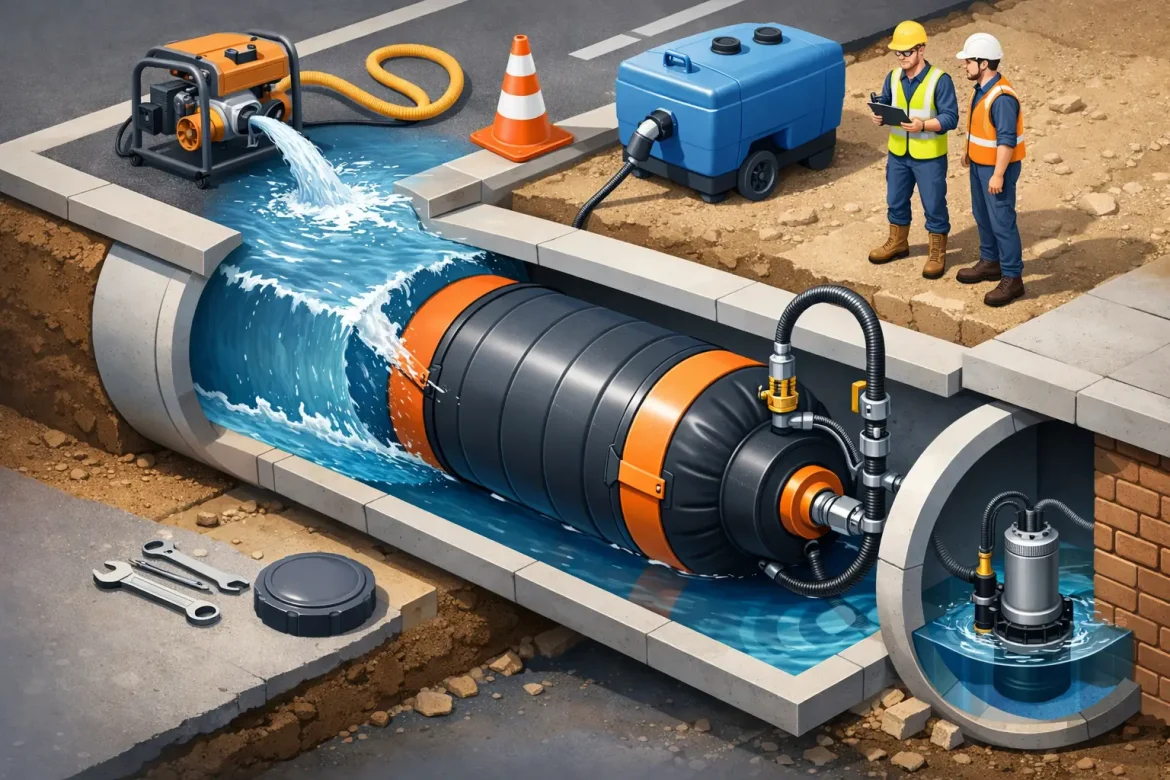
A pipeline does not need to be large to create a serious site risk. A poorly selected or inadequately restrained pipe plug can release stored water suddenly, interrupt critical works, damage assets and expose crews to hazardous conditions. For construction, mining and civil projects, pipe plugs are a practical isolation tool, but only when they are specified, installed and monitored for the conditions actually present on site.
At Dewatering Solutions, pipe isolation is treated as an operational control rather than a simple product hire. The plug, the pipe condition, the water head, the work sequence and the contingency plan must all work together. That approach protects people, keeps water where it needs to be and reduces avoidable delays.
What pipe plugs are designed to do
Pipe plugs temporarily seal a pipeline, culvert, drainage line or other conduit. They are commonly used to isolate a section for inspection, repair, maintenance, pressure testing, flow diversion or controlled dewatering. Depending on the application, the plug may be mechanical, inflatable, bypass-capable or purpose-designed for a particular pipe profile.
The objective is straightforward: create a dependable barrier while work is completed downstream or upstream. The operating conditions are rarely straightforward. Pipe materials vary, internal surfaces may be worn or contaminated, and the line may contain static head, changing flows or unknown connections. A plug that appears suitable based on nominal diameter alone may not be suitable once those factors are considered.
For temporary water management, isolation often supports a wider system. A plug may allow a sump to be pumped down, a damaged line to be repaired, a tank to be cleaned or a diversion arrangement to be brought online. Its performance can directly affect excavation stability, programme continuity and environmental controls.
Selecting the right pipe plug
Correct selection begins with the pipe, not the plug catalogue. Confirm the actual internal diameter, material, ovality, pipe condition and available insertion length. Older steel, concrete and earthenware lines can have irregular internal surfaces, while plastic pipe may require particular care to avoid deformation or damage.
Inflatable plugs are often useful where access is restricted or the pipe diameter varies within a specified range. They can provide a practical temporary seal and are available with bypass arrangements where controlled flow needs to continue through the isolation point. Mechanical plugs can be effective where a positive fixed seal is appropriate and the pipe condition supports it.
Neither type is automatically the better option. An inflatable plug may suit a confined access point, but it requires reliable inflation control and close attention to pressure limits. A mechanical plug can provide firm restraint in the right pipe, but installation tolerances and sealing surfaces remain critical. The required answer depends on the work scope and the consequences of a seal failure.
Pressure is the central consideration. Static water head can create substantial force against a plug, and pressure can rise quickly when pumps start, valves are operated or flows are restricted. Temporary systems should also allow for surge pressure, unexpected inflows and changes in water level. A plug must be rated for the expected duty, with an appropriate safety margin, rather than selected for an idealised condition.
Restraint is not optional
A pipe plug seals a line, but it also becomes a load-bearing component when pressure acts on it. The resulting force can be significant, particularly in larger diameter pipework or deeper systems. Relying on friction alone without confirming restraint can put personnel and infrastructure at risk.
A suitable restraint arrangement should account for plug capacity, anticipated differential pressure, the strength of the anchor point and the direction in which the plug could travel if it moves. Restraint systems need to be installed so they do not introduce pinch points, trip hazards or uncontrolled loads around the work area.
This is particularly relevant where crews are working in pits, manholes, trenches or other constrained locations. No person should be positioned in the potential line of travel of a plug or restraint system during pressurisation, testing or removal. Exclusion zones and controlled access are simple measures that can prevent a high-consequence incident.
Pipe plugs in dewatering and water-control works
On active project sites, pipe plugs are frequently used as part of a staged water-control plan. They can isolate existing drainage while a diversion is installed, separate sections of a dewatering discharge system, enable repairs without shutting down an entire network, or prevent backflow into an excavation.
The benefit is not simply stopping water. Effective isolation gives the project team control over where water moves, when it moves and how it is treated or discharged. That matters when excavation works are close to groundwater, when sediment controls are in place, or when discharge quality and volumes must be managed carefully.
For example, an excavation may need a section of stormwater line isolated before groundwater pumping begins. If the line remains open, water can migrate into an uncontrolled area or compromise a treatment process. Installing the correct plug, confirming restraint and monitoring the system allows pumping to proceed under known conditions.
In mining and industrial environments, isolation may also be needed before maintenance on process-water lines, sediment basins or temporary transfer systems. The site team must consider not only water pressure but also the nature of the fluid, potential contaminants, temperature and compatibility with plug materials.
Plan the installation before the crew arrives
The most reliable plug installations are planned as a work activity with defined controls, not handled as an afterthought once water is already causing a problem. Before installation, the responsible team should confirm the following:
- the pipe identification, line route and possible connections
- the expected pressure, water level and flow direction
- the plug type, size, rating and compatible inflation equipment where applicable
- the restraint method, anchor capacity and exclusion zone
- the pumping, bypass or emergency response arrangements if the seal does not hold.
This review should sit alongside the site’s permit, isolation and confined-space requirements where relevant. A manhole or pit may present atmospheric, access and rescue hazards independent of the pipe plug itself. The water-control task cannot be separated from the broader safety system.
Installation should follow the manufacturer’s instructions and the agreed work method. The pipe should be inspected as far as practical for debris, sharp edges, damaged joints or internal obstructions that could prevent a proper seal. For inflatable equipment, use calibrated pressure monitoring and avoid over-inflation. For all equipment, verify the plug position and restraint before introducing pressure to the line.
Monitoring protects the work programme
A plug installation should be checked throughout the period it is in service. Water level changes, pump cycling, rainfall and adjacent works can alter conditions after the initial setup. A system that holds during installation may behave differently after several hours of pumping or following a storm event.
Monitoring can include visual inspection for leakage, verification of pressure or inflation status, checks on restraint tension and review of upstream and downstream water levels. The frequency should reflect the risk. A low-pressure temporary isolation in a controlled area may require routine inspections, while a high-head plug near an active excavation or public interface needs tighter supervision and clear escalation arrangements.
Any sign of movement, leakage, unexplained pressure change or deterioration in the surrounding pipe condition should trigger a controlled response. The correct action may be to reduce pressure, stop pumping, isolate the area or install a secondary control. Continuing because the work is nearly complete is not an acceptable substitute for managing the risk.
Removal needs the same discipline as installation
Plug removal is often underestimated. Residual pressure, trapped water and an unexpected change in flow path can create a release when the seal is withdrawn. Before removal, confirm that the line has been depressurised, pumping is controlled and the receiving system can safely accept any remaining water.
Crews should maintain the exclusion zone until the plug is fully removed and the line is confirmed stable. If a bypass or temporary diversion has been operating, return the system to its intended configuration in a controlled sequence. Record the completed work, particularly where the isolation forms part of a larger dewatering or environmental management plan.
The best pipe plug solution is the one that gives the project team predictable control, not merely a temporary seal. When selection, restraint, monitoring and removal are handled with the same care as pumping and treatment, pipe isolation becomes a dependable part of safe, on-time water management.