
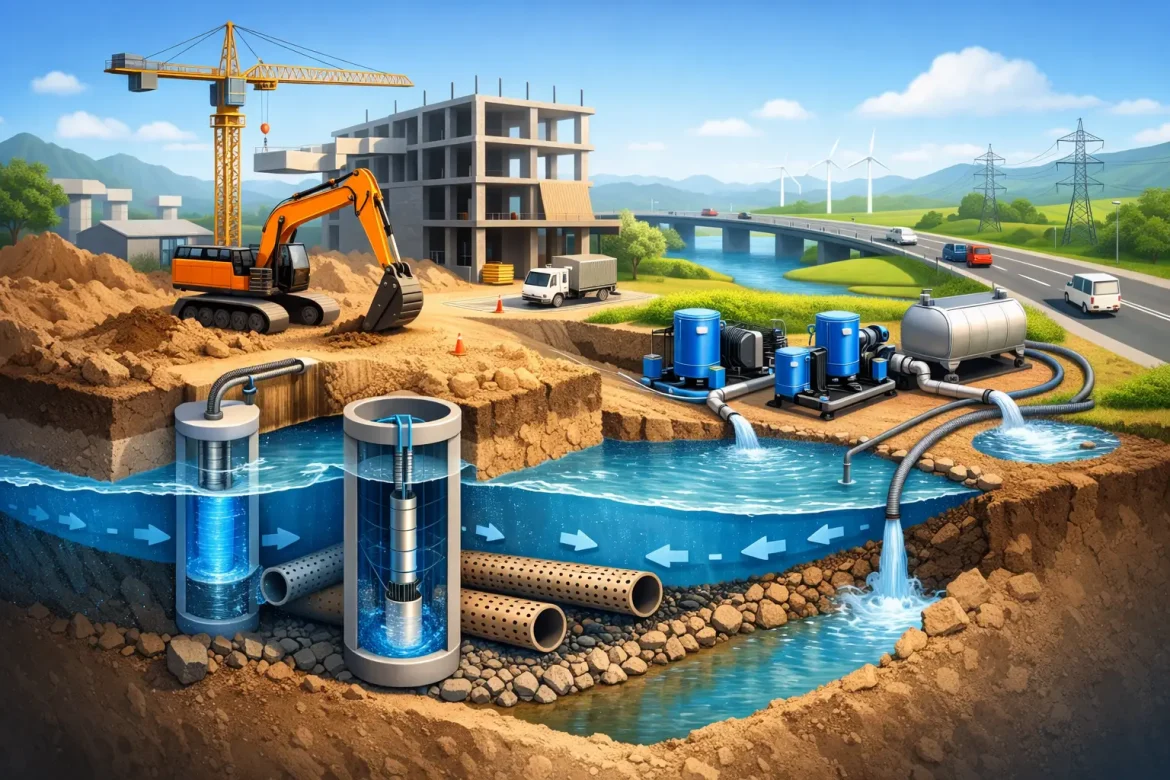
An excavation can look ready to pour one day and be carrying water the next. Seepage at the base, unstable batters, wet accessways and unexpected inflows can stop crews, compromise formation levels and put the programme under immediate pressure. Groundwater management is therefore not a secondary site activity. It is a planned control measure that protects the excavation, the workforce, neighbouring assets and the project budget.
For construction, civil infrastructure and mining works, the best outcome is rarely achieved by simply adding more pumps once water becomes visible. Reliable water control starts with understanding how groundwater will behave at the site, selecting a system suited to the ground conditions, and operating it with disciplined monitoring and maintenance.
Groundwater management starts before excavation
The most effective dewatering systems are designed before the first bulk excavation begins. This means reviewing available geotechnical and hydrogeological information, proposed excavation depths, construction staging and nearby receptors such as existing structures, services, waterways and bores.
The key question is not merely whether groundwater is present. It is how water is likely to enter the excavation, how quickly it can recharge, and what may happen when groundwater levels are lowered. A shallow sandy formation may respond well to a well point system, while a deeper excavation in more permeable strata may require deep wells with higher-capacity pumps. In low-permeability clay, groundwater may enter slowly, but perched water, rainfall and local seepage can still create difficult working conditions.
Site investigations should also consider groundwater quality. Water containing sediment, hydrocarbons, elevated salinity, acid-forming material or other contaminants may need treatment or controlled handling before discharge. Leaving this assessment until pumping is underway can create avoidable compliance issues and delays.
In Western Australia and Queensland, ground conditions can vary sharply across relatively short distances. Local experience matters because the same dewatering approach will not perform consistently across different soil profiles, aquifers and project environments.
Select the control method to suit the ground
A dewatering system must match the excavation geometry, permeability of the soils, inflow volume and required drawdown. Over-specifying a system can increase plant, energy and treatment costs. Under-specifying it risks saturated ground, interrupted works and repeated reactive changes on site.
Well point dewatering for shallow, permeable ground
Well point systems are commonly used for shallow excavations in sands and other permeable materials. A series of closely spaced well points is installed around the work area and connected to a header line and vacuum pump. The arrangement lowers groundwater around the excavation and can improve ground stability where it is correctly designed and maintained.
Well points are particularly useful where there is limited space, trenching is staged, or a broad shallow area requires consistent drawdown. Their performance depends on correct installation depth, spacing, vacuum integrity and discharge management. A small air leak or blocked point can reduce efficiency across the system.
Deep wells for larger drawdown requirements
Deep well dewatering is generally suited to deeper excavations and higher groundwater inflows. Submersible pumps installed in purpose-drilled wells lower the water table below the formation level, allowing excavation and foundation works to proceed in drier, more stable conditions.
Deep wells can provide significant drawdown, but they require careful design. Pumping rates, well spacing, screen selection and the likely radius of influence all need to be considered. Excessive drawdown may affect nearby ground conditions or structures, while insufficient drawdown may leave the excavation vulnerable to inflow.
Sump pumping has a place, but not as a default solution
Sump and open pumping can be effective for collecting local seepage, stormwater and minor inflows once water reaches a controlled low point. It is often straightforward to deploy and can be appropriate where groundwater inflow is limited or the excavation is in relatively stable material.
However, relying on sump pumping in granular soils can draw fines into the excavation, leading to erosion, softening beneath working platforms and instability around the sump. Where the aim is to reduce pore water pressure and stabilise the ground before excavation, a properly designed well point or deep well system is usually the more reliable option.
Discharge quality is part of the dewatering scope
Removing water from an excavation is only one part of the task. The water must also be managed responsibly once it leaves the pump. Discharging turbid water, contaminated water or water outside approved quality limits can expose a project to environmental harm, enforcement action and reputational damage.
A practical discharge plan considers the anticipated water quality, treatment requirements, discharge location, flow rates and monitoring obligations. Depending on the site, this may involve settlement tanks, sediment controls, filtration, oil-water separation, pH adjustment or other treatment processes. The right arrangement depends on the water and the approval conditions, not on a standard plant package.
Containment and routing also deserve attention. Hoses, pipelines and temporary drainage should be installed to avoid creating trip hazards, washouts, traffic conflicts or uncontrolled flows across the site. Pipe plugs and isolation measures may be required where existing drainage infrastructure needs to be protected during works.
Monitoring turns a pumping system into a control system
A dewatering installation should be measured by results at the excavation, not by whether pumps are running. Water levels, flow rates, turbidity, pump performance and excavation conditions provide the information needed to confirm that the system is achieving its purpose.
Monitoring frequencies should reflect project risk. A deep excavation near sensitive structures may require more frequent groundwater level checks and clear trigger levels for action. A remote or lower-risk work area may need a simpler regime, but it still requires routine inspection and documented checks.
Good records support more than compliance. They help the project team identify trends before they become failures. Increasing flows may indicate a new recharge path. Falling pump performance may point to blocked screens, worn equipment or air leaks. A rise in water level after rainfall may require changes to staging or additional standby capacity.
Remote alarms and telemetry can improve response times, particularly where pumping must continue outside normal working hours. They do not replace physical inspections. Hoses can be damaged, sumps can block and site conditions can change quickly. A competent operator still needs to verify the system in the field.
Build resilience into the operation
Dewatering is often critical-path work. If the system fails, excavation, steel fixing, formwork and concrete works may all be affected. For that reason, resilience should be planned rather than assumed.
This includes duty and standby pumps where the consequence of failure is high, suitable backup power, spare hoses and fittings, and a clear escalation process. Fuel management is equally important on diesel-powered systems. A pump that stops overnight because of a preventable fuel issue can cost far more than the fuel itself.
Maintenance needs to be scheduled around site operations, not treated as an interruption to them. Pumps, generators, filters, headers, electrical connections and treatment equipment all require inspection. Planned maintenance reduces the risk of a breakdown occurring at the point when the excavation is most exposed.
Safety controls must remain visible throughout. Temporary pipework, electrical leads, open sumps, confined spaces and wet surfaces create hazards that require practical controls, exclusion zones and regular housekeeping. Water control should make a site safer, not introduce a new set of unmanaged risks.
Manage groundwater as a project risk, not a hire item
The lowest daily plant rate is not always the lowest project cost. A system that is poorly matched to the site can consume more labour, delay trades, require emergency changes and increase environmental exposure. Conversely, a well-designed system may involve more planning upfront but reduce downtime and rework across the programme.
The strongest results come from integrating dewatering into the construction methodology. The groundwater control plan should align with excavation sequencing, access requirements, earthworks, foundation activities, discharge approvals and demobilisation. It should also allow for changing conditions as the works move deeper or across different materials.
Experienced groundwater management contractors bring value by connecting those operational details. Dewatering Solutions approaches water control as a site-performance task: keeping excavations workable, managing discharge responsibly and maintaining the reliability required for critical construction activities.
When groundwater is treated as a known project variable rather than an unexpected interruption, site teams can make clearer decisions early, protect the programme and keep the work moving with greater confidence.