
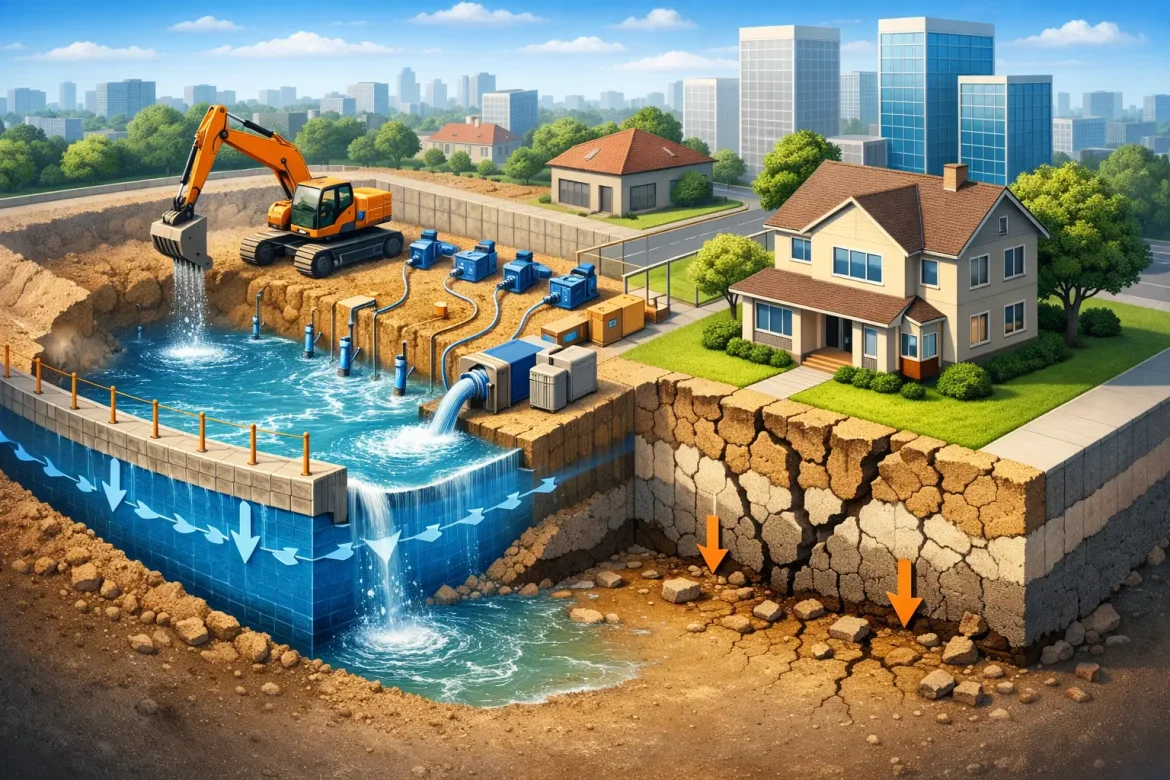
An excavation can look dry, stable and ready for work while conditions beyond the site boundary are changing. So, does dewatering affect nearby structures? It can. Lowering groundwater levels may alter pore water pressures in surrounding soils, which can lead to ground movement and, in some conditions, settlement affecting buildings, services, pavements, retaining walls or adjacent excavations.
That outcome is not inevitable. A properly designed and managed dewatering system can control groundwater while protecting neighbouring assets. The difference lies in understanding local ground conditions, limiting the area and depth of drawdown, monitoring the response, and acting early when results move outside agreed limits.
How dewatering can affect nearby structures
Groundwater within soil helps support the ground through pore water pressure. When water is removed, the effective stress carried by the soil skeleton increases. In dense sands, gravels and competent rock, this change may produce little or no measurable movement. In compressible clays, loose sands, uncontrolled fill or layered soils, the same groundwater reduction can cause consolidation, densification or settlement.
The risk is not confined to the excavation itself. A cone of drawdown can extend beyond the work area, depending on the aquifer, pumping rate, well spacing, soil permeability and duration of pumping. If that zone reaches beneath a neighbouring footing, slab, road, buried utility or rail formation, even small differential movements can become significant.
Differential settlement is often more damaging than uniform settlement. A structure that moves evenly by a small amount may remain serviceable. A building where one corner moves more than another can develop cracking, distorted doors and windows, pipe damage or changes to drainage falls. Underground services may be particularly vulnerable where they cross from stable native material into fill or where joints have limited flexibility.
Dewatering can also affect structures indirectly. High pumping rates can cause local erosion or migration of fine material if filters and well screens are not suited to the ground. In some situations, groundwater reduction may expose acid sulfate soils, alter groundwater-dependent vegetation, or change the pressure balance around an existing retaining system. These are design and environmental issues, not simply pumping issues.
Does dewatering affect nearby structures in every project?
No. The level of risk depends on the site, the proposed works and the assets nearby. A short-duration sump pumping arrangement in shallow, free-draining sand may have a limited influence beyond the excavation. A deep basement excavation, sewer trench, mine infrastructure installation or major civil structure requiring prolonged groundwater drawdown needs a more detailed assessment.
Several conditions deserve close attention. These include soft or compressible deposits, uncontrolled fill, reclaimed land, shallow or lightly founded buildings, heritage structures, ageing brickwork, high-value process infrastructure and sensitive buried services. The risk also increases when a project requires a substantial reduction in water level, when pumping will continue for weeks or months, or when existing groundwater conditions are poorly understood.
Local knowledge matters. Ground conditions can change sharply across a site, particularly in coastal areas, riverine deposits, weathered profiles and mixed urban fill. In Western Australia and Queensland, a dewatering approach that performs well on one project should not be assumed suitable for another without reviewing the hydrogeology and nearby receptors.
Start with a dewatering impact assessment
The most reliable way to protect nearby structures is to address the issue before pumps are installed. The assessment should establish the excavation depth, target groundwater level, anticipated pumping duration and likely drawdown extent. It should also identify what sits within and near that potential zone of influence.
A practical assessment combines available geotechnical and groundwater information with site investigation results. Bore logs, groundwater observations, pumping test data and nearby construction records can help define the soil profile and aquifer behaviour. Where the consequences of movement are high, groundwater modelling may be appropriate to test pumping scenarios and identify suitable control measures.
The assessment should identify nearby assets early, including buildings, roads, footings, retaining walls, stormwater and sewer lines, water mains, electrical conduits and existing underground structures. It is equally important to understand their condition before work begins. A condition survey, photographs and crack monitoring records create a clear baseline and reduce uncertainty if changes are observed later.
Design controls that reduce ground movement
The preferred control is usually to minimise drawdown rather than manage its effects after the fact. That may mean using a well point system, deep wells, sumps or staged pumping only where each method suits the ground and excavation geometry. The system should be designed to achieve the required water level without extracting more water than necessary.
For sensitive sites, isolation can be more effective than broad groundwater lowering. Cut-off walls, sheet piles, secant piles, slurry walls or grouted barriers may reduce groundwater inflow and limit the drawdown transmitted outside the excavation. These measures have cost and constructability implications, but they can be justified where neighbouring structures are sensitive or project delays would be costly.
Recharge wells can also be considered in suitable hydrogeological conditions. They return water to the ground outside the excavation to help maintain groundwater levels near vulnerable assets. Recharge is not a universal solution. Water quality, clogging potential, aquifer response, available space and approval requirements all need to be addressed before it is adopted.
A staged approach is often valuable. Pumping can begin at a controlled rate while groundwater levels and ground movement are observed. The system can then be adjusted before full drawdown is reached. This gives the project team real site data rather than relying solely on predictions.
Monitoring turns assumptions into site control
Monitoring is the operational safeguard that allows a dewatering plan to respond to actual ground behaviour. It should begin before dewatering, continue through the works and, where required, extend into the recovery period after pumping stops.
Typical monitoring may include piezometers to measure groundwater levels, settlement pins or survey points to detect vertical movement, inclinometers where lateral ground movement is a concern, and crack gauges on sensitive structures. Flow meters and discharge quality monitoring are also useful for confirming that the system is operating as designed and meeting environmental requirements.
The monitoring plan needs clear trigger levels and a documented response process. Data without action thresholds does not control risk. For example, an alert level may require increased reading frequency and engineering review, while an action level may require pumping to be reduced, paused or reconfigured. The appropriate triggers must be project-specific, based on asset sensitivity, expected movement and advice from the relevant engineering disciplines.
Regular communication is equally practical. Site supervisors, engineers, principal contractors and affected stakeholders should understand what is being monitored, who reviews the results and what happens if a trigger is reached. This avoids delays when a decision is needed during an active excavation.
Common errors that create avoidable risk
The most frequent issue is treating dewatering as a temporary service rather than a ground-control activity. Installing pumps after water has already delayed excavation can force a reactive approach, with limited time to investigate soil conditions or establish baseline monitoring.
Over-pumping is another avoidable problem. A system may be capable of drawing down water quickly, but maximum pumping is not always the safest or most economical operating point. Excess drawdown can enlarge the zone of influence, increase energy and treatment costs, and create unnecessary risk for nearby assets.
Poor filtration and inappropriate well construction can allow fines to enter the system. This can lead to sand production, loss of ground and reduced system performance. Likewise, relying on occasional visual inspections rather than measured groundwater and movement data can allow early warning signs to be missed.
Finally, stopping dewatering needs planning as well. Groundwater recovery can affect excavation stability, uplift pressures and temporary works. The shutdown sequence should be managed with the same discipline applied to initial drawdown.
A dewatering plan should protect more than the excavation
The right dewatering strategy keeps work areas dry, but its value is broader: it protects programme certainty, workforce safety, adjacent assets and project cost. On complex civil, construction and mining sites, that means integrating groundwater control with geotechnical design, structural considerations, environmental obligations and day-to-day site operations.
Before the first well is drilled or pump is started, make sure the proposed system has a defined area of influence, baseline asset information, suitable monitoring and authority to respond to changing conditions. That preparation gives the project team the confidence to keep excavation moving without transferring risk to the structures next door.