
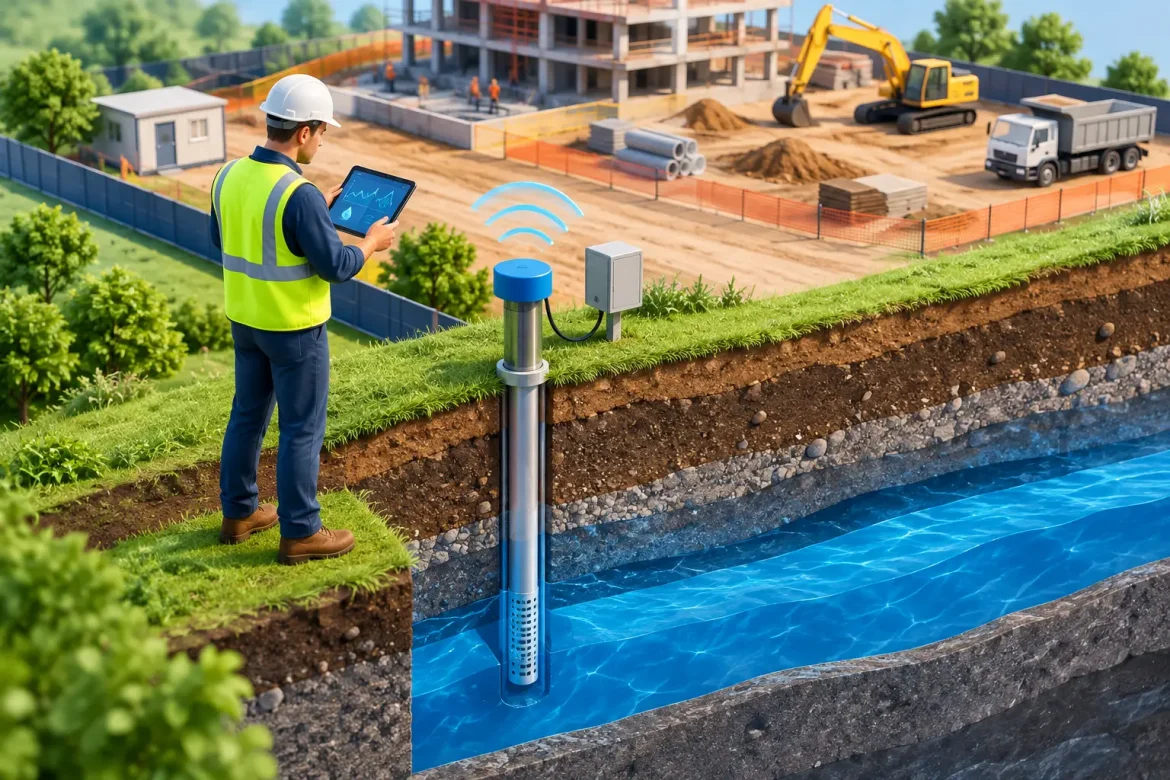
A dewatering system can keep an excavation dry today and still leave a project exposed tomorrow. Groundwater monitoring provides the evidence site teams need to see changing water conditions early, verify whether controls are working and make decisions before instability, discharge issues or programme delays develop.
For construction, mining and civil works, water below ground is rarely static. Rainfall, tides, nearby pumping, changing excavation depths and variable geology can all affect groundwater levels and pressures. A monitoring programme turns those variables into usable site information, rather than relying on a visual inspection when conditions have already deteriorated.
Why groundwater monitoring matters on active sites
The immediate purpose of monitoring is straightforward: understand where groundwater is, how it is behaving and whether it may affect the works. The practical value is much broader. Reliable data supports excavation stability, protects surrounding assets, helps manage discharge obligations and provides a defensible record of site conditions.
On a deep excavation, rising groundwater can increase pore pressure beneath a formation level. That may reduce effective ground strength, contribute to base heave or make working areas difficult to maintain. In a trench or service corridor, localised seepage can soften the formation, undermine bedding and create slip hazards. On mining and infrastructure projects, uncontrolled water can interrupt production, damage access and place pressure on critical construction milestones.
Monitoring allows the project team to distinguish between a one-off change and a developing trend. A single water-level reading may not be significant. Consistent readings over time can show recharge after rainfall, drawdown achieved by a pumping system, or recovery when equipment is shut down. That distinction matters when deciding whether to adjust the dewatering approach, pause excavation or investigate an unexpected source of inflow.
What a groundwater monitoring programme should measure
The programme should be designed around the project risks, not treated as a standard checklist. Water level is commonly the starting point, measured through standpipes, piezometers or purpose-built monitoring wells. The location, screened interval and frequency of readings must suit the ground model and excavation sequence.
Where pressure is a concern, piezometric monitoring is particularly valuable. It can identify conditions at depth that are not visible from the surface or reflected in a shallow sump. This is relevant where clay layers, confined aquifers or variable sand horizons influence stability beneath an excavation.
Water quality may also need attention. Depending on approvals, discharge arrangements and site history, monitoring can include pH, electrical conductivity, turbidity, hydrocarbons, metals or other parameters identified in the project environmental requirements. Water that appears clear is not automatically suitable for discharge, reuse or disposal. Sampling and field measurements should follow an agreed methodology so results can be compared confidently over time.
Flow rate is another useful operational measure. Tracking pumping volumes, discharge rates and pump run times helps assess whether the installed system is keeping pace with inflow. It can also reveal a blocked screen, falling pump performance, a burst line or an unexpected connection to a water-bearing zone.
Set monitoring points before the excavation drives the decision
A common mistake is installing monitoring points only after water has become a problem. By then, the project may have lost its baseline and be responding under pressure. Baseline monitoring before major excavation, piling or dewatering begins establishes the normal range of groundwater levels and quality conditions.
The number and position of monitoring points depends on the site. A relatively shallow, isolated excavation in uniform ground may require a modest arrangement. A major basement, rail corridor, mine infrastructure project or excavation near sensitive assets can require monitoring within the work area, around its perimeter and between the works and surrounding receptors.
Potential receptors may include adjacent buildings, roads, buried services, wetlands, waterways, bores and other groundwater users. In Western Australia and Queensland, conditions can vary substantially over short distances. Local ground knowledge matters when selecting screen depths and interpreting results, particularly where coastal sands, fractured rock, alluvial materials or layered formations are present.
Monitoring points must also be protected and accessible. A well that is damaged by plant movements, buried during earthworks or placed where readings cannot be taken safely will not support the programme. Their installation should be coordinated with traffic management, service locations, excavation staging and site access from the outset.
Frequency should match the risk
Reading frequency is not simply a compliance exercise. It should increase when conditions are changing quickly, such as during initial drawdown, after significant rainfall, as an excavation reaches a deeper stage or when pumping arrangements are altered. Automated loggers can provide high-frequency records where rapid changes are expected or access is restricted.
Manual readings remain valuable, particularly when they are taken by experienced personnel who can assess the condition of the bore, pump system and surrounding area at the same time. The best approach is often a combination of automated data for trends and scheduled site checks for verification.
Turning readings into site decisions
Data has limited value if no one is responsible for reviewing it and acting on it. Before work begins, the monitoring plan should identify trigger levels, reporting responsibilities, escalation pathways and response actions. These controls should be aligned with the dewatering design, geotechnical advice, environmental approvals and the principal contractor’s site management plan.
A trigger level is not necessarily a stop-work point. It may prompt an inspection, additional readings, a pump adjustment or a review by the geotechnical team. Higher-level triggers may require reduced excavation activity, increased pumping capacity, treatment changes or formal notification under the relevant approval conditions.
Clear triggers remove uncertainty during busy site periods. If a piezometer records a pressure above the agreed threshold, the response should not depend on who happens to be on shift. Teams should know what must be checked, who must be informed and what records are required.
Trend review also improves cost control. If the water table is consistently lower than anticipated and the system is performing as designed, the team may be able to optimise pumping hours and fuel use. If drawdown is not being achieved, early evidence allows a targeted response before crews, plant and follow-on trades are held up.
Monitoring and environmental compliance
Groundwater management does not end when water is removed from an excavation. The destination and quality of extracted water require equal attention. Discharge to sewer, stormwater systems, land or waterways may involve specific conditions, and those conditions can change the monitoring requirements.
A disciplined programme provides traceable records of levels, field observations, sample results, discharge volumes and corrective actions. This information supports compliance reporting and demonstrates that the project has actively managed its water risks. It can also be critical when investigating complaints, unexpected turbidity, neighbouring bore impacts or changes in receiving-water conditions.
There is a practical trade-off to manage. Over-monitoring can add cost without improving decisions, while under-monitoring can leave a project blind to material risks. The right scope is proportionate to the excavation depth, ground conditions, receptor sensitivity, discharge pathway and consequences of failure.
Common gaps that create avoidable risk
Projects often encounter difficulty when monitoring is disconnected from operations. Results may be collected but not reviewed promptly. Pumping data may sit separately from water-level records. Environmental sampling may be scheduled without considering a change in discharge conditions. These gaps make it harder to understand what the system is actually doing.
Another issue is treating all bores as interchangeable. A monitoring point only represents the groundwater conditions within its screened interval. Comparing readings from different depths without considering the geology can lead to incorrect conclusions. Good records of bore construction, elevations, screen depth and survey datum are essential.
Equipment maintenance also deserves attention. Blocked standpipes, damaged cables, fouled probes and poorly calibrated meters can produce misleading data. Routine checks, calibration records and occasional manual verification protect the integrity of the monitoring record.
A practical approach for dependable water control
Effective groundwater monitoring starts during planning and continues through excavation, dewatering, discharge and reinstatement. It should be integrated with the site programme rather than added as an afterthought. That means reviewing the ground model, identifying receptors, setting realistic triggers and making sure the people receiving the data have authority to act.
For complex sites, an experienced dewatering contractor can help connect monitoring results with practical field controls: wellpoint performance, deep well drawdown, sump capacity, pipework changes, treatment needs and discharge management. Dewatering Solutions approaches monitoring as part of a complete water-control strategy, focused on keeping people safe, protecting the environment and maintaining productive access to the workface.
The most useful monitoring programme is not the one with the most readings. It is the one that gives the project team clear, timely evidence to make the next safe decision.