
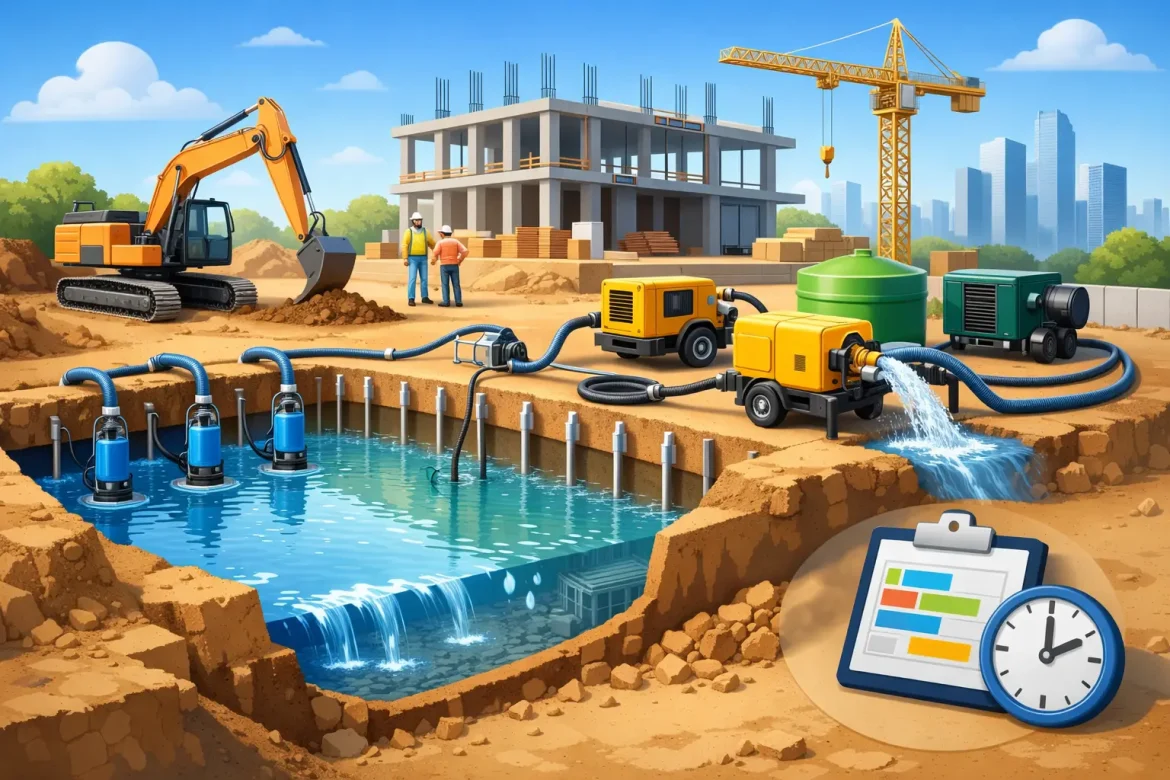
A wet excavation is not simply an inconvenience to pump around. It can delay bulk earthworks, weaken formation levels, restrict access, compromise trench safety and turn planned activities into a daily recovery exercise. Experienced dewatering contractors prevent that chain of events by treating groundwater control as a construction-critical system, not a hire-pump arrangement.
For civil, mining and infrastructure works, the right approach starts before excavation begins. Ground conditions, groundwater behaviour, excavation depth, discharge constraints and the construction sequence all affect the system required. A solution that performs well on one site may be ineffective, expensive or non-compliant on the next.
What dewatering contractors are really responsible for
The core task is to lower, control or remove water so work can proceed safely and predictably. In practice, that responsibility reaches much further than moving water from one point to another. A capable contractor assesses the hydrogeology, designs a practical system, installs and monitors it, manages discharge quality, responds to changing conditions and maintains equipment throughout the works.
The objective is not always to achieve the lowest possible groundwater level. Over-dewatering can create its own issues, including excessive drawdown beyond the excavation, settlement risk in susceptible ground or unnecessary treatment and energy costs. The target is controlled drawdown at the right depth, over the right area, for the required duration.
This is particularly relevant where excavation works sit near existing assets, service corridors, roads, waterways or neighbouring structures. Groundwater management must support the excavation without creating a problem beyond the work zone. That requires field judgement as well as sound design.
Start with the ground, not the equipment
Pump capacity is only one part of a dewatering system. The more useful questions are how quickly water will recharge into the excavation, whether soils transmit water freely, whether fine material may migrate, and how groundwater levels respond during pumping.
Clean sands and gravels may suit well point or deep well systems, depending on depth and drawdown requirements. Lower-permeability silts and clays can respond more slowly and may require a different approach, staged excavation or supplementary controls. Fractured rock can introduce highly variable inflows that demand contingency capacity and close monitoring.
Site investigation data is valuable, but it should be interpreted against the actual construction method. A bore log does not, by itself, confirm how an excavation will behave once opened. Trial pumping, test wells and early monitoring can provide practical evidence that improves system sizing before the project reaches a critical stage.
In Western Australia and Queensland, local experience matters because groundwater conditions can change sharply across short distances. Contractors familiar with regional ground conditions can identify likely constraints early, including saline water, iron staining, fine sand mobilisation, high recharge or difficult discharge pathways.
Match the method to the excavation
There is no single best dewatering method. The appropriate system depends on the ground, geometry, programme and environmental requirements.
Well point dewatering
Well points are commonly used for relatively shallow excavations in permeable soils. Multiple small-diameter points are installed around or alongside the work area and connected to a header line and vacuum-assisted pump. This method can provide even drawdown across a broad excavation and is often suited to trenches, basements, service installations and civil structures.
Its effectiveness depends on installation quality, spacing, vacuum integrity and the soil’s permeability. Poorly installed well points or leaking connections can leave local wet areas that affect productivity even when the pump appears to be operating normally.
Deep well dewatering
Deep wells are generally considered where excavations are deeper or where significant drawdown is required in more permeable aquifers. Submersible pumps within properly designed wells can lower groundwater from below the excavation level, improving stability and reducing the likelihood of water entering working areas.
Deep well systems require careful planning. Well locations must work with access, craneage, piling, retaining works and the excavation sequence. They also need sufficient lead time for drilling, development, test pumping and commissioning. Leaving this decision until the excavation is already wet usually increases cost and limits options.
Sump and open pumping
Sump pumping can be an efficient solution for localised seepage, surface water and manageable inflows. Water is directed through drains or graded areas to collection sumps and pumped away. It is simple in principle and can be appropriate where groundwater inflow is low and soil stability is not adversely affected.
However, it is not a substitute for groundwater drawdown where water is entering through unstable or fine-grained formation. Pumping directly from an excavation can draw fines into the system, soften the base and contribute to erosion or instability. The method must suit the site, rather than being selected because it is quickest to mobilise.
Discharge quality is part of the job
Dewatering water cannot be assumed suitable for release simply because it is clear. Sediment, hydrocarbons, dissolved metals, acidity, salinity and elevated iron can all affect the permitted discharge route. Requirements may involve testing, settlement, filtration, treatment, controlled release, reuse or off-site disposal.
A dewatering contractor should establish the discharge strategy early, alongside system design. This includes identifying available discharge points, confirming approvals, assessing flow limits and allowing space for treatment equipment. A well-designed pumping system can still hold up works if discharge arrangements have not been resolved.
Environmental controls also need to work under site conditions. Sediment basins that are undersized, filters that are not maintained or hoses that cross active haul routes create avoidable compliance and operational risks. Practical layout, routine inspections and clear responsibilities keep the system functional over the life of the project.
Selecting dewatering contractors for high-risk works
Procurement should assess more than equipment availability and an initial rate. Pumps, hoses and tanks are readily sourced. The difference lies in whether the contractor can predict site behaviour, commission a system properly and maintain performance when conditions change.
Ask how the proposed system has been sized and what assumptions underpin the design. A credible contractor can explain anticipated inflow, drawdown targets, duty and standby capacity, monitoring points and the contingency plan for higher-than-expected water. Vague assurances of sufficient pumping capacity are not enough for a programme-critical excavation.
Also examine the contractor’s approach to safety. Electrical installations, hoses, access around wells, lifting activities, confined spaces and wet excavation interfaces all need to be managed within the broader site controls. Dewatering should reduce construction risk, not introduce poorly managed temporary works.
Responsiveness is equally important. Groundwater is rarely static over a project lifecycle. Rainfall, tidal influence, adjacent works, changes in excavation depth and seasonal variation can alter site conditions. A contractor with field capability, available equipment and disciplined reporting can adjust the system before a small issue becomes a lost shift.
Build dewatering into the programme
The most effective projects treat dewatering as an enabling work package. It is planned with excavation support, service relocations, access, disposal, power supply and the construction sequence. This gives the system time to achieve the required drawdown before crews need the formation.
Early planning also makes costs more controllable. It allows the team to select appropriate equipment, avoid rushed treatment arrangements and schedule installation without conflicting with other trades. More importantly, it provides time to verify actual performance and make adjustments while the programme still has flexibility.
Dewatering Solutions approaches water control as a practical site operation with direct consequences for safety, cost and delivery. The measure of success is not how much water has been pumped. It is whether the excavation remains stable, compliant and ready for the next activity when the project needs it.
Before the first cut is made, confirm what the ground is likely to do, where the water will go and who will take responsibility when conditions change. That preparation gives the project team a far better chance of keeping water in its place and the programme moving.