
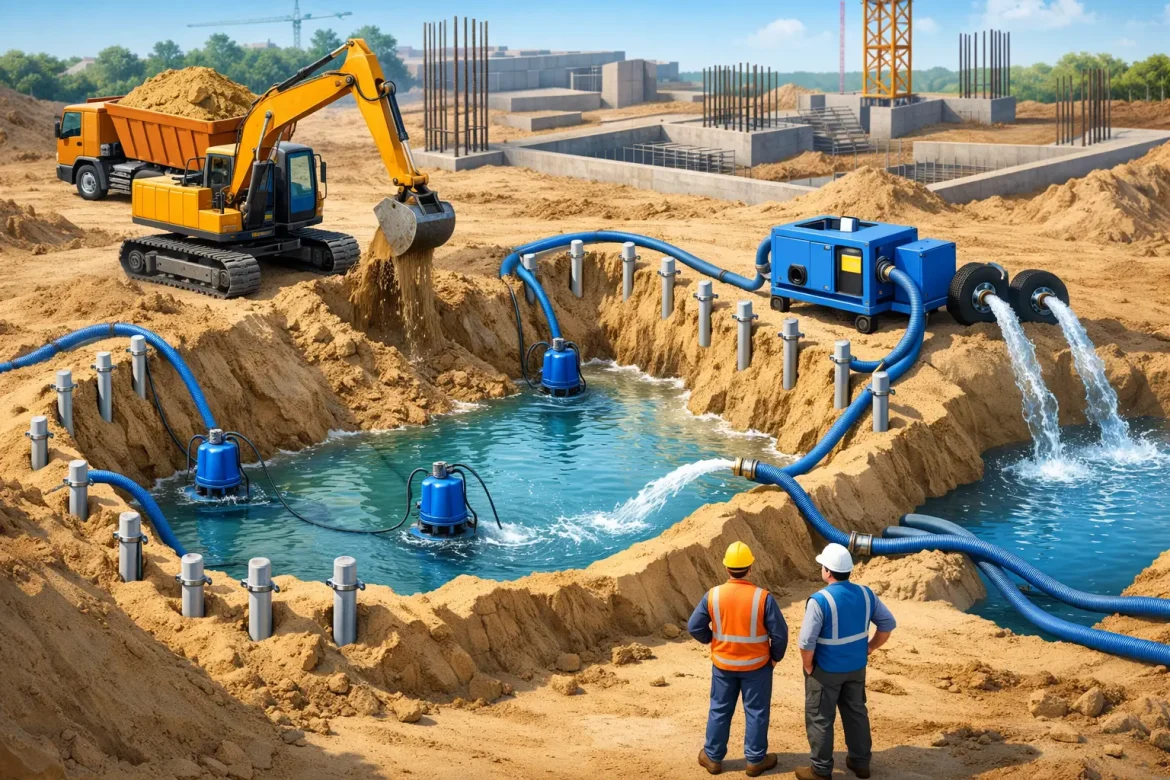
A sandy excavation can look manageable at the start of a shift, then lose its formation within hours once groundwater starts moving. To dewater sandy excavations effectively, the objective is not simply to remove water from the bottom of the cut. It is to lower groundwater in a controlled way without drawing fines into the system, undermining batter stability or creating an uncontrolled discharge issue.
For civil, construction and mining works, getting this wrong can mean soft formation, slumping batters, base heave, damaged services, pump downtime and an excavation that cannot be handed over for the next trade. The right approach starts with understanding how water and sand will behave together at that specific site.
Why sandy ground needs a different dewatering approach
Sand is generally permeable, so groundwater can move quickly towards a pumped point. That makes it possible to achieve strong drawdown, but it also creates a risk: the same flow that delivers water to a pump can carry fine particles with it. If sand migration is not controlled, voids can develop behind sheet piles, below nearby pavements or beneath the excavation base.
The consequences are not always immediate. A system may appear to be performing because the water level is falling, while excess fines in the discharge, settlement at the surface or a softening excavation base signals a developing problem. This is why pump capacity alone is a poor basis for system selection.
Excavation depth, soil grading, groundwater level, formation permeability, nearby structures and the required construction sequence all affect the design. Clean, uniform sand behaves differently from silty sand or layered ground containing lenses of clay and gravel. Tidal influence, rainfall recharge and perched water can further change site conditions over the life of the works.
Start with the groundwater and ground model
A practical dewatering plan should be developed before excavation reaches the water table. Available geotechnical information provides a starting point, but field verification is essential. Trial bores, monitoring points and pumping tests help establish the likely inflow, drawdown response and risk of fine migration.
The key question is how far groundwater must be lowered below the proposed excavation level. In many cases, maintaining the water table at least 0.5 metres below the formation is a useful working target, but the required level depends on the ground conditions, temporary works design and activity being undertaken. A deeper drawdown may be needed for foundations, pipe installation or dry access, while excessive drawdown can create settlement risks beyond the excavation.
A sound assessment considers where the water will come from, where it will go and what will happen if conditions change. On constrained sites, this includes checking surrounding buildings, buried services, existing bores and environmentally sensitive receptors. In Western Australia and Queensland, local ground conditions can vary substantially within short distances, so assumptions based on a nearby project are not enough.
Select a system that controls water and sand
Wellpoint systems for shallow to moderate drawdown
Wellpoints are often well suited to sandy excavations where a broad, relatively even drawdown is required. A series of small screened wellpoints is installed around the excavation or along the work area, connected to a header main and vacuum-assisted pump. This spreads the extraction effort across the site rather than concentrating it at one sump.
Correct screen selection, filter pack design and installation depth are critical. The aim is to admit groundwater while retaining the surrounding formation. If screens are poorly matched to the soil grading, the system can pump sand, lose efficiency and affect the ground around each point.
Wellpoints can be installed in stages as excavation progresses. This is often more efficient than overbuilding a system at the outset, provided the staging is planned and there is sufficient redundancy to manage changing inflows.
Deep wells for greater depth or higher flows
Where the excavation is deeper, the permeable layer extends well below formation level, or inflows are significant, deep well dewatering may be the more reliable option. Submersible pumps installed in properly developed wells can provide deeper drawdown than a standard wellpoint arrangement.
Deep wells require careful drilling, screen and gravel-pack selection, development and monitoring. They are particularly valuable where the programme cannot tolerate a wet base or repeated interruptions, but they are not automatically the best choice for every sandy site. For a shallow trench or localised pit, a wellpoint system may provide better control at lower cost.
Sump pumping has limits in sand
Sump and open pumping can suit minor seepage, temporary local water or excavations in stable ground. In loose sand below the water table, however, relying on a sump can be risky. Water flowing through the excavation face and base towards a sump may transport fine material, cause erosion channels and destabilise the working area.
If open pumping is used, it should generally manage residual water after the groundwater has been lowered through wellpoints or wells. Properly designed drainage layers, filter media and protected collection points can reduce erosion, but they do not replace a groundwater-control system where sustained inflows are expected.
Control drawdown, not just water level
The best dewatering systems are actively managed. Water levels should be monitored in the excavation and, where relevant, at external monitoring points. Pump run times, flow rates, discharge quality and rainfall response provide useful information about whether the system is operating as intended.
A rapid increase in turbidity can indicate screen damage, poor filter performance or changing ground conditions. Falling pump flow can point to a blocked screen, air leak, failing pump or declining water availability. Neither condition should be ignored simply because the excavation currently looks dry.
Controlled drawdown also protects neighbouring assets. On a site close to existing structures or services, lowering groundwater too aggressively can contribute to ground movement. The appropriate response may be staged pumping, revised well spacing, lower extraction rates or additional monitoring, rather than simply installing a larger pump.
Reliable operations also need contingency. Standby pumps, backup power, spare hoses and fittings, alarm response procedures and access for maintenance are practical safeguards against rainfall events, power loss or equipment failure. Dewatering is a live site activity, not a set-and-forget installation.
Treat and manage discharge properly
Water removed from sandy excavations often carries sediment, particularly during system start-up or after a disturbance. Discharging turbid water without treatment can create environmental, compliance and downstream drainage issues. The discharge pathway should be confirmed before pumping begins, including approval requirements, flow limits and water-quality criteria.
Sediment control may involve settlement tanks, settling ponds, filtration units or purpose-designed treatment equipment. The required level of treatment depends on the water quality and approved discharge location. If hydrocarbons, acid sulfate soil indicators, elevated salinity or other contaminants are present, additional assessment and treatment may be required.
Discharge infrastructure needs the same attention as the extraction system. Hoses should be protected from traffic, connections secured, outlets stabilised and flows managed so they do not erode drains, verges or unprotected ground. A clean excavation achieved by creating a problem elsewhere is not a successful dewatering outcome.
Build dewatering into the construction programme
Dewatering should be mobilised early enough to establish drawdown before critical excavation, not after wet ground has already delayed earthworks. Allow time for installation, testing, system adjustment and water treatment commissioning. This is particularly relevant where the works involve deep service trenches, lift pits, basement structures, bridge foundations or long excavation runs.
The system must also suit the construction sequence. Access routes, crane positions, piling works, excavation stages and later backfill activities can all affect pipework and well locations. Early coordination with the principal contractor and temporary works team avoids a system that performs technically but obstructs the job.
For project teams, the most useful measure is not how much water a pump can move. It is whether the formation remains stable, workers can operate safely, water quality stays compliant and the work proceeds to programme. An experienced dewatering contractor will design around those outcomes, then monitor the site closely enough to adjust before minor changes become costly delays.
When sandy ground is involved, treat groundwater control as part of the excavation support strategy from day one. A properly selected, monitored and maintained system gives the project a dry, stable platform to keep work moving safely.