
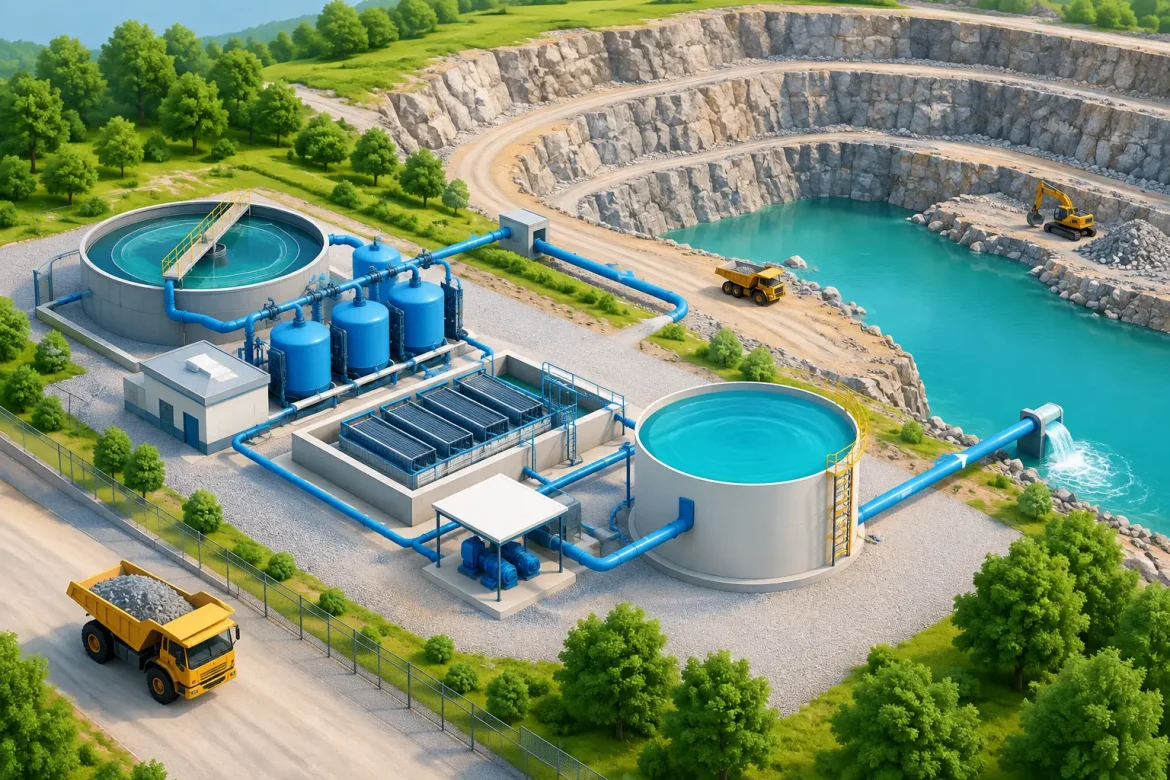
A quarry water reuse case study is rarely just about finding another use for pit water. It is about maintaining production through wet periods, reducing pressure on freshwater supplies, controlling sediment and protecting the site from avoidable environmental and compliance risk. For quarry managers, the practical question is whether water that must be managed can become a dependable operating resource.
The representative case below reflects a common quarry scenario: a site with rainfall runoff, groundwater inflow and process water collecting in a pit sump, where discharge is constrained and water demand continues across crushing, screening, haul roads and dust suppression. The project details are illustrative, but the operating lessons apply broadly across hard rock, sand and gravel operations.
The operating problem: water was both a constraint and a resource
The quarry operated through seasonal rainfall events that rapidly increased water levels in the active pit. Water entered from direct rainfall, catchment runoff and seepage through fractured ground. If it remained unmanaged, it reduced access to working faces, affected haul roads and created a higher risk of sediment-laden water leaving the controlled site area.
At the same time, the operation was drawing on freshwater for dust suppression and plant wash-down. During dry weather, haul roads required regular watering to maintain visibility, reduce airborne dust and support safe vehicle movements. This created a familiar contradiction: the site had excess water during wet periods, yet still paid to secure water for operational use.
The initial response had been largely reactive. Pumps moved water from low points to temporary settlement areas, and water was discharged when conditions and approvals allowed. This approach could keep the pit workable in the short term, but it did not provide consistent water quality, secure storage or a defined reuse pathway. It also left the site exposed when a rainfall event arrived before the available settlement capacity had recovered.
Quarry water reuse case study: defining a workable system
The first decision was not to select a pump or treatment unit. It was to establish a site water balance. The project team needed to understand where water entered the quarry, how quickly it accumulated, what quality it was at each collection point and where it could be used without disrupting plant performance or environmental controls.
Inflows were separated into three broad streams. Relatively clean runoff from undisturbed areas was diverted away from the pit where practical. Water from active work zones and haul roads was directed towards collection points where sediment could settle. Pit water and groundwater seepage were managed through dedicated sumps and pumping infrastructure.
That separation mattered. Treating every litre to the same standard would have added unnecessary capital and operating cost. Conversely, combining clean water with sediment-heavy runoff would have increased treatment demand and reduced the available storage volume. Good quarry water management starts by keeping water streams separate for as long as the site layout allows.
The reuse plan prioritised applications with a practical tolerance for variable water quality. Dust suppression was the main demand because it could absorb significant volumes across the working day. Water was also allocated for wash-down in selected areas, subject to sediment control and equipment requirements. It was not nominated for uses where dissolved salts, fine solids or hydrocarbons could create a product-quality, corrosion or safety issue.
Treatment matched to the reuse purpose
The treatment train was based on the contaminants present and the intended end use. For sediment-heavy water, staged settling was the foundation. Water passed through a pit sump and settlement arrangement designed to slow flow, drop out coarse solids and provide sufficient retention time before transfer to storage.
Where fine suspended solids remained high, chemical dosing and clarification could be considered. This is often useful where available land for ponds is limited or where water must be reused through spray equipment that is susceptible to blocked nozzles. Filtration may also be required before water enters a dust suppression system, particularly where fine particles and biological growth create maintenance issues.
Treatment is not automatically the right answer for every quarry. If water quality is suitable for the proposed use after settlement, adding complex equipment can create more maintenance exposure than value. The right level of treatment depends on the water quality, the required reliability of supply, the reuse application, site footprint and the consequences of a system failure.
Storage created operating flexibility
Storage was the link between dewatering and reuse. Without adequate storage, a quarry may need to discharge water during a wet event even though it will need water for dust control a few weeks later. With storage, the operation can retain suitable water when it is available and draw from it when demand rises.
In this representative scenario, the storage arrangement was designed around realistic site constraints. It needed enough capacity to buffer rainfall-driven inflows while maintaining contingency volume for severe weather. It also needed controlled access for water carts, transfer pumps and inspections, without creating a new vehicle interaction risk.
Storage design should account for more than volume. Lined versus unlined storage, seepage potential, freeboard, overflow pathways, erosion protection and water quality stratification all require attention. A pond that looks adequate on a dry day can become a compliance issue if it has no defined response during a high-intensity rainfall event.
Controls that made reuse dependable
Water reuse only delivers value when it is dependable at the point of use. The quarry therefore treated the system as an operational asset rather than a set of temporary pumps and ponds.
Pump capacity was selected to manage expected inflows and allow for peak events, with duty and standby arrangements where loss of pumping would affect production. Float controls and level monitoring supported early response to rising water levels. Pipework was routed and protected to reduce damage from mobile plant, while isolation points allowed sections to be maintained without stopping the whole system.
Water quality checks were built into routine site management. Turbidity was a practical field indicator for sediment performance, while periodic laboratory testing helped assess issues such as pH, electrical conductivity, hydrocarbons and dissolved metals where relevant to the quarry geology and approvals. The testing frequency should be based on risk. A stable water source used only for haul road watering needs a different regime from a system operating near a sensitive receiving environment.
Dust suppression demand was also planned, rather than assumed. Water carts can consume significant volumes when production is high and weather is dry. Estimating daily use by route length, application rate, weather conditions and shift pattern allowed the site to size storage and pumping for actual demand rather than an optimistic average.
Measurable value came from avoided disruption
The strongest business case was not simply a lower water bill. Reuse reduced reliance on imported or licensed supply for suitable non-potable tasks, but the broader value came from better control of site water.
A managed reuse system can reduce the frequency of emergency pumping, limit unplanned production interruptions caused by flooded work areas and provide greater confidence that water remains within the site’s approved management framework. It can also reduce truck movements associated with external water supply, provided the reuse water is consistently available and suitable for the application.
For project decision-makers, the financial assessment should include more than equipment cost. It should consider freshwater purchase and transport, water cart downtime, labour for reactive pumping, lost production during wet weather, sediment removal, maintenance, monitoring and the risk cost of non-compliant discharge. In many cases, the avoided disruption is more significant than the direct saving per kilolitre.
Where quarry water reuse can fall short
Reuse is not a substitute for a compliant discharge strategy or a properly designed dewatering plan. During prolonged rainfall, inflows may exceed storage and reuse demand. The site still needs contingency pumping, controlled overflow arrangements where approved, and a clear wet-weather response plan.
Water chemistry can also limit reuse. High salinity may affect roads, vegetation or equipment. Acidic water, elevated metals or hydrocarbons may require more advanced treatment and tighter controls. In some quarries, the cost and operational burden of treating water to a reusable standard may outweigh the benefit, particularly where freshwater is readily available and the water source is highly variable.
The practical response is to assess reuse as part of the whole water system. Dewatering, sediment control, storage, treatment, monitoring and end use need to work together. Treating one element in isolation usually shifts the risk somewhere else on site.
For quarry operations in Western Australia and Queensland, local ground conditions, rainfall patterns and approval requirements can materially change the design. Dewatering Solutions approaches these projects from the ground up: defining inflows, protecting access and production, then building a water management system that can perform under site conditions rather than on paper.
A well-planned reuse system gives a quarry more than stored water. It gives the site time, options and control when the weather changes and production cannot wait.