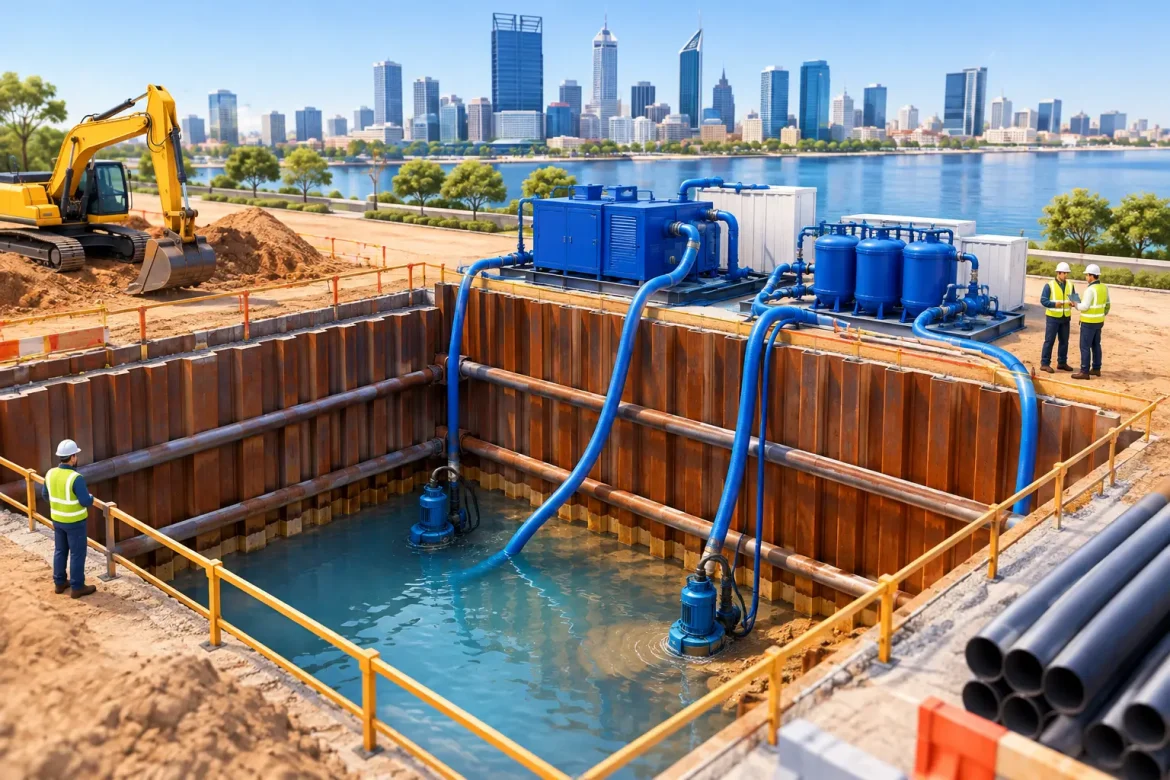
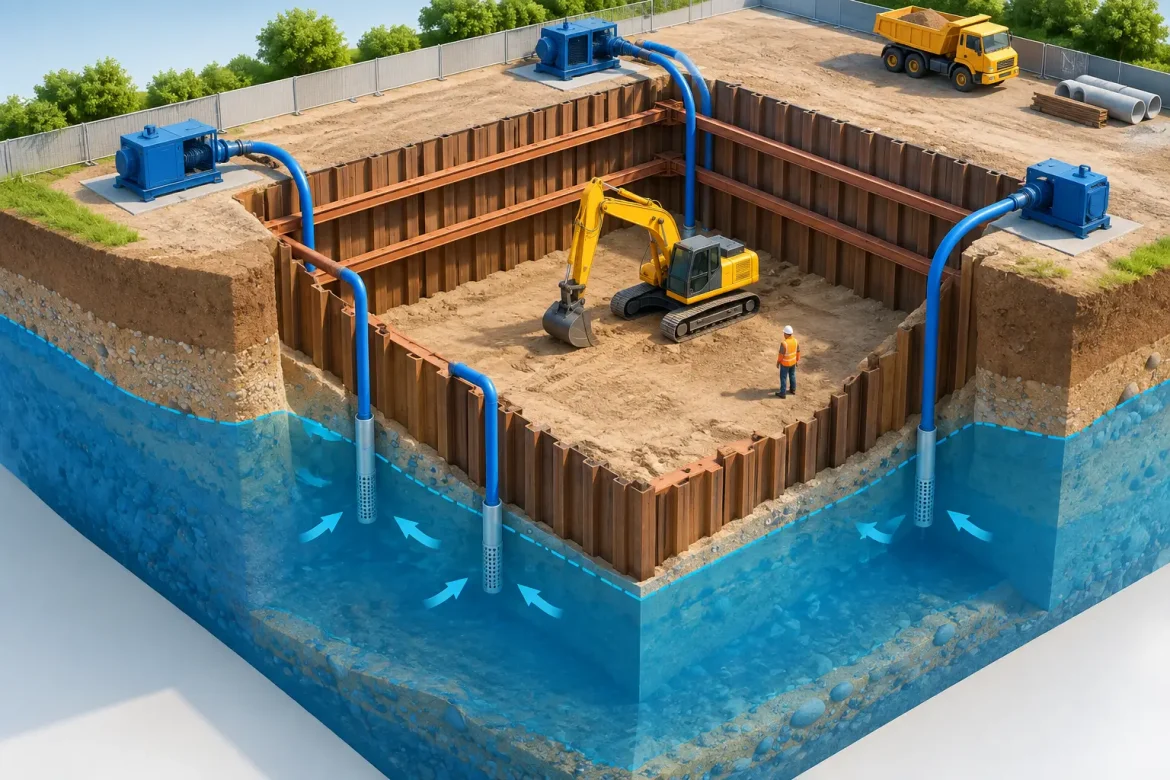
Groundwater rarely arrives at a convenient point in the programme. It can seep through excavation faces, soften founding material, flood trenches and turn a controlled dig into a safety, quality and scheduling risk. Lowering water tables is therefore not simply a pumping task. It is a planned site-control measure that allows construction, mining and civil works to proceed on stable, workable ground.
For project teams, the objective is clear: reduce groundwater pressure and maintain dry enough conditions for the work at hand without creating movement, environmental exposure or unnecessary operating cost. Achieving that outcome depends on understanding the ground, selecting the right method and managing the system closely from installation through to shutdown.
Why lowering water tables matters on active sites
Water below ground exerts pore pressure within soil and rock. When that pressure rises around an excavation, it can reduce effective stress – the mechanism that helps soil hold together. The result may be unstable batters, base heave, running sand, muddy access routes or difficulty placing and compacting material to specification.
A wet excavation also affects more than the dig itself. Survey set-out becomes harder to protect, plant loses traction, formwork and reinforcement work slow down, and concrete placement can be compromised. In mining and infrastructure works, uncontrolled inflows can restrict access to critical areas and place significant pressure on the programme.
The operational case for dewatering is strongest when it is considered before excavation begins. Early assessment gives the project team time to identify likely aquifers, estimate inflow, allow for treatment or discharge controls, and establish monitoring. Leaving the issue until water is already entering the excavation usually means fewer options and higher costs.
Lowering water tables starts with the ground model
No two sites respond to dewatering in exactly the same way. A shallow sandy formation may draw down quickly through wellpoints, while a deep excavation in variable sands, gravels or fractured rock may require deep wells, staged pumping or a combined approach. Fine silts and clays can be particularly challenging because water travels through them slowly, even where the excavation appears wet at surface level.
The site investigation is the starting point, but it should not be treated as a final answer. Bore logs, groundwater observations, historical records and nearby construction experience provide a useful baseline. Trial wells, pump testing and field observations then help confirm how the ground responds in practice.
For projects in Western Australia and Queensland, local conditions matter. Coastal sands, alluvial deposits, seasonal recharge, perched water and saline groundwater can each change the design and operating requirements. A system that has worked on a neighbouring project may not deliver the same drawdown or water quality outcome a few kilometres away.
Define the required drawdown
The target is not to remove every drop of water. It is to lower the groundwater level sufficiently below the excavation formation or work zone to maintain stability and workable conditions. The required depth depends on excavation geometry, soil type, foundation design, construction sequence and the consequences of a loss of control.
Over-pumping can be as problematic as under-pumping. Excessive drawdown may increase settlement risk beyond the excavation, affect adjacent services or structures, and create avoidable treatment and disposal volumes. A disciplined design sets a drawdown target, checks performance against that target and adjusts pumping only when site data supports the change.
Selecting the right dewatering method
The method should suit the ground and the job, not the other way around. Wellpoint systems are often effective for shallow excavations in permeable soils, particularly where a broad and relatively even drawdown is required. Multiple wellpoints connected to a header main allow groundwater to be drawn down around the work area before and during excavation.
Deep well dewatering is generally better suited to deeper excavations, higher flows or formations where wells can access more permeable layers below the works. Submersible pumps in properly installed wells can provide significant drawdown, but their spacing, depth and pump duty must be based on site conditions rather than a standard layout.
Sump and open pumping can be practical where inflows are limited, the excavation can safely direct water to a collection point, and the ground will remain stable. It is often used as a supplementary measure. Used as the primary approach in loose, water-bearing ground, however, it can draw fines into the excavation, cause erosion and leave groundwater pressure largely uncontrolled.
Some sites require a hybrid system. Wellpoints or deep wells may lower the broader water table, while sumps manage rainfall, minor seepage and local construction water. The value lies in matching each component to its purpose and avoiding a single-method solution where the ground demands more control.
Design for the excavation and the surrounding asset
A dewatering plan must consider what sits outside the excavation line. Nearby buildings, rail corridors, roads, underground services, basements and environmentally sensitive areas can all be affected by groundwater movement. Drawdown may extend beyond the work zone, particularly in highly permeable formations.
That is why monitoring is not an optional extra. Standpipes, piezometers, flow metres and regular site inspections provide evidence of whether the system is achieving the required outcome. They also provide early warning if groundwater levels are not responding as expected, flows are increasing, sand is entering the system or nearby ground movement requires attention.
Instrumentation needs to be matched to project risk. A remote trench in open ground may need a straightforward inspection regime. A deep excavation beside existing structures requires tighter monitoring, clear trigger levels and defined response actions. The project team should know who receives the data, who can change pump settings and when an issue must be escalated.
Keep discharge quality under control
The water removed from an excavation cannot simply be treated as a disposal problem. Depending on the source and site history, it may contain sediment, elevated salinity, hydrocarbons, metals or other contaminants. Discharge arrangements must account for water quality, receiving environment, approvals and the capacity of any treatment system.
Sediment control is especially important. Poorly designed pumping points, damaged filters or excessive pump rates can carry fines into the discharge stream. This can affect compliance, block treatment equipment and contribute to ground loss around wells or excavation faces.
A practical water management setup may include settlement, filtration, oil-water separation, pH adjustment or other treatment measures based on test results. The right approach depends on the water, the approval conditions and the discharge or reuse pathway. Testing early provides a better basis for planning than waiting until tanks are full and the excavation is on hold.
Reliable operation protects the programme
A dewatering system is only effective while it is operating as intended. Pumps need appropriate duty and standby capacity, reliable power, protected pipework and planned maintenance. Alarmed systems and regular checks are particularly valuable where a rapid groundwater rebound could affect excavation stability or flood low points.
Site changes also need to be reflected in the dewatering plan. Excavations deepen, temporary works change, rainfall events occur and construction activities move across the footprint. A system installed for the first cut may not be adequate for the next stage. Reviewing flows, groundwater levels and excavation conditions keeps the controls aligned with the work.
Cost control comes from correct planning and active management, not from reducing equipment without regard to risk. An undersized system can cause downtime, rework and programme slippage. An oversized system may add unnecessary pumping, fuel, treatment and monitoring costs. The strongest outcome is a system that meets the required drawdown consistently, with evidence to demonstrate performance.
Treat dewatering as a construction control
Dewatering works best when it is integrated with excavation methodology, geotechnical advice, temporary works, environmental management and daily site planning. It should be discussed at pre-start meetings, considered in wet-weather planning and reviewed whenever ground conditions change.
For principal contractors and project managers, the key question is not simply whether water can be pumped away. It is whether the selected approach will maintain stable ground, protect people and adjacent assets, meet discharge requirements and keep critical works moving. Experienced dewatering contractors bring field judgement to that question, combining ground response, plant capability and disciplined monitoring into a system the project can rely on.
The best time to address groundwater is while there is still room to make good decisions. A clear drawdown objective, site-specific design and attentive operation give the excavation the conditions it needs to perform safely and predictably.