Groundwater rarely waits for a convenient point in the programme. It can enter an excavation overnight, soften formation level, restrict plant access and turn a planned concrete pour into a recovery exercise. This Perth construction dewatering guide sets out how project teams can make water control a planned site activity rather than a reactive hire decision.
For civil, commercial and infrastructure works across Western Australia, a dewatering system needs to do more than remove visible water. It must lower or manage groundwater to the required level, maintain excavation stability, protect nearby assets and discharge water responsibly. The right approach depends on ground conditions, excavation depth, programme demands and the quality of water being handled.
Start dewatering before excavation starts
The lowest-risk dewatering scope is developed during planning, not after the excavation has filled. Early investigation gives the project team a clearer view of soil layers, groundwater depth, seasonal variation, likely recharge and potential pathways for water to move through the site.
Existing geotechnical data is a starting point, but it may not answer every dewatering question. Bore logs can indicate whether sand, gravel, clay or weathered rock is present, while trial bores and monitoring wells can help confirm actual groundwater behaviour. Permeable sands can transmit water quickly and may suit wellpoint systems. Lower-permeability silts and clays may respond more slowly, requiring a different approach or more time to achieve drawdown.
Planning should also identify what sits beyond the excavation boundary. Nearby buildings, services, roads, retaining structures and contaminated land can all influence the design. Lowering groundwater outside the required area may cause settlement risk in some conditions. Conversely, failing to provide enough drawdown can leave the base unstable and increase the likelihood of piping, heave or batter failure.
The dewatering contractor should be involved early enough to assess the excavation sequence, access for drilling and pipework, power availability, discharge options and contingency requirements. This avoids a system being designed around an ideal site layout that no longer exists once bulk earthworks commence.
Select the system for the ground, not the catalogue
There is no single construction dewatering method that suits every Perth site. A practical system is selected around hydraulic conditions and the construction outcome required.
Wellpoint dewatering
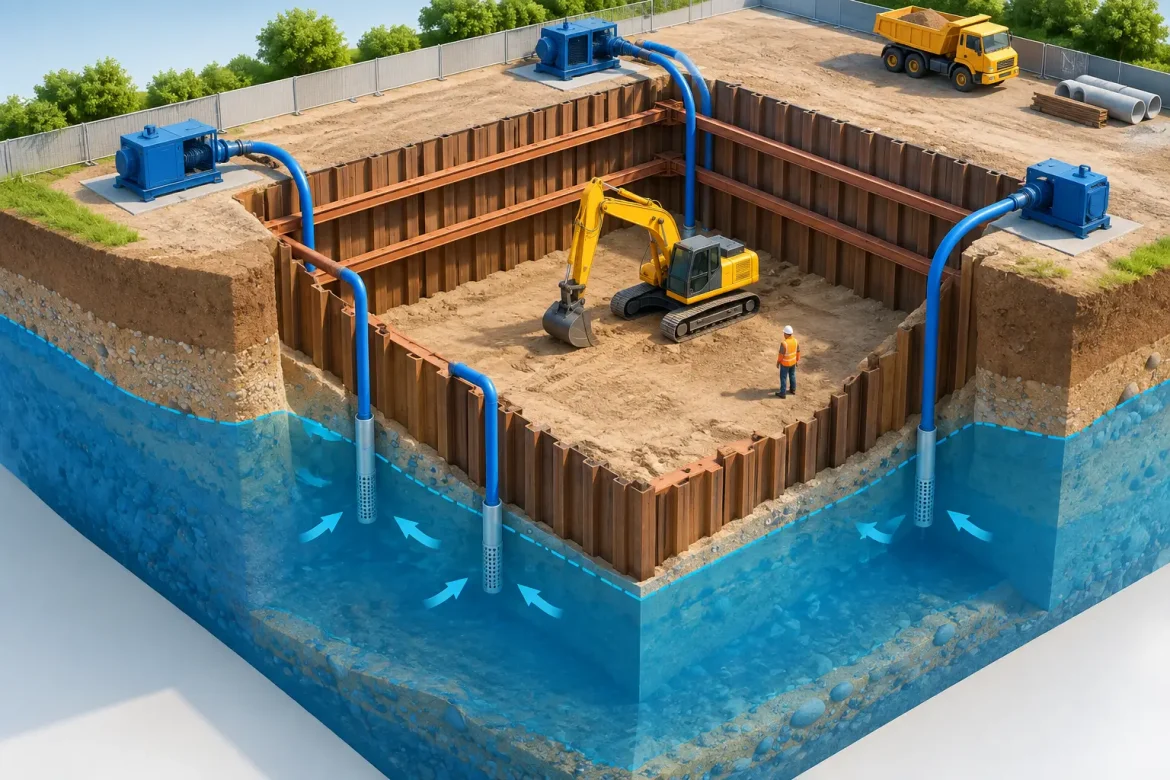
Wellpoints are commonly effective for shallow to moderate-depth excavations in permeable soils such as sands. A series of closely spaced wellpoints is installed around or alongside the work area and connected to a header line and vacuum-assisted pump. The system draws down the water table, allowing excavation to proceed in drier, more stable conditions.
Wellpoints can be efficient for trenches, basement excavations and pipeline works, but spacing, installation depth and pump capacity matter. A poorly designed layout can leave wet zones within the excavation or create excessive drawdown in areas that do not need it.
Deep well dewatering
Deep wells are generally suited to deeper excavations, larger sites or conditions where groundwater needs to be lowered well below the formation level. Submersible pumps are installed in screened wells, with water discharged through a managed pipe network.
This method can deliver significant drawdown, although it requires careful design, drilling access and monitoring. Deep wells are not automatically the best answer for every deep excavation. In low-yield ground, for example, a different arrangement may be more cost-effective and reliable.
Sump and open pumping
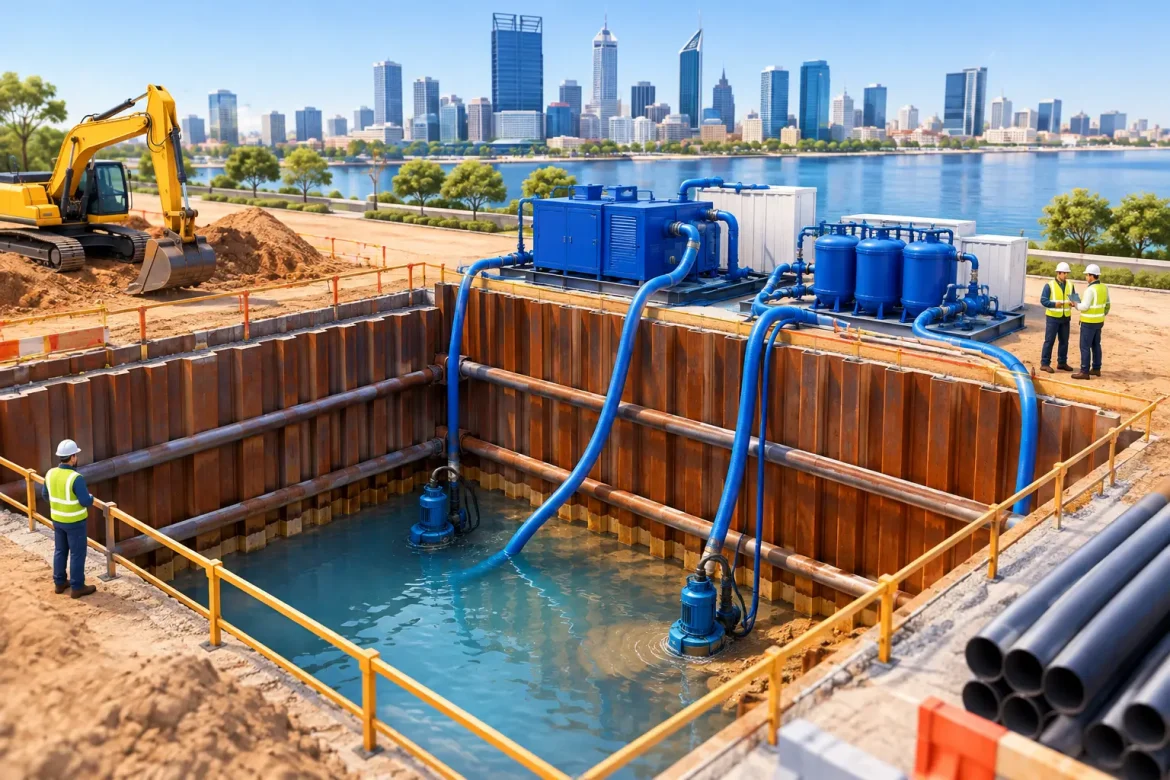
Sump pumping manages water that has already entered an excavation through rainfall, seepage or construction activity. Water is directed through graded drainage lines or temporary channels to a low point, then pumped out.
It is often useful as a supplementary measure, particularly for surface water management. On its own, however, it may not provide the groundwater control required for unstable sandy formations or deep excavations. Drawing water through an exposed excavation can also mobilise fines, undermine batters and create muddy work areas if it is not properly controlled.
A combination of methods is common. Wellpoints or deep wells may control groundwater pressure while sump pumps manage rain and local seepage within the work zone.
Treat discharge as part of the construction scope
Removing water is only half the task. The other half is managing where it goes and whether it meets the relevant discharge requirements. Groundwater may contain sediment, hydrocarbons, acidity, salinity or naturally occurring minerals that affect the available disposal pathway.
Before pumping begins, the project should establish likely water quality, proposed discharge volumes and the receiving location. Depending on the site and approvals, water may require settlement, filtration, pH adjustment, oil-water separation or other treatment before reuse, sewer discharge or release to an approved point.
Sediment control deserves particular attention. A discharge that appears clear at the pump outlet can still carry fine material that settles downstream or affects drainage infrastructure. Treatment equipment should be sized for expected flow rates and maintained throughout the works, not installed once and left unchecked.
Discharge arrangements must also account for wet-weather events. If a sediment basin, tank or treatment train is overwhelmed during heavy rain, the project can face environmental exposure and avoidable downtime. Contingency storage, standby pumping capacity and clear escalation procedures are practical safeguards.
Build monitoring into the daily site routine
Dewatering performance should be measured against the construction requirement. The key question is not simply whether pumps are running, but whether groundwater is at a safe and workable level where excavation, piling, pipe installation or foundation works are occurring.
Monitoring points within and around the excavation help confirm drawdown and identify changes early. Pump flow, operating hours, fuel or power use, water levels and discharge quality should be recorded at a frequency that reflects the risk profile of the works. During critical excavation stages, daily checks may be necessary.
Site teams also need clear visual triggers. Wet spots at formation level, sand boils, cloudy discharge, slumping batters, increased pump cycling or unexpected settlement are not minor inconveniences. They can indicate a changing groundwater condition, a blocked line, pump failure or an inadequate system capacity.
Reliable operation depends on basic discipline: protecting hoses and electrical leads from plant movements, checking strainers, maintaining pumps, securing backup power where required and ensuring the system continues to run outside normal working hours. A dewatering failure at 2 am can cost a full shift the following day.
Manage the risks that cause programme blowouts
The most expensive dewatering issues are often predictable. They arise when water control is treated as temporary plant hire rather than a live engineering and operational scope.
Common pressure points include insufficient system capacity, no allowance for rainfall, limited access for maintenance, delayed water testing, unprotected discharge lines and no backup pump for a critical excavation. Another frequent issue is changing excavation geometry without reviewing the dewatering layout. As the dig deepens or extends, a system that worked in the first stage may no longer achieve the required drawdown.
Coordination with the principal contractor is essential. Dewatering affects excavation sequencing, crane and plant access, concrete works, service installation and environmental management. It should be visible in pre-start discussions and short-term programmes, particularly where water levels need to reach a target before a following trade can begin.
Safety controls must remain practical. Open sumps require barricading, hoses create trip and vehicle hazards, and electrical equipment must be installed and inspected for wet conditions. Waterlogged ground can also reduce safe access for people and plant. The objective is not merely a dry-looking excavation, but a controlled work area that supports safe production.
Choosing a dewatering partner
A capable contractor brings more than pumps to site. Look for demonstrated experience in local ground conditions, the ability to assess and design around site constraints, suitable treatment capability and field crews who can respond when conditions change.
For high-consequence works, ask how the contractor will verify drawdown, manage discharge quality, provide standby capacity and report performance. Their answer should be specific to the excavation, not a generic equipment schedule. Dewatering Solutions approaches water control as part of project delivery: planned around safety, compliance, ground conditions and the programme the site needs to protect.
Groundwater will always be a variable on construction sites. The practical advantage comes from identifying it early, selecting the right control method and operating the system with enough discipline that water never becomes the activity controlling the programme.