
An excavation can look dry at the surface while groundwater pressure continues to weaken the formation beneath it. That distinction sits at the centre of sump pumping vs wellpoints. Both methods remove water from a work area, but they control it in very different ways. Selecting the wrong approach can lead to soft excavation bases, unstable batters, lost productivity and costly rework.
For civil, construction and mining projects, the decision should be based on ground conditions, excavation depth, inflow rate, programme requirements and environmental controls – not simply on which pump is available first.
The fundamental difference between sump pumping and wellpoints
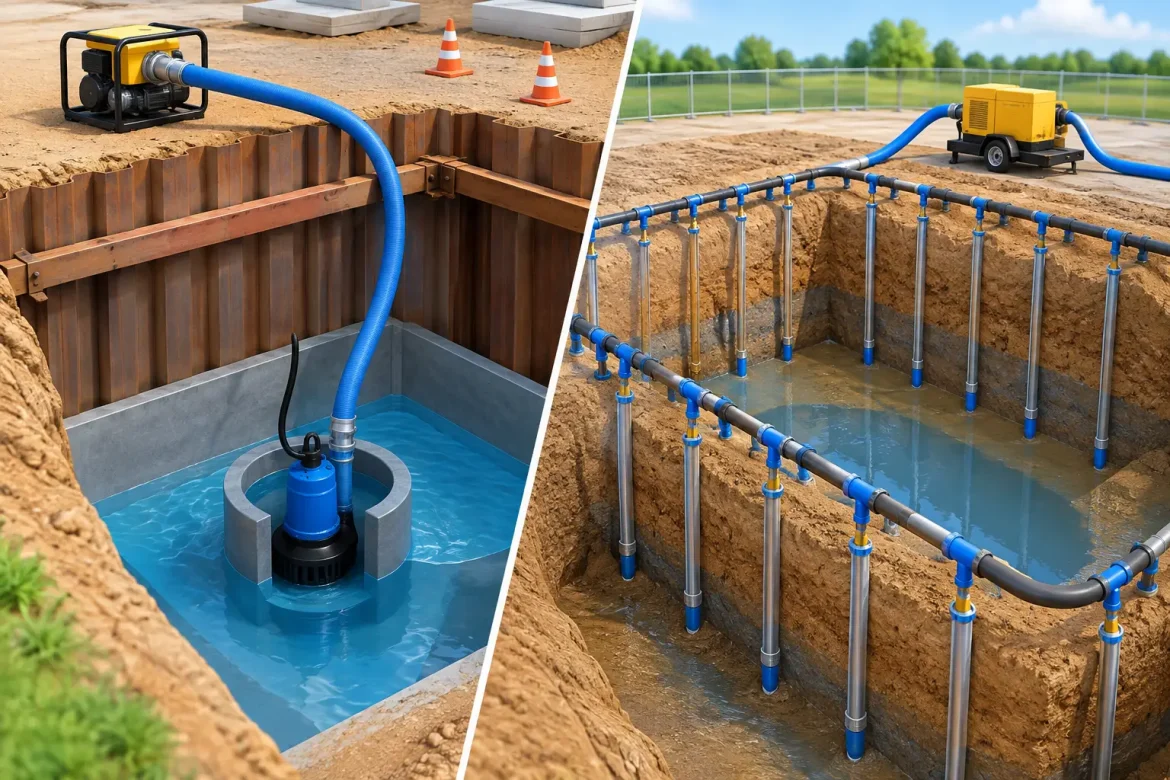
Sump pumping is an open dewatering method. Water entering an excavation is directed through drains, trenches or graded surfaces to a low point, where it collects in a sump and is pumped away. It is straightforward, adaptable and often highly effective where water inflows are manageable and the excavation remains stable.
Wellpoint dewatering works before groundwater reaches the excavation. A series of small-diameter wellpoints is installed around the work area and connected to a header pipe and vacuum pump. The system draws groundwater from the surrounding soil, lowering the local water table and reducing pore water pressure before or during excavation.
This is not merely a difference in equipment. Sump pumping manages water after it enters the excavation. Wellpoints control groundwater within the ground mass around the excavation. That distinction has direct consequences for safety, formation quality and construction sequencing.
When sump pumping is the practical choice
Sump and open pumping is often the right solution for shallow excavations in competent material, particularly where groundwater seepage is limited or where water is primarily generated by rainfall, washdown, surface runoff or isolated perched water.
It can be deployed quickly and adjusted as conditions change. For trenching, pits, minor service excavations, temporary works and sites with intermittent inflow, a well-designed sump system can keep the workface accessible without the lead time and installation footprint of a wellpoint system.
The method is also useful where the excavation can safely act as a collection point. Water is directed away from active work zones using shallow drains, geotextile protection, filter material or temporary channels, then removed from a sump positioned so it does not compromise access or the excavation base.
However, the apparent simplicity of sump pumping can be misleading. Pumping directly from a sump in fine sand or silty ground can pull soil particles towards the collection point. This may cause erosion, piping, localised settlement or softening of the formation. If water is continually entering through the base or excavation walls, simply installing larger pumps does not resolve the underlying ground-pressure issue.
Limits of open dewatering
Sump pumping is less suitable when groundwater inflows are sustained, when the excavation base is highly permeable, or when the water table must be lowered below formation level. It can also become problematic where excavation stability relies on keeping soil particles and groundwater movement under control.
A pump may keep visible water out of the hole while seepage continues to affect the base. For projects involving slabs, footings, pipe bedding or other works requiring a firm, dry formation, that can create a quality and programme risk. In these conditions, surface water control alone is rarely enough.
When wellpoints provide better groundwater control
Wellpoints are commonly used in sands, sandy silts and other permeable soils where groundwater must be lowered ahead of excavation. By reducing the water table outside the excavation, the system helps maintain drier working conditions and improves the stability of excavation faces and bases.
This is particularly valuable for deeper trenches, basements, pump stations, drainage structures, below-ground services and other works where groundwater would otherwise flow persistently into the excavation. Rather than waiting for water to emerge at the face, wellpoints intercept it in the surrounding ground.
A typical system includes closely spaced wellpoints, riser pipes, a header main, vacuum-assisted pump set and discharge management equipment. The spacing, depth and layout are determined by site conditions. Soil permeability, groundwater level, excavation geometry, available drawdown and nearby structures all affect the design.
Wellpoints generally achieve a practical drawdown of around 4 to 6 metres from a single stage, depending on conditions and system performance. Deeper excavations may require staged wellpoints, deeper wells or an alternative dewatering strategy. Treating a wellpoint system as a standard layout without reviewing the ground model is a common source of underperformance.
The conditions that influence wellpoint performance
Wellpoints need sufficient soil permeability for water to move towards the system. They are often effective in granular soils but may be less productive in very low-permeability clays, where groundwater movement is slow. Conversely, very coarse, highly permeable ground may require careful design to manage inflow rates and prevent fines migration.
The installation itself also matters. Poor seals, blocked points, damaged headers, inadequate vacuum or air leaks can reduce drawdown across the whole system. Dewatering is not a set-and-forget activity. Water levels, pump vacuum, flow rates, discharge quality and excavation conditions should be monitored throughout the works.
Sump pumping vs wellpoints: the decision factors
The best choice is rarely based on one factor. A practical assessment considers how water behaves across the whole work area and how the excavation will be built.
Ground conditions are the first consideration. Competent clay or rock with localised seepage may suit sumps and diversion drains. Saturated sands and silts are more likely to require wellpoints or another groundwater-lowering method to protect the excavation.
Excavation depth is equally important. A shallow trench with minor inflow can often be managed through open pumping. As excavation depth increases below the water table, hydrostatic pressure and seepage risks become more significant. Lowering groundwater outside the excavation may then be necessary to maintain a stable formation.
Programme also influences the decision. Sump pumping can be mobilised quickly, but repeated interruptions to clear water, repair erosion or replace softened material can consume more time than a planned wellpoint installation. Wellpoints involve more up-front work, yet they can create more predictable working conditions over a longer construction sequence.
Discharge requirements must be considered from the outset. Pumped water may contain sediment, hydrocarbons, elevated salinity or other contaminants. Depending on the site and discharge destination, water may require settling, filtration, treatment, testing or controlled disposal. A dewatering method is only effective when water is managed responsibly from extraction through to discharge.
Finally, assess surrounding assets. Groundwater drawdown can cause settlement in susceptible soils and may affect adjacent structures, services or environmental receptors. The required drawdown should be no greater than necessary, and monitoring points may be needed to verify system performance and manage risk.
A combined system is often the most effective approach
Sump pumping and wellpoints are not always competing options. On many sites, they work together.
A wellpoint system can lower the groundwater table and reduce seepage into an excavation, while small sumps manage residual water from rainfall, surface runoff and localised inflow. This arrangement protects the formation while keeping day-to-day water control practical for site crews.
The same principle applies to larger or more complex excavations. A staged approach may use wellpoints during bulk excavation, then temporary sumps during detailed works. The system should evolve with the construction sequence rather than remaining fixed after initial installation.
Planning for reliable dewatering performance
Reliable dewatering begins before a trench is opened or a pump arrives on site. Available geotechnical data should be reviewed alongside groundwater observations, excavation drawings, programme constraints and discharge requirements. Where information is limited, field testing and initial monitoring can provide the data needed to refine the approach.
The plan should also account for wet-weather events, standby pumping capacity, power supply, hose and pipe routing, sediment control, access for maintenance and emergency response. A pump failure during a critical pour or confined excavation is not a minor inconvenience. It can quickly become a safety, quality and schedule issue.
For projects in Western Australia and Queensland, local ground conditions can vary sharply over short distances. Field experience is valuable because the final system must respond to what is actually encountered, not only what was expected in desktop information.
The right question is not whether sump pumping or wellpoints is better in general. It is whether the selected system will keep the excavation stable, the formation suitable for construction and the project moving under real site conditions. Engage a dewatering specialist early enough to make that decision before groundwater dictates the programme.