
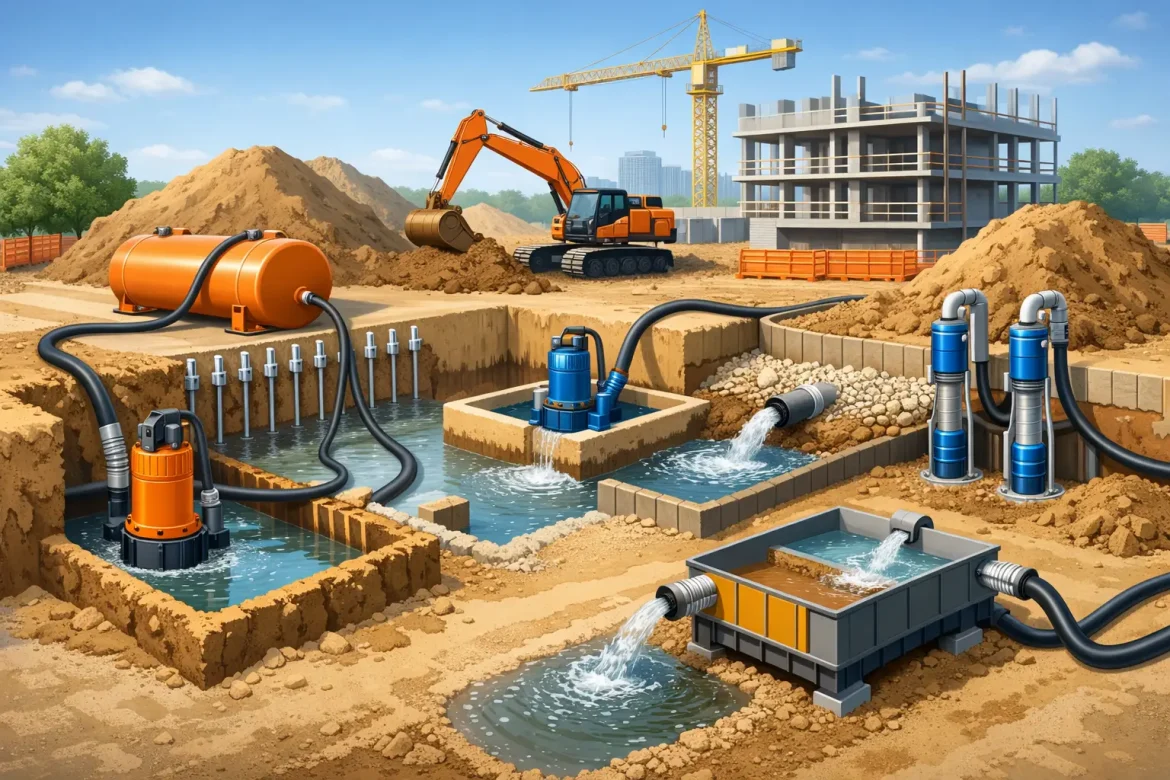
An excavation can look ready for work at first light and be unsafe by mid-morning after groundwater seepage, a perched aquifer response or a heavy rainfall event. Selecting the best dewatering methods construction teams can rely on is therefore not simply a pump-hire decision. It is a ground-control decision that affects excavation stability, worker safety, concrete quality, environmental compliance and the programme.
The right system is determined by site conditions, not by a standard equipment list. Soil permeability, excavation depth, groundwater level, drawdown requirement, water quality, nearby assets and discharge constraints must be assessed together. A method that performs well in clean, granular sand may be ineffective in low-permeability clay, while an oversized system can create unnecessary operating cost or settlement risk around adjacent structures.
Best dewatering methods for construction: matching method to ground
The most effective dewatering approach lowers or controls water without causing instability, uncontrolled discharge or avoidable disruption to surrounding ground. Four methods cover the majority of civil, construction and infrastructure applications, although complex sites often require a combined system.
Wellpoint dewatering
Wellpoint systems are widely used for shallow to medium-depth excavations in permeable sands, gravels and mixed alluvial ground. A series of small-diameter wellpoints is installed around the excavation perimeter, connected to a header main and vacuum-assisted pump. The system lowers the water table across the work area, rather than merely removing water after it reaches the excavation.
This makes wellpoints a strong option for trenches, basements, pits, service corridors and foundation works where dry, stable working conditions are required. They are generally quick to install, scalable and well suited to staged excavation.
Their limitation is drawdown depth. A single-stage wellpoint system is usually effective only to a limited depth below pump level. Where deeper drawdown is needed, a multi-stage arrangement or a different method may be required. Fine silts and clays can also restrict groundwater flow to the wellpoints, reducing performance unless the system is designed specifically for those conditions.
Deep well dewatering
Deep well systems use larger-diameter bores fitted with submersible pumps. They are designed for deeper excavations, high groundwater inflows and more substantial drawdown requirements. Deep wells are often appropriate for major infrastructure works, deep basements, shaft construction, mining-related civil works and excavations where the groundwater level must be reduced well below formation level.
The key advantage is capacity. Correctly designed deep wells can manage significant volumes while providing drawdown at depths that wellpoints cannot practically achieve. They also allow surface activities to remain less congested than a dense wellpoint layout.
However, deep well dewatering depends on accurate hydrogeological assessment, suitable bore construction and diligent monitoring. Pumping rates must be controlled to avoid excessive drawdown beyond the site boundary, particularly near existing buildings, services, waterways or sensitive ground. In Western Australia and Queensland, local aquifer characteristics can vary considerably over short distances, which is why drilling records, test pumping and field observations matter before committing to a final design.
Sump and open pumping
Sump pumping is the simplest and often the fastest way to remove surface water, rainfall runoff or localised seepage. Water is directed through temporary drains or graded excavation floors into sumps, then pumped away. It is commonly used for shallow excavations, short-duration works, emergency water removal and as a support measure alongside a primary groundwater control system.
For low-flow conditions in stable ground, this method can be cost-effective and practical. It is also valuable during wet-weather events, when even a well-designed groundwater system may need supplementary surface-water control.
Sump pumping should not be treated as a default substitute for groundwater lowering. If water is entering through the excavation base or sides under pressure, open pumping can draw fine material into the flow path. That can lead to erosion, piping, softened formation, unstable batters and settlement. Filters, geotextiles, appropriately constructed sumps and controlled pumping can reduce these risks, but a wellpoint or deep well system may be the more reliable answer where groundwater is persistent.
Eductor or ejector systems
Eductor systems use high-pressure water circulated through small wellpoints to create a vacuum effect and lift groundwater. They are suited to low-permeability soils such as fine sands, silty sands and some silts, where conventional wellpoints may struggle to achieve adequate drawdown.
They can provide deeper drawdown than a standard single-stage wellpoint system and are useful where access is constrained or where a closely controlled system is needed. The trade-off is complexity. Eductor systems require high-pressure pumping equipment, careful installation and experienced operation. They can also use more energy than simpler systems, so they are generally selected because ground conditions justify the additional setup and operating demand.
Water treatment is part of the dewatering method
Removing water is only half the scope. The other half is managing where that water goes and what it contains. Construction groundwater may carry suspended solids, sediment, hydrocarbons, elevated salinity, iron, acid sulfate soil indicators or other contaminants. Direct discharge without assessment can create environmental exposure, damage receiving environments and stop work when compliance issues emerge.
Treatment requirements should be identified during planning, not after pumps are running. Depending on water quality and the approved discharge pathway, a system may require settlement tanks, sediment controls, filtration, oil-water separation, pH correction, flocculation or more specialised treatment. Discharge flows and water quality should be monitored against project conditions and relevant approvals.
This is especially important when works are near waterways, sensitive land uses or existing drainage networks. A dewatering system that maintains a dry excavation but cannot meet discharge requirements is not a complete solution. It simply transfers project risk from the excavation to the environmental and compliance side of the job.
How to select the right construction dewatering approach
The best choice starts with a clear understanding of the excavation and the ground response expected during pumping. Bore logs and groundwater monitoring provide a starting point, but they should be tested against what is encountered on site. Groundwater levels can fluctuate with seasons, tides, nearby pumping, rainfall and changing site drainage conditions.
Start by defining the required drawdown. The target is not always a completely dry excavation. In some conditions, the objective is to lower groundwater sufficiently below formation level to prevent base heave, seepage and loss of bearing capacity. Over-pumping can be as problematic as under-pumping when nearby settlement or movement is a concern.
Next, consider the soil profile and permeability. Coarse granular material commonly responds well to wellpoints or deep wells. Lower-permeability material may call for eductors, targeted drainage measures or a different excavation strategy. Layered ground needs particular care because a permeable sand seam beneath clay can introduce water unexpectedly once excavation reaches that level.
The construction sequence also matters. A system suitable for a short trench section may not be suitable for a deep excavation that remains open for months. Consider how plant will access the area, where header lines and power will sit, whether the excavation will be staged, and how the system can remain operational through concrete pours, service installation and backfilling.
Finally, assess discharge early. Identify the likely flow rate, expected water quality, storage needs, treatment equipment and discharge point. This avoids the common problem of successfully extracting water but having insufficient capacity to treat, store or lawfully discharge it.
Monitoring protects programme and ground conditions
Dewatering is not a set-and-forget activity. Pump performance, groundwater levels, discharge volumes, turbidity and water quality can all change as excavation progresses. Regular inspections also identify blocked wellpoints, leaking headers, pump faults, declining flow, sediment build-up and changes in ground behaviour before they affect productivity.
Piezometers or monitoring wells are particularly valuable on deeper or sensitive excavations. They show whether the required drawdown is being achieved and help confirm that pumping is not affecting groundwater beyond the intended area. Where adjacent buildings, roads or services may be vulnerable, monitoring should be tied to clear response actions rather than treated as a reporting exercise.
A reliable contractor will also plan for redundancy. Standby pumps, backup power, alarm systems and spare critical components can prevent a short equipment failure becoming an excavation recovery operation. On high-consequence sites, that preparation is often far less costly than lost shifts, remediation works or damage to completed construction.
Treat dewatering as an enabling work, not a temporary afterthought
The best dewatering method is the one that matches the ground, supports the construction sequence and controls water from extraction through to compliant discharge. It may be a wellpoint installation around a service trench, deep wells for a major excavation, carefully managed sumps for a shallow work area, or a combined arrangement built around the actual site response.
Early assessment and disciplined field management give project teams room to work safely and keep formation conditions intact. When groundwater control is planned with the same care as shoring, piling or concrete works, it becomes a practical safeguard for programme certainty rather than a recurring source of site delays.