
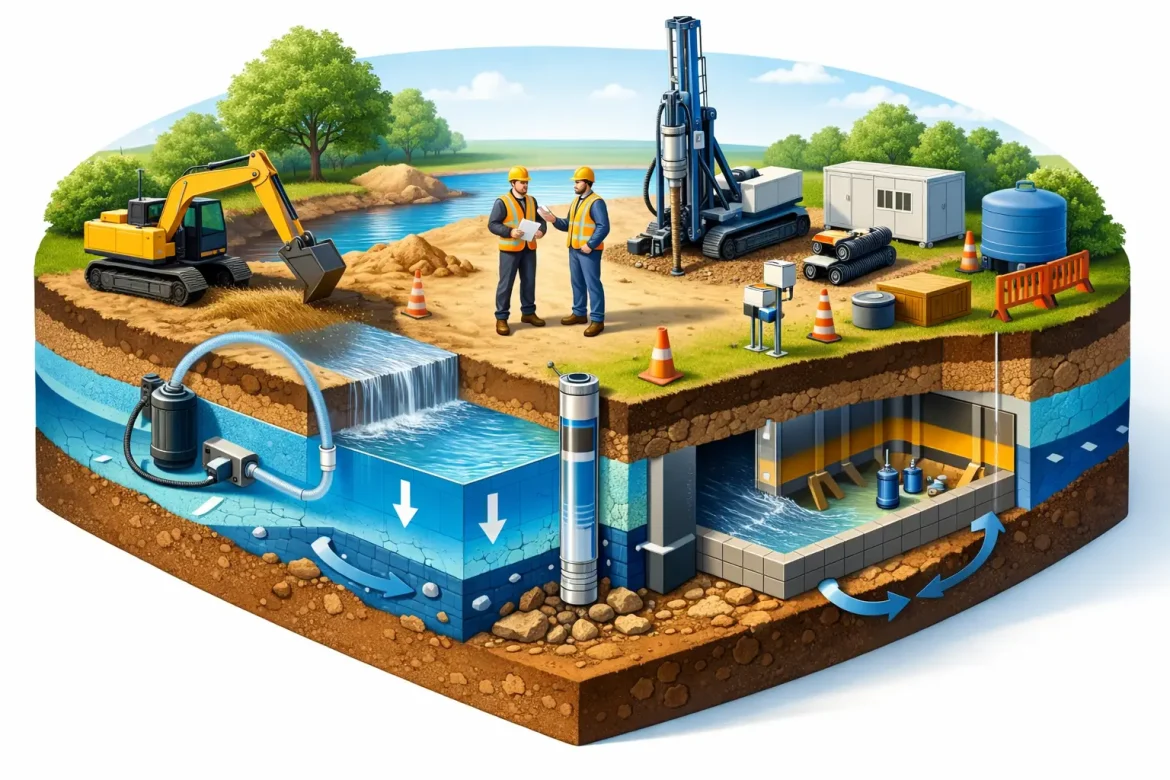
Groundwater rarely becomes a project problem without warning. It shows up in bore logs, changing ground conditions, wet excavation faces, rising sump levels and unexplained loss of bearing capacity. The difference between a manageable issue and a costly disruption is whether the project team acts early to reduce groundwater risk on site, using a system suited to the actual ground and construction sequence.
For civil, construction, mining and infrastructure works, water control is not simply a pumping task. It affects excavation stability, worker safety, foundation performance, environmental compliance, programme certainty and project cost. A well-designed dewatering approach keeps these factors connected rather than treating water as an issue to solve after the hole is already wet.
Reduce Groundwater Risk on Site Before Mobilisation
The lowest-cost groundwater issue is usually the one identified before excavation begins. Desktop information, geotechnical investigations and nearby bore records provide a starting point, but they should not be treated as a complete design. Groundwater conditions can vary significantly across a site, particularly in variable alluvial soils, fractured rock, coastal sands or areas influenced by seasonal rainfall and nearby drainage.
A useful pre-start assessment considers the anticipated groundwater level, soil permeability, likely inflow rates, excavation depth, nearby structures, discharge options and the planned duration of the works. It should also account for the effect of drawdown beyond the excavation. Lowering groundwater inside a trench or basement may affect surrounding soils, existing services, pavements or neighbouring foundations if it is not controlled.
The construction methodology matters as much as the water data. A shallow, short-duration service trench has different requirements from a deep lift station excavation, mine infrastructure footing or long linear pipeline installation. The question is not simply whether water is present. It is how water will behave as the excavation progresses, and what happens if the system is interrupted.
Establish clear trigger points
Before work starts, agree on measurable site triggers. These may include groundwater levels, inflow volume, turbidity, excavation movement, rainfall thresholds or pump run times. Trigger points give supervisors a defined reason to respond before conditions compromise the work area.
They also reduce uncertainty between the principal contractor, engineer and dewatering provider. If the water level rises above an agreed limit, or standby pumps are running more often than expected, the response process should already be known.
Match the Dewatering Method to the Ground Conditions
The right dewatering method depends on ground permeability, excavation geometry, depth of drawdown and water quality. Selecting equipment by habit, rather than site conditions, can create avoidable cost and risk.
Well point dewatering is often effective in permeable sands and granular soils where a controlled, relatively shallow drawdown is required. A correctly installed well point system can lower groundwater around trenches, pits and excavations while helping maintain a workable formation. However, its performance can reduce in low-permeability clays and silts, where water moves slowly through the ground.
Deep well dewatering is generally better suited to deeper excavations and larger drawdown requirements. It can provide controlled groundwater lowering over a broader area, but requires sound bore design, appropriate pump selection and close monitoring. Deep wells are not a set-and-forget solution. Poor placement, inadequate capacity or interrupted power can quickly affect excavation conditions.
Sump and open pumping can be practical for shallow excavations, localised seepage and short-term works. It is often simple to deploy, but it has limits. Pumping directly from a sump may draw fine material towards the excavation, leading to erosion, instability or sediment-laden discharge. In some conditions, a staged approach using well points or deep wells to lower groundwater, supported by sumps for local rainfall and residual water, provides better control.
A specialist should also assess whether cut-off measures, recharge, filtration or treatment are needed. The most efficient system is not always the one with the largest pump. It is the one that achieves the required drawdown without creating ground movement, excessive energy use or downstream water-quality issues.
Control Water Quality as Well as Water Volume
Removing water from an excavation is only half the task. The water must be managed responsibly once it reaches the surface. Site discharge requirements may depend on turbidity, pH, hydrocarbons, dissolved metals, salinity and other project-specific conditions. Uncontrolled discharge can expose a project to environmental non-compliance, complaints, clean-up costs and programme delays.
A practical water management plan identifies where water will go before pumping begins. Depending on site conditions and approvals, this may involve settlement tanks, sediment control, filtration, oil-water separation, treatment, lawful sewer discharge or approved off-site removal. The appropriate pathway depends on water quality, receiving environment and project approvals.
Rainfall can change the equation quickly. A system sized only for expected groundwater inflow may be overwhelmed when a storm hits an open excavation. Separate rainfall management from groundwater control where possible, and make sure diversion drains, bunding and sump capacity are maintained throughout the works.
Build Redundancy Into Critical Excavations
Every dewatering system has failure points: power loss, blocked suction lines, damaged hoses, worn pumps, high rainfall, unexpected inflow or equipment theft. On critical works, the issue is not whether a component can fail, but how long the excavation can remain safe if it does.
Standby pumps, backup power, high-level alarms and remote monitoring can provide valuable protection where water levels must remain controlled continuously. The level of redundancy should reflect the consequences of failure. A minor trench may need a straightforward contingency arrangement, while a deep excavation near sensitive assets may require duty and standby capacity, automatic changeover and after-hours response procedures.
Pump performance should be checked against actual conditions, not assumed from nameplate capacity. Lift height, hose length, friction losses, solids handling and changing water levels all affect delivered flow. Routine inspections should include suction strainers, discharge lines, electrical connections, fuel levels, sediment build-up and alarm operation.
Monitor Ground Response, Not Just Pumping Output
A dewatering system can appear to be working because pumps are running and water is leaving the site. That does not necessarily mean groundwater is at the required level or that the surrounding ground is stable. Monitoring needs to verify outcomes.
Piezometers or observation bores can confirm groundwater levels at relevant locations. Excavation inspections can identify softening, seepage, sand boils, cracking, slumping or erosion. Where nearby structures, roads or services may be affected, settlement and movement monitoring may be required under the project’s engineering controls.
Record keeping is equally useful. Pump run times, flow estimates, groundwater readings, water-quality results, rainfall and maintenance activity create a factual record of site conditions. This helps the team identify emerging trends, demonstrate compliance and adjust the system before performance deteriorates.
Adjust for changing construction stages
Groundwater control should change as the project changes. Excavation depth, temporary works, concrete pours, pipe installation, backfilling and wet-weather exposure can all alter the required level of control. A system that was appropriate during bulk excavation may not suit detailed foundation work or final reinstatement.
Review dewatering at key hold points rather than allowing the original setup to run unchanged. This can avoid paying for unnecessary capacity late in the programme, while ensuring critical controls remain in place when excavation support or foundation works are most vulnerable.
Put Ownership and Communication on Site
Groundwater risk is often worsened by unclear responsibility. The dewatering contractor may operate the equipment, but excavation crews, supervisors, environmental staff and project engineers all need to understand the controls and escalation process.
Daily pre-starts should cover water-related changes when relevant: forecast rain, current groundwater levels, pump status, discharge arrangements, exclusion zones and any maintenance planned. Site personnel should know who to contact if water rises, an alarm activates or discharge quality changes. A fast response is only possible when the right people receive clear information.
For complex projects in Western Australia and Queensland, local ground knowledge can make a material difference to system selection and response planning. Dewatering Solutions applies practical field experience to develop and operate water-control systems that support safe, productive works rather than adding another unmanaged interface to the job.
The strongest groundwater strategy is one that remains visible throughout the project: assessed before excavation, tested against site conditions, monitored during delivery and adjusted as the work evolves. That discipline gives project teams a better chance of keeping excavations stable, workers protected and the programme moving when water conditions become demanding.