
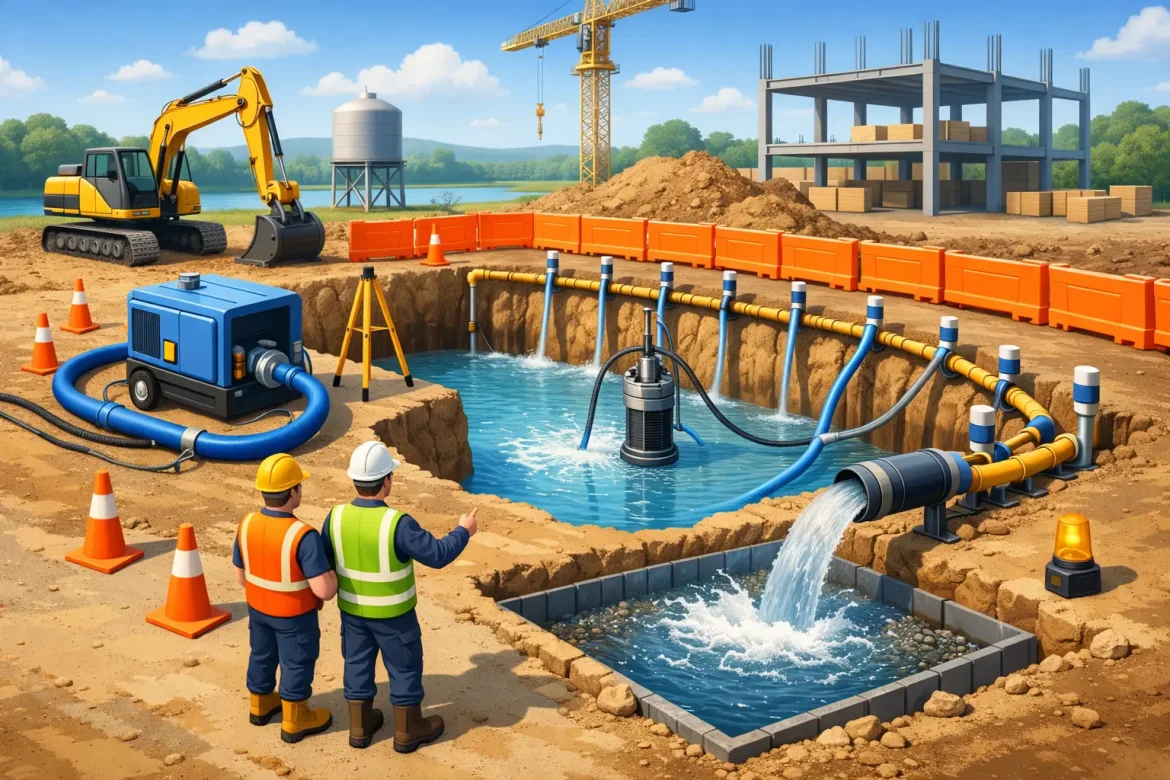
An excavation can look dry at the start of a shift and become a serious risk before lunch. A rising groundwater level, failed hose coupling or blocked discharge line can quickly affect batter stability, access, electrical equipment and the safety of everyone working below ground level. Dewatering safety requirements are therefore not a paperwork exercise. They are the operating controls that keep water management from becoming the next site incident.
For civil, construction and mining projects, the right approach begins before drilling a wellpoint, lowering a pump or opening a sump. It requires an understanding of ground conditions, the excavation design, likely water volumes, discharge constraints and how the system will be managed as site conditions change.
Dewatering safety requirements start with site risk
A dewatering system should be designed around the work area it is protecting, not simply around the volume of water expected. Groundwater pressure can undermine an excavation from below, while surface water can overload sumps and create uncontrolled flow paths. In loose sands, fractured ground or variable fill, even a short period of poor water control can change the condition of the excavation.
The project team should assess the geotechnical information alongside the construction sequence. This includes the depth and geometry of the excavation, adjacent structures and services, plant movements, traffic loading near edges, expected rainfall, tidal influence where relevant, and the consequences if pumping stops. On many Western Australian and Queensland sites, local ground knowledge makes a material difference to pump selection, well spacing and drawdown expectations.
The assessment also needs to identify who may be affected. That extends beyond workers in the excavation. Plant operators, nearby trades, pedestrians, neighbouring properties and downstream water users can all be exposed if a discharge fails or water migrates unexpectedly.
A practical dewatering plan records the system layout, pump capacities, duty and standby arrangements, discharge route, monitoring points, isolation methods and response actions. It should sit within the site’s broader excavation, electrical, environmental and emergency management processes rather than operating as a separate document no one refers to after mobilisation.
Design controls that protect the excavation
The safest pump is not necessarily the largest pump. Excessive drawdown can cause settlement, movement of nearby ground or damage to adjacent assets. Insufficient drawdown can leave unstable faces, boggy access and water pressure beneath the formation. The required water level depends on the excavation design, soil profile and work being undertaken.
Wellpoint systems, deep wells, sump pumping and open drains each have different safety considerations. A wellpoint system may offer more even drawdown across a broad excavation, but it requires secure headers, protected vacuum lines and regular checks for air leaks. Deep well systems can manage greater depths and higher flows, but drilling locations, overhead hazards, electrical supply and wellhead protection need careful control. Sump and open pumping can be efficient for localised inflows, although it should not be used as a substitute for a properly engineered groundwater-control solution where inflow or ground conditions demand more.
Discharge infrastructure deserves the same attention as the extraction side. Hoses and pipelines must be sized for the duty, restrained at joins, protected from vehicle traffic and routed so they do not create trip hazards or block emergency access. Temporary lines across traffic routes need suitable protection, while discharge points must be stable and controlled to prevent erosion, scour and flooding.
Where a system relies on electrical submersible pumps, installation and inspection must account for wet conditions, leads, protection devices, isolation points and the risk of mechanical damage. Fuel-powered pumps require secure refuelling arrangements, spill controls, ventilation where applicable and a managed exclusion area around moving parts and hot surfaces.
Plan for failure, not just normal operation
Pump failure, power loss and intense rainfall are foreseeable events. The system design should include an appropriate level of redundancy based on the consequence of interruption. For a critical excavation, that may mean duty and standby pumps, automatic changeover, backup power, high-level alarms and remote notification to nominated personnel.
The response time matters as much as the equipment. An alarm is of limited value if no one has authority, access or equipment to respond after hours. Site teams should establish trigger levels for groundwater, sump water and rainfall, then define the actions required at each level. This may include stopping work, withdrawing personnel, isolating power, deploying additional pumping capacity or arranging geotechnical inspection.
Safe installation and daily operation
Installation is often when avoidable hazards are introduced. Pumps, generators, pipework and treatment equipment should be positioned on stable ground with clear access for inspection, servicing and refuelling. Plant must not compromise excavation setbacks or obstruct haul routes. Barricades, signage and physical protection are needed where equipment, hoses or open sumps are exposed to site traffic.
Open sumps require particular discipline. They should be located and formed so they do not weaken excavation edges or create an unprotected fall risk. Where people can access the area, suitable barriers and safe access arrangements are essential. Mud, algae and wet ground around pumps can make routine checks hazardous, so housekeeping is a direct safety control, not a cosmetic task.
Before work begins, the dewatering operator and relevant supervisor should confirm that:
- pumps, hoses, fittings and electrical connections are intact and operating as intended;
- discharge is flowing to the approved point without leaks, scour or overtopping;
- water levels and excavation conditions remain within the agreed operating limits; and
- access ways, barriers, alarms and emergency equipment are serviceable.
These checks need to be repeated after heavy rain, a power interruption, a plant strike, significant excavation progress or any change to the discharge arrangement. Daily records provide evidence of control, but their greater value is that they reveal trends. A gradual increase in pump run time, falling discharge quality or recurring line blockages can indicate a developing issue before it causes a shutdown.
Water quality and environmental controls are safety controls
Managing discharged water is central to dewatering safety requirements. Sediment-laden water can block drains, undermine surfaces and affect receiving environments. Water from industrial, mining or contaminated land may also require testing and treatment before discharge, reuse or removal.
The appropriate controls depend on the water quality, volume, receiving environment and project approvals. They may include settlement tanks, sediment basins, filtration, pH correction, hydrocarbon separation or specialist treatment. These measures should be selected before pumping begins, with enough capacity to handle variable inflows rather than only average conditions.
Discharge monitoring should be aligned with site requirements and relevant approvals. Operators need clear instructions on what to test, acceptable limits, monitoring frequency and escalation steps if results fall outside limits. A turbid discharge or unexpected odour is not something to manage informally. Stop, contain and assess the cause before it becomes an environmental incident or affects work downstream.
There is also a practical trade-off in water reuse. Reusing treated water for dust suppression or other site purposes can reduce disposal costs and demand on supply, but only where quality is suitable and the distribution system will not expose workers, equipment or the environment to unnecessary risk.
Competent people and clear ownership
Dewatering can appear simple when the system is running well. That is precisely why responsibility can become blurred between the dewatering contractor, principal contractor, electrical team, earthworks crew and environmental personnel. Clear ownership prevents gaps.
The people installing and operating the system need competence in the equipment and an understanding of the site-specific risks. Supervisors need to know the system’s limitations, including what conditions require work to stop. Workers in the excavation should understand warning signs such as new seepage, softening ground, water pooling, cracking, slumping or changes in pump performance, and know who to notify immediately.
Communication must keep pace with construction. As excavation levels deepen, retaining systems are installed, services are exposed or work moves to another stage, the dewatering arrangement may need adjustment. A system that was safe during bulk excavation may not be appropriate during foundation works or confined access activities.
Treat monitoring as an early-warning system
Water levels, pump performance, flow rates and discharge quality provide operational intelligence. Combined with regular visual inspections of batters, shoring, benching and adjacent ground, they allow the team to act before a condition becomes critical.
For high-risk works, monitoring may also include settlement points, piezometers or other geotechnical instruments specified for the project. The value lies in having defined trigger levels and people who can interpret and act on the results. Collecting readings without a response process creates a false sense of control.
Dewatering Solutions approaches water control as part of the project’s safety and delivery plan, not a temporary service at the edge of the work zone. When the system is designed for the ground, maintained through disciplined inspections and supported by clear response actions, it protects people while helping the programme keep moving.