
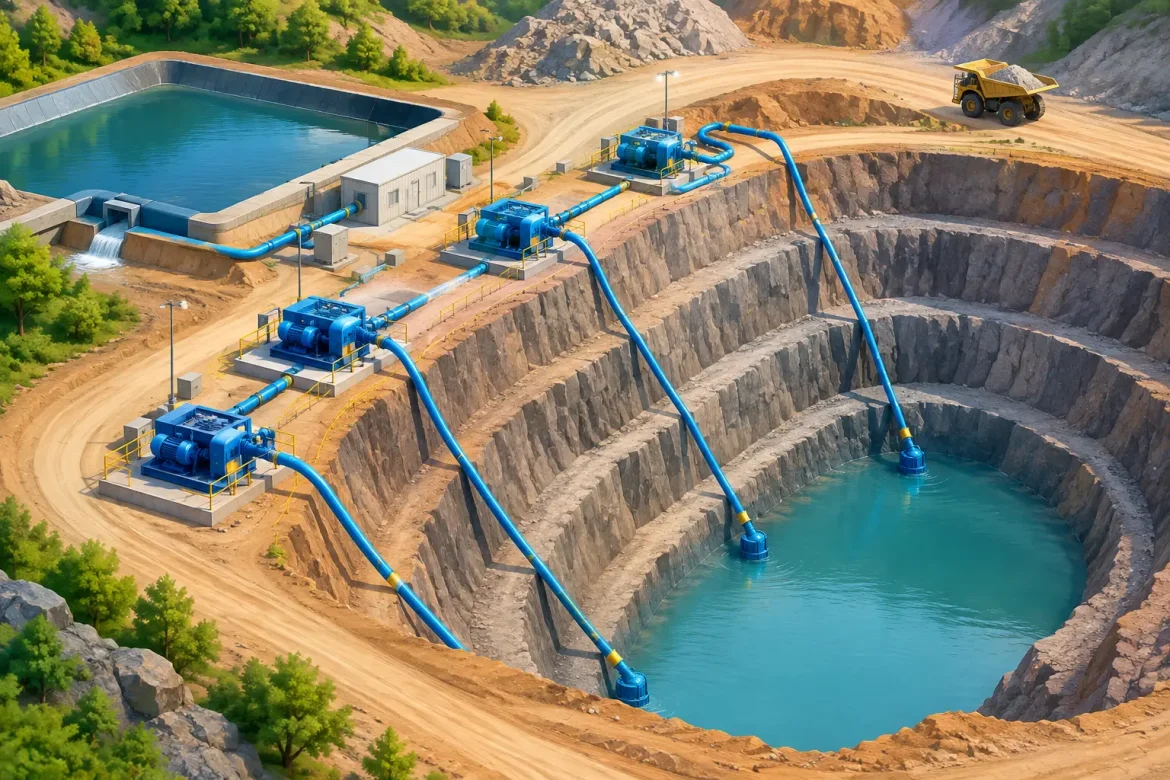
A wet pit rarely starts as a pumping problem. It starts as a planning gap: groundwater inflows were underestimated, a cut was advanced ahead of the water-control system, or discharge capacity was treated as an afterthought. Knowing how to plan mine dewatering means putting water management into the mine plan early enough to protect production, people, slopes and compliance.
For operating mines and new developments, the right approach is site-specific. Ground conditions can change quickly across short distances, particularly where fractured rock, palaeochannels, alluvial sediments or variable recharge are present. A workable plan combines hydrogeology, mine sequencing, practical pumping capacity and a clear operating response when conditions differ from forecast.
Start with the mine plan, not the pump selection
The dewatering system must serve the mining schedule. Before selecting wells, pumps or pipelines, define where mining will occur, the depth and timing of each cut, expected pit geometry, ramp locations, sumps, access requirements and the consequences of water at each stage.
Ask a direct question: what water level is required, where, and by what date? A target groundwater level may be set below the working floor, below a critical slope horizon, or below an excavation zone that needs stable drilling and blasting conditions. The target should be expressed in measurable terms, not simply as a requirement to “keep the pit dry”.
This is also where production and water-control teams need to agree on priorities. A system designed only to maintain dry access at the pit floor may not provide enough drawdown to manage pore pressures behind a highwall. Conversely, a broad drawdown target may add significant drilling, pumping and treatment cost where localised depressurisation would achieve the operational outcome. The practical answer depends on geotechnical risk, ore access, water quality and the planned life of the cut.
Build a defensible site water model
A dewatering plan is only as reliable as the information behind it. Existing bore logs, historic pumping records, pit inflow observations, rainfall data, water quality results and nearby groundwater users all provide useful context. However, they should be tested against current mine geometry and operating conditions.
Define the groundwater setting
Establish the aquifers, aquitards, fault zones, weathered profiles and surface-water connections that may influence inflow. Determine whether groundwater movement is primarily through porous materials, fractures, karst features or a combination of these. Each setting changes how a system performs.
For example, a uniform sandy aquifer may respond predictably to an array of production bores. A fractured rock environment can deliver highly variable yields, with one bore producing strongly while another only metres away provides little water. In those conditions, early test drilling and staged installation reduce the risk of committing to an ineffective layout.
Install monitoring points that can distinguish between local drawdown and broader aquifer response. Water levels should be measured before pumping begins to establish a baseline, then monitored through drilling, test pumping and operation. Where pit wall performance is sensitive to groundwater pressure, piezometers should be located and read in consultation with the geotechnical team.
Test yields and water quality early
Pump testing gives more useful planning information than a static water level alone. It helps estimate sustainable bore yield, drawdown behaviour, interference between bores and likely recovery after pumping stops. Step tests can guide pump sizing, while longer-duration testing provides better evidence of aquifer performance over time.
Water quality needs the same early attention. High salinity, acidity, dissolved metals, hydrocarbons, suspended solids or elevated iron can change the discharge pathway and treatment requirements. Water that is suitable for dust suppression may not be acceptable for release to the environment. Water that can be discharged under one set of conditions may require storage, treatment or blending during wet weather.
Match the dewatering method to the ground conditions
Mine dewatering is usually a combination of methods rather than a single installation. Deep well systems are suited to larger drawdown requirements and deeper aquifers where productive boreholes can be established. In-pit sumps and open pumping manage rainfall, runoff and local seepage, but they are not a substitute for groundwater control when inflows threaten floor heave, wall stability or sustained access.
Well points may be effective in shallow, permeable materials or around smaller excavations. Horizontal drains and targeted depressurisation wells can assist where pore pressure reduction is needed behind pit walls. The final arrangement should consider installation access, drillability, expected bore life, pump duty, power availability and the ability to move infrastructure as mining progresses.
Capacity should not be based solely on average inflow. Plan for normal groundwater inflow, rainfall-driven events, operational downtime and a realistic allowance for declining pump performance. Duty and standby capacity are essential where an unplanned shutdown could close a ramp, compromise a working face or create a safety issue.
Plan the full water pathway
Getting water out of the ground is only one part of the scope. The plan must show where it goes next, how it is conveyed, how it is measured and what happens if the preferred route is unavailable.
Consider the complete pathway from bore or sump to header line, storage, treatment, reuse point or approved discharge location. Pipeline routes need to avoid haul roads and active mining areas where possible, while allowing safe access for inspection and repairs. Crossings, isolation valves, pressure ratings, thrust restraint and spill containment should be addressed in the design rather than improvised after commissioning.
Discharge and reuse options should be confirmed before pumping begins. Depending on site approvals and water quality, mine water may be used for processing, dust suppression, washdown or other operational demands. Where discharge is proposed, the plan must align with applicable environmental conditions, monitoring obligations and receiving-environment limits. In Western Australia and Queensland, requirements vary by project approval and location, so a generic discharge assumption is not sufficient.
Storage can provide valuable flexibility, particularly when treatment capacity or permitted release rates are constrained. However, it also introduces evaporation, seepage, liner integrity, overtopping and water-balance considerations. Size storages against credible operating scenarios, including wet-season inflows where relevant.
Make monitoring part of operations
A dewatering plan should set trigger levels and actions before they are needed. This includes groundwater elevations, pit sump levels, pump run hours, flow rates, line pressures, turbidity, pH, conductivity and storage freeboard where applicable.
Data is most useful when it drives a clear decision. If a monitoring bore does not achieve the target drawdown, the response may be to adjust pump duty, clean or redevelop a bore, install an additional bore, investigate a structural control or revise the mining sequence. If discharge water moves outside agreed quality limits, the response may involve diversion to storage, treatment adjustment or temporary reduction in pumping.
Remote telemetry can improve visibility across a distributed borefield, but it does not replace site inspections. Operators still need to check leaks, vibration, pump condition, fuel or power supply, pipeline damage and changes in water appearance. A system can show a normal flow rate while losing efficiency or creating an erosion issue at a discharge point.
Allow for failures, changes and mobilisation constraints
The most effective plans include contingencies that can be actioned on site. Identify critical equipment, available spares, standby pumps, backup power arrangements, overflow routes and escalation contacts. Confirm how quickly replacement pumps, drill rigs, electricians, treatment equipment and operators can be mobilised to the mine.
Review the plan at each material change in the mine schedule. A deeper pushback, a revised ramp, new geotechnical information or a change in water use can alter the required system. Treat dewatering as a live production support function, not a fixed package installed once and forgotten.
For major or variable projects, staged delivery usually controls risk better than overbuilding at the outset. Initial investigation and test pumping can inform the first operating borefield, with expansion points built into power, pipework and controls. This approach protects the programme while keeping capital expenditure tied to proven site conditions.
A well-planned system gives mine teams confidence to advance when ground conditions are demanding. The value is not simply a lower water level. It is predictable access, safer working areas, informed environmental management and fewer avoidable disruptions when every shift matters.