
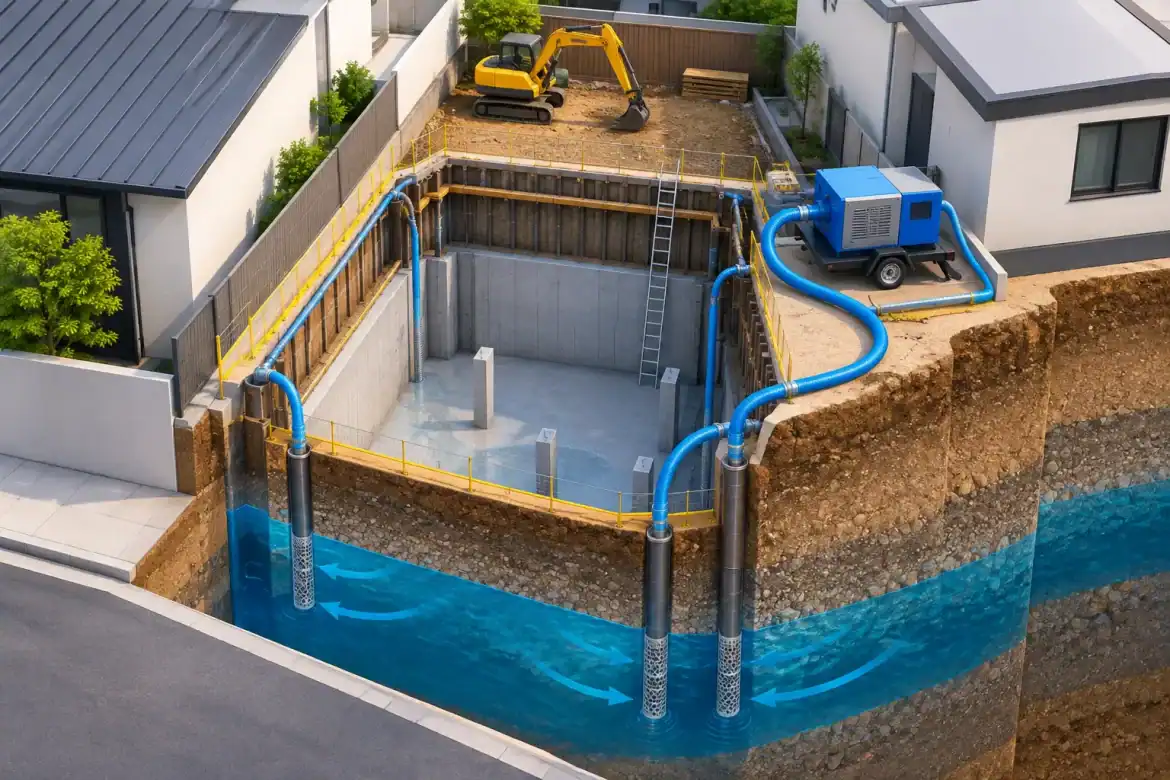
A basement excavation can look straightforward on a programme until groundwater starts entering the cut. This Perth basement dewatering case study examines a representative inner-metropolitan commercial project where restricted access, variable sands and a live construction schedule demanded more than simply putting pumps in a sump. The outcome depended on early investigation, staged installation and daily control of the water system as excavation progressed.
The site conditions and approach described here reflect the type of basement dewatering scope commonly encountered across Perth. Every site requires its own investigation, design and approvals, particularly where nearby structures, groundwater quality or discharge limits introduce additional constraints.
The project: a constrained basement excavation
The project involved a multi-level commercial development with a two-level basement excavation. The proposed dig extended below the expected groundwater level, with neighbouring commercial properties close to the boundary and limited room for plant, pipework and stockpiles.
Initial geotechnical information indicated sandy strata with variable permeability across the site. In practical terms, that meant water was likely to move readily through some zones while finer material could reduce flow and affect the performance of individual extraction points. The excavation also needed to remain stable while shoring, footing works and basement slab preparation were completed.
The principal contractor’s priorities were clear: maintain a dry and workable excavation, avoid instability around the retaining system, protect crews working below ground, manage water in accordance with project requirements, and prevent dewatering from becoming a critical path issue.
A simple open pumping arrangement was not considered sufficient as the primary control measure. While sumps have a role in collecting rainfall and local seepage, relying on them alone can allow groundwater pressures to persist behind excavation faces or beneath the formation level. That can lead to softening, sand migration, uneven ground conditions and reduced productivity.
Why the dewatering risk was higher than it appeared
Basement dewatering is not only about removing visible water. The greater issue is controlling groundwater levels and pore pressure in the ground surrounding the excavation. If water is allowed to remain at or above formation level, workers may be dealing with wet, unstable surfaces while concrete crews, steel fixers and survey teams lose access to key work areas.
On this project, the proximity of adjacent structures added another layer of responsibility. Excessive drawdown beyond the excavation footprint can affect surrounding ground conditions, particularly in susceptible soils. Conversely, inadequate drawdown inside the excavation can place pressure on temporary works and create ongoing ingress.
The workable operating window was therefore narrow. The system needed to lower groundwater sufficiently for excavation and construction activities, without treating dewatering as an isolated pumping task. Monitoring, discharge management and response times all had to be built into the delivery plan.
Perth basement dewatering case study: the site strategy
The dewatering strategy was developed around staged well point dewatering, supported by controlled sump pumping for residual water and rainfall. Well points were selected because the anticipated groundwater conditions and excavation depth suited a vacuum-assisted system installed around the excavation perimeter.
Before installation, the dewatering team reviewed available geotechnical data, excavation staging, retaining-wall sequencing, access limitations and discharge pathways. This early coordination was essential. Installing a capable system at the wrong time, or without allowing for future excavation stages, can create avoidable rework and disruption.
The system was divided into manageable sections rather than treated as one continuous run. This allowed the team to adjust extraction according to the active excavation area, isolate sections for maintenance where required and avoid unnecessary pumping once local work fronts were complete.
Discharge water was directed through treatment and settlement measures appropriate to site conditions and project requirements before release or approved disposal. Water quality management is not an afterthought on metropolitan sites. Turbidity, sediment and other potential contaminants must be considered before water leaves the work area.
Installation around live construction activity
Restricted access shaped the installation method. Pipe routes had to avoid crane operations, haul paths and areas allocated to excavation support works. Headers and hoses were secured and clearly managed to reduce trip hazards, prevent damage from plant movements and preserve access for site crews.
The well point installation was coordinated with the excavation sequence. Dewatering commenced ahead of bulk excavation in the relevant zone, allowing groundwater levels to respond before deeper digging began. This reduced the likelihood of chasing water after the excavation was already compromised.
As the dig advanced, the team checked flow rates, vacuum performance and water levels at agreed intervals. These checks helped identify issues such as blocked points, air leaks, changing soil response or localised inflows that required adjustment. A dewatering system can be correctly specified and still underperform if it is not actively operated and maintained.
Monitoring drove the decisions
Water-level monitoring provided the evidence needed to confirm that the system was achieving the required drawdown. The target was not to pump as much water as possible. It was to maintain groundwater at a level that supported safe excavation and construction while controlling the potential effects outside the work area.
Daily site observations were equally valuable. Soft spots, seepage at the excavation face, changes in discharge clarity and pump cycling patterns can indicate developing problems before they become delays. Site-based experience matters because groundwater behaviour does not always follow a neat line on a drawing.
Where conditions changed, the response was practical: adjust pumping duty, inspect and service affected points, modify the local layout or add temporary collection measures. The system was managed as an operating asset, not left unattended after commissioning.
The result: a drier, more predictable work front
With staged groundwater control in place, the excavation could progress with reduced water-related interruption. Formation areas remained more workable for subsequent trades, and site management had a clearer basis for planning excavation, blinding and structural works.
The strongest outcome was programme certainty. Dewatering did not eliminate all water management tasks – rainfall, local seepage and construction washdown still required attention – but it removed groundwater as a constant uncontrolled variable. This helped the project team maintain safer access and make decisions on excavation progress with better information.
There was also a cost-control benefit. Addressing groundwater early generally costs less than recovering a wet excavation after delays have occurred. Reactive pumping can consume labour, plant time and materials while holding up multiple subcontractors. A planned system has an upfront scope, but it reduces exposure to the more expensive consequences of poor water control.
What project teams can take from this case
The key lesson is that basement dewatering needs to start before groundwater becomes visible in the excavation. For a Perth site, the right method depends on the depth of drawdown, soil profile, permeability, excavation geometry, nearby assets, discharge requirements and construction programme.
Well points are often effective in permeable shallow-to-medium-depth conditions. Deep wells may be more suitable for deeper drawdown or different subsurface conditions. Sump pumping can support either approach, but it should not automatically be treated as the whole solution. The right answer depends on what is happening below ground, not what is easiest to mobilise on day one.
Project teams also benefit when the dewatering contractor is brought into planning early enough to review sequencing and site constraints. That allows equipment, pipework, monitoring and water treatment to be integrated into the works instead of competing with them once the excavation is under way.
For basement projects where groundwater threatens safety, stability or the programme, the practical question is not whether water will need managing. It is whether the control system will be planned early enough to keep the excavation working when it matters most.