
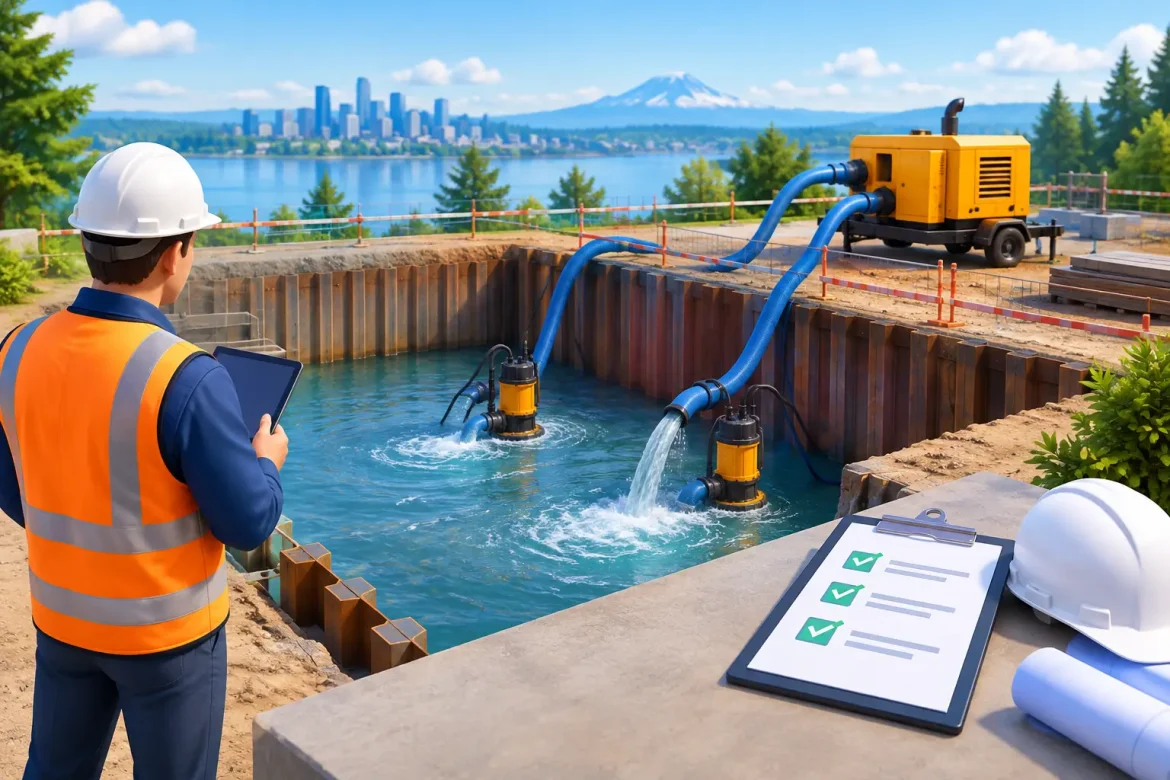
An excavation can be ready to pour, crews can be booked and plant can be on site, yet uncontrolled groundwater can still stop the programme. This WA dewatering permit guide helps project teams identify the approvals, evidence and controls that should be resolved before pumping begins – not after water is already moving across the site.
For Western Australian construction, civil and mining projects, the approval pathway depends on more than the volume of water expected. The source of water, bore location, proposed discharge point, surrounding receptors and project conditions can all change what is required. Treat permits as part of dewatering design, not as an administrative task handed over once mobilisation is due.
Start by separating abstraction from discharge
A dewatering scope often involves two distinct regulatory questions. The first is whether the project can take groundwater. The second is where that water can be discharged, reused or otherwise managed. Approval for one does not automatically provide approval for the other.
Groundwater abstraction may require a licence under the Rights in Water and Irrigation Act 1914, particularly where works are located in a proclaimed groundwater area. The Department of Water and Environmental Regulation, commonly known as DWER, administers water licensing in WA. Depending on the location and nature of the works, bore construction requirements may also apply.
Discharge creates a separate set of considerations. Pumped water may be directed to an approved infiltration area, sediment basin, sewer connection, surface-water system, licensed facility or another authorised destination. Each option carries different constraints. Discharging clean-looking groundwater to a drain is not a default entitlement, and a proposed outlet may be controlled by a local government, drainage authority, utility, land manager or environmental approval condition.
The practical lesson is straightforward: define the complete water pathway. Establish where water will be extracted, how it will be treated, where it will go, how much will be moved and what happens during rainfall or treatment plant upset.
When does a WA dewatering permit apply?
There is no single WA dewatering permit that covers every site. Some projects need a water licence, some need approval for bore construction or discharge, and some are managed under existing project approvals with specific conditions. Larger industrial or mining operations may also have obligations under environmental licences, ministerial conditions or approved mining proposals.
Whether an approval is required depends on site-specific facts. A shallow, short-duration sump pumping operation may be treated very differently from a deep well system operating for months beside a sensitive wetland, coastal aquifer or neighbouring bore field. The volume and duration of pumping matter, but so do predicted drawdown, groundwater quality and the potential effect on other users and environmental receptors.
This is why early desktop review and field investigation pay for themselves. Before finalising the methodology, project teams should establish the relevant groundwater resource, known bore users, depth to groundwater, expected inflows, likely water quality and available discharge options. A hydrogeologist or experienced dewatering specialist can convert this information into an achievable pumping and approval strategy.
Build the approval strategy around the construction programme
Permitting delays are often caused by incomplete information rather than the application itself. A regulator or asset owner needs enough detail to understand the proposed impact and the controls that will be in place. Submitting an application before the dewatering design has been properly developed can create avoidable requests for further information.
A credible package generally describes the excavation, construction sequence, pumping method, anticipated abstraction volume and duration, bore or wellpoint layout, drawdown predictions and discharge arrangement. It should also identify treatment equipment, sampling locations, monitoring frequency, contingency measures and the party responsible for compliance.
For a major project, the approval programme should be tied directly to the construction programme. Allow time for investigation bores, pumping tests, laboratory analysis, design revisions and regulator or third-party review. A discharge option that appears convenient on a drawing may need significant lead time if it requires an agreement with an asset owner or connection to another system.
There is also a commercial benefit to doing this work early. Knowing the likely water volumes and discharge limitations allows the project team to price treatment, power, pipework, storage and monitoring accurately. It reduces the risk of hiring a system sized for one assumption, then redesigning it after water quality or discharge conditions prove different on site.
Water quality determines the treatment train
Groundwater is not automatically suitable for release or reuse. Even clear water can contain elevated salinity, iron, nutrients, metals or naturally occurring contaminants. On brownfield sites, hydrocarbons and other historic contaminants may also be present. Where acid sulfate soils are possible, disturbance and oxidation can introduce additional water-quality risks.
Baseline sampling should be targeted to the receiving environment and the proposed discharge conditions. Typical parameters can include pH, electrical conductivity, turbidity, total suspended solids, hydrocarbons and dissolved metals. The correct suite depends on the site history, geology and destination of the water. Testing only for turbidity may be insufficient where dissolved contaminants drive the discharge risk.
Treatment should match the actual water quality and the required outcome. Settlement tanks and filtration can manage suspended solids, while other water characteristics may require different controls, off-site disposal or a revised discharge route. Reuse for dust suppression or construction activities may reduce disposal volumes, but it still needs to be assessed against water quality, operational needs and any applicable project conditions.
Design monitoring and records before mobilisation
Approval conditions commonly require measurement, but monitoring should also serve the project. Flow metres, water-level monitoring points and routine field checks show whether the system is achieving the required drawdown without pumping more than necessary. They can identify blocked filters, falling pump efficiency, unexpected recharge or a change in water quality before it becomes a site issue.
Keep a clear record of abstraction volumes, discharge volumes, rainfall, water-quality results, treatment maintenance, incidents and corrective actions. Bore logs, pump test data, photographs and disposal dockets should be retained in a controlled project file. Good records provide evidence of compliance and make it easier to respond quickly if conditions change.
Where nearby properties, waterways, vegetation or underground assets could be affected, monitoring triggers should be agreed before pumping starts. The response plan needs to be practical. It should specify who receives an alert, who has authority to reduce or stop pumping, how water will be contained and when the regulator, superintendent or asset owner must be notified.
Common approval mistakes that create site risk
The most costly error is assuming dewatering is temporary, so approvals can wait. Temporary works can still create long-term environmental, legal and programme consequences. Another frequent issue is designing extraction and discharge separately, only to find that the available discharge point cannot accept the volume or water quality proposed.
Projects also run into difficulty when consent conditions are not translated into field instructions. If a licence sets limits on volume, location, monitoring or reporting, those requirements need to appear in the dewatering management plan, daily checks and subcontractor responsibilities. A permit stored in a project folder will not control a pump running at 2 am.
Finally, avoid treating the approved design as fixed when ground conditions differ from the investigation. Higher inflows, unexpected artesian pressure, saline water or a new contamination finding may require a revised approach. Escalate early, document the change and confirm whether existing approvals still cover the amended works.
A practical path to controlled dewatering
The strongest dewatering plans begin with a site-specific water assessment, then align approvals, engineering and construction sequencing around the same set of assumptions. This allows the team to select the right method, whether wellpoints, deep wells, sump pumping or a combined system, while allowing for treatment and a lawful discharge route.
Dewatering Solutions approaches water control as a project-performance issue: maintain safe, stable excavations while managing water responsibly and keeping the programme moving. When approvals, treatment and field execution are planned together, groundwater becomes a controlled construction variable rather than the reason a critical pour is delayed.